Space-time Vortex
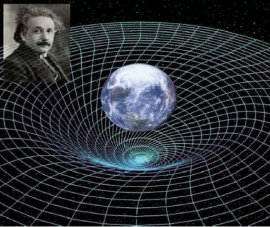
Is Earth in a vortex of space-time? We'll soon know the answer: A NASA/Stanford physics experiment called Gravity Probe B (GP-B) recently finished a year of gathering science data in Earth orbit. The results, which will take another year to analyze, should reveal the shape of space-time around Earth--and, possibly, the vortex.
Image: An artist's concept of twisted space-time around Earth.
Time and space, according to Einstein's theories of relativity, are woven together, forming a four-dimensional fabric called "space-time." The tremendous mass of Earth dimples this fabric, much like a heavy person sitting in the middle of a trampoline. Gravity, says Einstein, is simply the motion of objects following the curvaceous lines of the dimple.
If Earth were stationary, that would be the end of the story. But Earth is not stationary. Our planet spins, and the spin should twist the dimple, slightly, pulling it around into a 4-dimensional swirl. This is what GP-B went to space to check
The idea behind the experiment is simple:
Put a spinning gyroscope into orbit around the Earth, with the spin axis pointed toward some distant star as a fixed reference point. Free from external forces, the gyroscope's axis should continue pointing at the star--forever. But if space is twisted, the direction of the gyroscope's axis should drift over time. By noting this change in direction relative to the star, the twists of space-time could be measured.
In practice, the experiment is tremendously difficult.
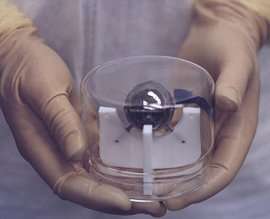
The four gyroscopes in GP-B are the most perfect spheres ever made by humans. These ping pong-sized balls of fused quartz and silicon are 1.5 inches across and never vary from a perfect sphere by more than 40 atomic layers. If the gyroscopes weren't so spherical, their spin axes would wobble even without the effects of relativity.
According to calculations, the twisted space-time around Earth should cause the axes of the gyros to drift merely 0.041 arcseconds over a year. An arcsecond is 1/3600th of a degree. To measure this angle reasonably well, GP-B needed a fantastic precision of 0.0005 arcseconds. It's like measuring the thickness of a sheet of paper held edge-on 100 miles away.
GP-B researchers invented whole new technologies to make this possible. They developed a "drag free" satellite that could brush against the outer layers of Earth's atmosphere without disturbing the gyros. They figured out how to keep Earth's penetrating magnetic field out of the spacecraft. And they concocted a device to measure the spin of a gyro--without touching the gyro.
Pulling off the experiment was an exceptional challenge. A lot of time and money was on the line, but the GP-B scientists appear to have done it.
Image: One of the spherical gyroscopes of Gravity Probe B.
"There were not any major surprises" in the experiment's performance, says physics professor Francis Everitt, the Principal Investigator for GP-B at Stanford University. Now that data-taking is complete, he says the mood among the GP-B scientists is "a lot of enthusiasm, and a realization also that a lot of grinding hard work is ahead of us."
A careful, thorough analysis of the data is underway. The scientists will do it in three stages, Everitt explains. First, they will look at the data from each day of the year-long experiment, checking for irregularities. Next they'll break the data into roughly month-long chunks, and finally they'll look at the whole year. By doing it this way, the scientists should be able to find any problems that a more simple analysis might miss.
Eventually scientists around the world will scrutinize the data. Says Everitt, "we want our sternest critics to be us."
The stakes are high. If they detect the vortex, precisely as expected, it simply means that Einstein was right, again. But what if they don't? There might be a flaw in Einstein's theory, a tiny discrepancy that heralds a revolution in physics.
First, though, there are a lot of data to analyze. Stay tuned.
Source: Science@NASA (Authors: Patrick L. Barry)


