Scientists capture nanoscale images with short and intense X-ray laser
November 13, 2006 Scientists capture nanoscale images with short and intense X-ray laser

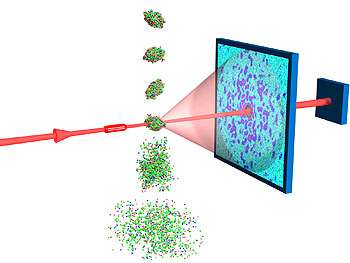
Single-molecule diffractive imaging with an X-ray free-electron laser. Individual biological molecules will be made to fall through the X-ray beam, one at a time, and their structural information recorded in the form of a diffraction pattern. The pulse will ultimately destroy each molecule, but not before the pulse has diffracted from the undamaged structure. The patterns are combined to form an atomic-resolution image of the molecule. Credit: Lawrence Livermore National Laboratory

LLNL scientists for the first time have validated the idea of using extremely short and intense X-ray pulses to capture images of objects such as proteins before the X-rays destroy the sample.

At the same time, the team also established a speed record of 25 femtoseconds for flash imaging.

The new method will be applicable to atomic-resolution imaging of complex biomolecules when even more powerful X-ray lasers, currently under construction, are available. The technique will allow scientists to gain insight into the fields of materials science, plasma physics, biology and medicine.
Scientists capture nanoscale images with short and intense X-ray laser

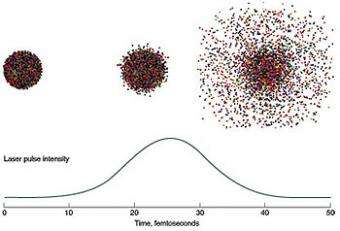
Atom trajectories computed by a hydrodynamic model show a 2-nanometer protein exploding after it is hit by a 20-femtosecond, 12-kiloelectronvolt x-ray pulse that is 0.1 micrometer wide. Models indicate that atomic-resolution imaging can be achieved with pulses shorter than 20 femtoseconds. They also show that a water tamper on the protein slows its destruction so that longer pulses could be used. Credit: Lawrence Livermore National Laboratory

Using the free-electron laser at Deutsches Elektronen-Synchrotron (DESY) in Hamburg, Livermore scientists, as part of an international collaboration led by LLNL's Henry Chapman and Janos Hajdu of Uppsala University, were able to record a single diffraction pattern of a nanostructured object before the laser destroyed the sample. A Livermore-developed computer algorithm was then used to recreate an image of the object based on the recorded diffraction pattern. This "lensless" imaging technique could be applied to atomic-resolution imaging because it is not limited by the need to build a high-resolution lens. The flash images could resolve features 50 nanometers in size, which is about 10 times smaller than what is achievable with an optical microscope.

Theory predicts that a single diffraction pattern may be recorded from a large macromolecule, a virus or a cell with an ultra-short and extremely bright X-ray pulse before the sample explodes and turns into a plasma. This means that scientists could better understand the structure of macromolecular proteins without crystallizing them and thus allow rapid study of all classes of proteins.

Livermore scientists, along with colleagues at Uppsala University in Sweden, DESY, Technische Universität Berlin, the Center for Biophotonics Science and Technology at UC Davis, Stanford Synchrotron Radiation Laboratory, and private firm Spiller X-ray Optics of Livermore, conducted the first experimental demonstration of this theory.

Computer simulations based on four different models suggest that a near-atomic resolution structure could be achieved by well-thought out choice of pulse length and intensity of X-ray wavelength before the sample is stripped of its electrons and is destroyed. However, up until now, there had been no experimental verification of the technique.

The experimental demonstration of "flash diffractive imaging" uses the first soft X-ray FEL (free electron laser) in the world located at the FLASH facility at DESY. FLASH generates high-power soft X-ray pulses by the principle of self-amplification of spontaneous emission. The pulses are 10 million times brighter than today's brightest X-ray sources, synchrotrons. In addition, this experiment showed that it only takes a 25-femtosecond pulse duration to capture the image.

There has been a question whether the diffraction pattern recorded under these circumstances could be reconstructed to obtain undamaged sample information.

"These results could become a standardized method," Chapman said. "This imaging could be applied at the cellular, sub-cellular and down on to single molecule scale."

The research appears in the Nov. 12 online edition of Nature Physics. It will appear on the cover of the December hard copy issue of Nature Physics.

Source: Lawrence Livermore National Laboratory


print this article email this article download pdf blog this article bookmark this article     Stumble it Digg this share on Facebook retweet share on Reddit add to delicious
Rate this story - 4.6 /5 (19 votes)


November 13, 2006 all stories

Comments: 0

4.6 /5 (19 votes)
  • Stumble this up

  • Digg this

  • share this

  • hide
  • Related Stories

  • The world's smallest synchrotron, MIRRORCLE-6X, now commercially available
    created Feb 21, 2005 | popularity not rated yet | comments 0
  • X-ray Method Images Ions at Interface
    created Jun 12, 2004 | popularity not rated yet | comments 0
  • Animated Movie of Ice
    created Jan 07, 2008 | popularity not rated yet | comments 0


  • hide
  • Relevant PhysicsForums posts

  • Young's Double Slit - Fringe Width
    created 4 hours ago
  • Pressure exerted by a liquid is different to gas?
    created 5 hours ago
  • Work
    created 8 hours ago
  • I need some help with this project (optics and lens design)
    created 9 hours ago
  • black hole gravity
    created 10 hours ago
  • Photoelectric effect
    created 12 hours ago
  • More from Physics Forums - General Physics

Other News

First Bose-Einstein condensation of strontium

First Bose-Einstein condensation of strontium

Physics / Quantum Physics

created 1hour ago | popularity 5 / 5 (1) | comments 0

In an international first, scientists from the Institute of Quantum Optics and Quantum Information (IQOQI, Austria) produced a Bose-Einstein condensate of the alkaline-earth element strontium, thus narrowly ...


The LHC tunnel

Peckish bird briefly downs big atom smasher

Physics / General Physics

created 8 hours ago | popularity 3.6 / 5 (8) | comments 11

A peckish bird briefly knocked out part of the world's biggest atom smasher by causing a chain reaction with a piece of bread, the European Organisation for Nuclear Research (CERN) said Monday.


Ginzburg helped develop the Soviet Union's hydrogen bomb in the late 1940s and early 1950s

Russian bomb physicist Ginzburg dead at 93

Physics / General Physics

created 9 hours ago | popularity 5 / 5 (2) | comments 0

Nobel Physics prize winner Vitaly Ginzburg, who helped develop the Soviet hydrogen bomb, has died at age 93, the Russian Academy of Sciences said Monday.


Stars Fueled by Dark Matter Could Hold Secrets to the Universe

Stars Fueled by Dark Matter Could Hold Secrets to the Universe

Physics / General Physics

created Nov 03, 2009 | popularity 4.5 / 5 (52) | comments 43

(PhysOrg.com) -- The first stars in the universe may have been very different from the stars we see today, yet they may hold clues to understanding some of the mysterious features of the universe. These "dark ...


Second Law of Thermodynamics May Explain Economic Evolution

Second Law of Thermodynamics May Explain Economic Evolution

Physics / General Physics

created Nov 02, 2009 | popularity 4.3 / 5 (31) | comments 28

(PhysOrg.com) -- Terms such as the "invisible hand," laissez-faire policy, and free-market principles suggest that economic growth and decline in capitalist societies seem to be somehow self-regulated. Now, ...