DESY's FLASH illuminates the nano-world
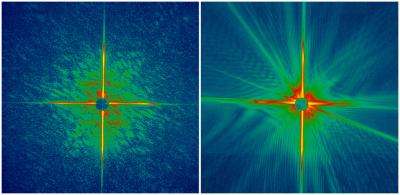
Using the unique soft X-ray free-electron laser FLASH at DESY in Hamburg, Germany, an international team of scientists achieved a world first by taking a high-resolution diffraction image of a non-crystalline sample with a single extremely short and intense laser shot.
This first successful application of “flash diffractive imaging” – which was published online on November 12, 2006 in Nature Physics – opens the beginning of a new era in structural research ranging from materials to molecular sciences.
The experiment suggests that in the near future images from nano-particles and even large individual macromolecules – viruses or cells – may be obtained using a single ultra-short high-intensity laser pulse. This would provide unique possibilities to study the structure and dynamics of nanometer-sized particles, including large biomolecules, without the need for crystallizing as is required in conventional X-ray structure analysis.
“The experimental principle that was verified at DESY’s new FLASH free-electron laser promises to revolutionize structure research in many areas of science, including the life sciences, where ever very high spatial and temporal resolution is required,” says Professor Jochen Schneider, DESY research director and co-author of the paper. “As the only soft X-ray laser providing extremely bright coherent pulses of just 25 femtoseconds duration, FLASH is the world’s first radiation source to permit this and other proof-of-principle experiments. Due to pioneering efforts at DESY, FLASH is also the first user facility in this area that is available to a broad scientific community.
The ‘lensless’ single-shot imaging technique demonstrated here can be extended to atomic resolution when hard X-ray lasers become available. The experiment, done by an international collaboration under the leadership of Professor Henry Chapman from University of California and Professor Janos Hajdu from Uppsala University backs up the high hopes for revolutionary experimental opportunities with hard X-ray free-electron lasers, such as the Linac Coherent Light Source LCLS under construction in Stanford, California, or the European XFEL facility in Hamburg.”
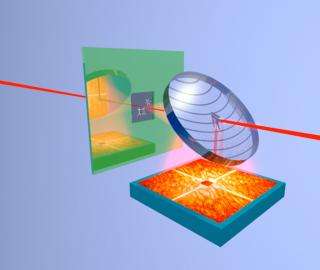
Imaging experiments are often limited by radiation damage, i.e. the fact that the radiation used for creating the picture destroys the sample being studied. This is a severe limitation of imaging in the life sciences. “However, there is a way to circumvent the problem,” Janos Hajdu explains. “Take the image faster than the relevant damage processes.” In addition this idea does away with the need for crystallizing large molecules to obtain usable information on their structure. In single-shot diffractive imaging, only one individual molecular assembly is required, from which a diffraction pattern is obtained by directing a single ultra-short, extremely intense X-ray laser pulse onto it.
Theoretical studies predicted that it should be possible to obtain such a diffraction pattern from non-crystalline objects. “There were two big questions, however,” says Hajdu. “Can an interpretable image be recorded from a single free-electron laser pulse before the sample is turned into a plasma by the X-rays? And does the diffraction pattern really carry structural information about the object before the object is destroyed? In our experiment, we were able to verify these possibilities for the first time.”
In the FLASH experiment, the researchers directed a very intense free-electron laser pulse of 32 nanometers wavelength and only 25 femtoseconds duration at a test sample, a thin membrane into which 3-micrometer-wide patterns had been cut. The energy of the laser pulse heated the sample up to around 60,000 Kelvin, causing it to vaporize. However, the international team of scientists was able to record an interpretable diffraction pattern before the sample was destroyed. The image obtained by phase retrieval and inversion of the diffraction pattern showed no discernible sign of damage, and the two-dimensional test object could be reconstructed to the resolution limit of the detector. Damage occurred only after the ultra-short pulse traversed the sample.
In order to take images from large molecules with atomic resolution, such experiments will have to be carried out using radiation of even shorter wavelengths, i.e. hard X-rays such as the ones that will be produced from 2009 on by LCLS in Stanford, or by the European X-ray laser XFEL in Hamburg, due to take up operation in 2013. Since the method demonstrated at FLASH does not require any image-forming optic, it can be extended to these hard X-ray regimes, for which no lenses currently exists.
FLASH is a free-electron laser at DESY that was commissioned in 2004 and has been used for research with shortwave ultraviolet and soft X-ray radiation since 2005. The 260-meter-long facility was first called VUV-FEL (Vacuum Ultraviolet Free-Electron Laser), and renamed FLASH (Free-Electron Laser in Hamburg) in April 2006. In the first measuring period at FLASH, during which the Chapman and Hajdu team carried out its flash diffraction experiment, the facility already held the world record of the shortest wavelengths ever achieved with a free-electron laser, with pulses at 32 nanometers.
In 2006, it reached a new record with a wavelength of only 13.1 nanometers, and intense so-called third harmonic radiation at 4.4 nanometers. FLASH will be further expanded in 2007, allowing a further increase in photon energy to the design value of 6 nanometers. Besides being used for research in photon science, FLASH also serves as a pilot facility for the European X-ray free-electron laser XFEL, the construction of which will start in 2007.
Source: Deutsches Elektronen-Synchrotron (DESY)


