November 14, 2006 feature
Organic micro-sensors provide quick, convenient medical diagnostics at home
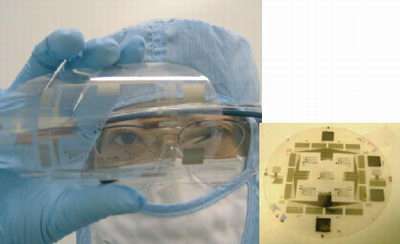
In an effort to bring health monitoring to the patient, scientists from the University of Arkansas have developed a micro-sensor that monitors vital signs and can be incorporated into smart fabrics for wearable illness prevention. With this “point-of-care” testing, physicists Soyoun Jung, Taeksoo Ji and Vijay Varadan are making it possible for the continuous monitoring of signs including respiration, heart rate, ECG, and body temperature outside the doctor’s office.
“In order to meet the requirements for low-cost, large-area sensor applications such as smart fabric systems, the sensors need to be light, flexible, washable, and even disposable,” Varadan told PhysOrg.com. “These requirements can hardly be satisfied with silicon-based sensors, which are inherently robust, brittle, limited in size, and expensive. In addition to flexibility, the low-cost deposition techniques . . . will eventually enable roll-to-roll manufacturing, making organic semi-conducting material suitable for such sensor applications.”
Currently, bio-micro-sensors based on silicon semiconductors can provide some of these capabilities, but their downside is a high manufacturing cost due to inherent high-temperature processes.
Instead, the scientists have based their micro-sensor on an organic semiconductor. A thin film transistor (TFT), for example, operates on the field effect principle like silicon, but the organic semiconductor’s low-temperature process enables much lower cost manufacturing. Organic-based devices, which also have potential applications in other areas such as flat panel displays (FPDs), may make it possible to provide point-of-care diagnostics to a larger population.
“Because of its light weight and flexibility, a smart fabric system with organic sensors will be easy to wear for patients,” said Varadan. “Moreover, the multi-functionality that organic TFT sensors typically possess enables one to envision and realize a highly integrated sensor network, which leads to easy commercialization in addition to inexpensive manufacturing.”
The two types of micro-sensors developed in this study, temperature and strain, both use the molecule pentacene as the organic semiconductor and sensing device. In their study, the scientists explain that they chose pentacene because of its high field effect mobility, meaning that it has efficient and controllable conductivity.
In studying the temperature sensor, which used a TFT structure of about 300 micrometers wide, the scientists observed that the electrical current exhibited a linear response to temperature change. In low voltage regions (sub-threshold regions), the current displayed the highest sensitivity to temperature changes, creating a promising tool for the researchers.
The pentacene strain sensor, which would monitor respiration rate, has recently been shown to exhibit greater flexibility than current silicon sensors. A strain (e.g. breathing) would produce a mechanical deformation of the sensor, which in turn would affect the electrical current’s resistance running through the pentacene. In fact, the smaller the pentacene sensor (between 0.1 and 1 millimeter wide), the more sensitive it was to current variations, demonstrating the effectiveness of a small model.
“It is expected that both the sensor network and wireless instrument can easily fit on garments like undershirts using the organic flexible technology,” said Varadan. “The smart fabric, comprised of these sensors that monitor patients’ vital signs, will collect data to be sent—by virtue of advanced wireless technologies including Bluetooth and WLAN—to an information hub in real time. By tracking patients’ statistics, doctors will be capable of instant responses to patients’ irregular health conditions.”
With this near-instantaneous detection of abnormalities, physicians could also begin treating or preventing illnesses at very early stages—making the technology not only convenient, but also life-saving.
Citation: Jung, Soyoun, Ji, Taeksoo, and Varadan, Vijay K. “Point-of-care temperature and respiration monitoring sensors for smart fabric applications.” Smart Materials and Structures. 15 (2006) 1872-1876.
By Lisa Zyga, Copyright 2006 PhysOrg.com


