Return of the Leonids
November 14, 2006 Return of the Leonids

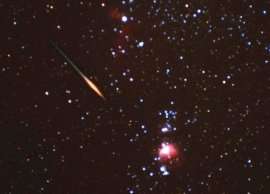
A Leonid meteor streaks past the Orion Nebula in 2001. Photo Credit: Mark Brown of Alabama.

On Sunday, Nov. 19th, Earth will pass through a stream of debris from comet 55P/Tempel-Tuttle. The result: a shower of Leonid meteors.

"We expect an outburst of more than 100 Leonids per hour," says Bill Cooke, the head of NASA's Meteoroid Environment Office in Huntsville, AL. This pales in comparison to the Leonid storms of 2001 and 2002, when sky watchers saw thousands of meteors. Even so, a hundred per hour would make the Leonids one of the best showers of 2006.

The problem is, you have to be in the right place at the right time to see them.

Earth's encounter with the comet dust is going to be brief—"possibly no more than a few hours long," says Cooke. Forecasters differ on when the outburst will occur. Estimates range from 0445 UT to 0630 UT on Nov. 19th (11:45 p.m. on Nov. 18th to 1:30 am EST on Nov. 19th). The timing favors western Europe, Africa, Brazil and eastern parts of North America: map.

Cooke urges observers to find the darkest possible skies. "These Leonids are going to be faint." Why? "The stream contains very small grains of comet dust. Small grains make faint meteors--it's as simple as that."
Return of the Leonids

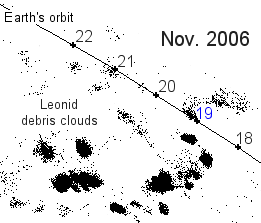
A minefield of Leonid debris streams. The streams intersect the plot at nearly right angles, so they resemble 2D clouds rather than 3D filaments. Credit J. Vaubaillon.

The mid-November region of Earth's orbit is littered with debris from Comet Tempel-Tuttle. Every time the comet visits the inner solar system (once every 33 years), it lays down a new stream of dust, pebbles and rock. This creates a sort of "minefield" for Earth to navigate every November.

Not all of these debris streams are alike. For example: "A Leonid stream we hit in 1998 was full of rock-sized debris. They made brilliant fireballs when they hit the atmosphere," recalls Cooke. "The stream we're hitting this year is just the opposite. It's mostly fine dust."

Debris streams are segregated—dusty vs. rocky—by the force of sunlight. Consider the stream directly ahead of us: "It was ejected from the comet in 1933," says Cooke. "At first, the debris was a mixture of many sizes." But as years passed, the smaller particles diverged from the larger ones. Radiation pressure—the delicate pressure of sunlight itself—pushed the light dust onto a collision course with Earth. Heavier rock-sized fragments resisted the pressure and lagged behind.

Perhaps in some future year we'll encounter the larger debris from 1933 and receive an overdue display of fireballs. How would they get here? "Nudged by Jupiter," suggests Cooke. Jupiter's gravity is strong enough to alter the course of heavier fragments. Indeed, by guiding debris toward us, Jupiter is indirectly responsible for many bright Leonid displays in the past.

But this is 2006. So prepare for an outburst of faint Leonids.

Extra: Don't believe everything you read. While meteor forecasters have done a splendid job predicting Leonid outbursts in recent years—sometimes "nailing the peak within minutes"—they could be wrong in 2006. The outburst might happen at an unexpected time or it might be better than expected. Cooke urges enthusiasts everywhere to keep an eye out for Leonid meteors the nights of Nov. 17th – 19th. "The best time to look," he says, "is just before local dawn when the constellation Leo is high in the sky."

Source: Science@NASA, by Dr. Tony Phillips


print this article email this article download pdf blog this article bookmark this article     Stumble it Digg this share on Facebook retweet share on Reddit add to delicious
Rate this story - 4.6 /5 (18 votes)


November 14, 2006 all stories

Comments: 0

4.6 /5 (18 votes)
  • Stumble this up

  • Digg this

  • share this

  • hide
  • Related Stories

  • Meteor showers in Asia disappoint
    created Nov 18, 2009 | popularity not rated yet | comments 0
  • The 2009 Leonid Meteor Shower
    created Nov 10, 2009 | popularity not rated yet | comments 0
  • Return of the Leonids
    created Dec 05, 2008 | popularity not rated yet | comments 0
  • Amateur Astronomers See Perseids Hit the Moon
    created Sep 03, 2008 | popularity not rated yet | comments 0
  • Lunar Leonid Strikes
    created Dec 04, 2006 | popularity not rated yet | comments 0


  • hide
  • Relevant PhysicsForums posts

  • Help with Images and Optical Instrument Question..
    created 10 hours ago
  • Redshift as a distance indicator
    created 17 hours ago
  • Question about 2-body gravity
    created Nov 24, 2009
  • life on Mars
    created Nov 24, 2009
  • Semi-major axis from cartesian co-ordinates
    created Nov 23, 2009
  • Primary Mirror grinding
    created Nov 23, 2009
  • More from Physics Forums - General Astronomy

Other News

Past regional cold and warm periods linked to natural climate drivers

Space & Earth / Earth Sciences

created 15 hours ago | popularity 3.8 / 5 (11) | comments 16

Intervals of regional warmth and cold in the past are linked to the El Niño phenomenon and the so-called "North Atlantic Oscillation" in the Northern hemisphere's jet stream, according to a team of climate scientists. These ...


Russia: no space for space tourists (AP)

Russia: no space for space tourists

Space & Earth / Space Exploration

created 23 hours ago | popularity 2.7 / 5 (3) | comments 2

(AP) -- A top Russian space official says there is no space for tourists wishing to fly to the International Space Station.


Astronauts surprised by holiday turkey dinners (AP)

Astronauts surprised by holiday turkey dinners

Space & Earth / Space Exploration

created 18 hours ago | popularity 5 / 5 (1) | comments 0

(AP) -- Space shuttle Atlantis' astronauts thought they were going to give thanks with pantry leftovers Thursday as their mission drew to a close, but found turkey dinners awaiting them.


Gullies and Flow Features on Crater Wall

Gullies and Flow Features on Crater Wall

Space & Earth / Space Exploration

created 18 hours ago | popularity 5 / 5 (1) | comments 0

(PhysOrg.com) -- This image from the High Resolution Imaging Science Experiment (HiRISE) camera on NASA's Mars Reconnaissance Orbiter shows a sample of the variety and complexity of processes that may occur ...


Thanksgiving last full day in space for shuttle (AP)

Thanksgiving last full day in space for shuttle

Space & Earth / Space Exploration

created 22 hours ago | popularity not rated yet | comments 0

(AP) -- Space shuttle Atlantis' astronauts will spend Thanksgiving checking their ship for the ride home.