Seismic Testing of Wood-Frame Townhouse Makes History
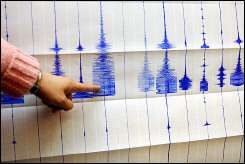
Unprecedented. That's how earthquake engineers describe today's seismic test at the University at Buffalo. Most simulated earthquake tests feature neither full-scale structures nor ground motions in three directions, but the seismic test of a wood-frame townhouse conducted today in UB's Structural Engineering and Earthquake Simulation Laboratory featured both.
For 15 seconds, the two-story, wood-frame townhouse similar to those found in southern California and constructed on the laboratory's twin shake tables was exposed to a magnitude 6.7 earthquake like the Northridge quake that struck the Los Angeles area in 1994. The ground motions in three directions created by the shake tables were similar to those recorded less than four miles from the Northridge earthquake's epicenter.
The three-bedroom, 1,800-square-foot townhouse shook violently during the test, but did not collapse. Remote cameras located inside various rooms showed contents falling off of desks and shelves. Large cracks were created in the structure on each corner of the frame above the garage door.
The townhouse is the largest wood structure in the world ever to undergo seismic testing.
The townhouse was completely furnished for the test, down to a car in the garage, two water heaters (one anchored, according to earthquake protection measures and one not anchored), and dishes on the dining room table.
An upstairs bedroom was decorated as a UB dorm room, by the university's student chapter of the American Society for Civil Engineers. On the wall hang T-shirts from the project's participating universities: UB, Colorado State, Cornell, Rensselaer Polytechnic Institute and Texas A&M.
"The goal of furnishing the house is to make the test as realistic as possible," Andre Filiatrault, professor of civil, structural and environmental engineering in the UB School of Engineering and Applied Sciences and lead investigator on the UB tests, said in an interview prior to the testing. "The test will demonstrate in a dramatic way how much damage can occur during an earthquake if homeowners don't take the proper precautions."
Today's test ended the first year of a four-year, $1.24 million National Science Foundation-funded project called NEESWood, designed to provide engineers with data on how to improve performance of wood-frame structures during earthquakes.
Led by Colorado State University, the NEESWood research is based on the premise that if more is known about how wood structures react to earthquakes, then larger and taller wood structures can be built in seismic regions worldwide, providing economic, engineering and societal benefits.
The NEESWood project will culminate with validation of new seismic design processes in 2009, when a six-story wood-frame structure is tested on the world's largest shake table in Miki City, Japan.
While the structure previously underwent several tests of lesser magnitude, today's shaking represented what Filiatrault said engineers call "the 'maximum design event. It's a very realistic test. This is a full-scale earthquake."
Constructed on twin shake tables last spring, the townhouse in recent months has been subjected to five increasing levels of shaking in three dimensions, the most authentic ground motions that can be produced in a U.S. laboratory. The ground motions simulate increasing intensities recorded during the 1994 Northridge earthquake in the Los Angeles region.
During today's test, 250 sensors installed inside the house gathered detailed information about how each component of the building behaved during the simulated earthquake. A dozen video cameras -- eight inside and four outside of the townhouse -- recorded the shaking as it happened.
According to John van de Lindt, Ph.D., associate professor of civil engineering at Colorado State University and the lead investigator for NEESWood, the UB benchmark testing that occurred to today's final test already has begun to generate useful data on how to make wood-frame homes and buildings safer for occupants during earthquakes.
"The results from this benchmark test at UB probably will change the way we model wood-frame structures," said van de Lindt. "That's a huge advance because without those modeling tools, we would not be able to achieve our greater objective, which is constructing six-story, wood-frame structures that perform better during earthquakes and provide an economical and sustainable construction solution."
Detailed evaluation of the data gathered by sensors and camera will take approximately six months to analyze, they said.
Earthquake engineers say testing like today's is long overdue.
While wood-frame construction accounts for an estimated 80-90 percent of all structures in the United States and 99 percent of all residences in California, fewer than 10 percent of civil engineering students are required to study wood design.
Source: University at Buffalo


