Listening to gunshots may save lives
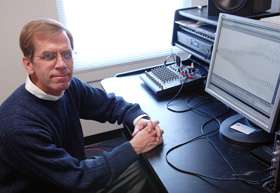
From the crack of a supersonic bullet, Montana State University electrical engineering professor Rob Maher is exploring how sound can be used for everything from saving soldiers from snipers to saving wilderness from noise pollution.
This fall, Maher presented the results of two years of research into gunshots at the Institute of Electrical and Electronic Engineers (IEEE) Signal Processing Society's annual meeting in Jackson Hole, Wyo.
Because of its intense energy and distinctness, a gunshot is "the perfect signal" with which to explore the uses of sound, Maher said.
"It produces what engineers call the 'impulse response' of the sonic environment," Maher said. "If we can't make sense of how a gunshot behaves, then it's unlikely we can do much with more complicated, or lesser quality, sounds."
Maher initially explored two questions with gunshots: First, could the sound of a gunshot on a 911 recording be linked to a specific weapon? The question has intrigued prosecuting attorneys for decades. Second, could the sound of a gunshot be used to determine the location of a hidden sniper?
Through a search of previous studies and his own research, Maher found the "acoustical fingerprinting" of a gunshot from a 911 tape was impossible.
"If you had a very high quality recording made with a very high quality microphone, you might be able to determine if it was a handgun or rifle and the type of ammunition - at best - but you couldn't rule in, or out, a specific firearm," Maher said.
Finding a sniper holds more promise. While a sniper may be able to hide and use a silencer to cover the sound of gunpowder exploding in a shell, the laws of physics will reveal the path of a bullet.
"Most military rifles fire bullets at supersonic speeds," Maher said. "At that speed, the air in front of the bullet doesn't move out of the way in a nice, regular fashion. It moves in a shock."
That shock creates one "boom." There is a second, smaller "boom" as the air returns to normal.
This phenomenon is clearly heard when something big, like a space shuttle, breaks the sound barrier. The shuttle creates two booms as it comes in for landing.
"There is no way to hide the shock wave created by a supersonic bullet," Maher said.
Those booms can be recorded using microphones placed in different locations and then with geometry, the trajectory of the bullet can be determined through triangulation.
Maher successfully determined the trajectory of a bullet using this method at the Logan Shooting Range, near Trident, Mont.
"There are a few commercial systems using this method in Iraq," Maher said. "But they're classified and it's not clear what's being done."
The only way a sniper could hide from such shockwave detection is to fire a bullet that travels at less than the speed of sound, an unlikely prospect since the world's most common weapon, the AK-47 rifle, fires bullets at a little more than twice the speed of sound.
While Maher was able to determine the trajectory of a bullet on a flat shooting range, the real-world application in a city, where sound would bounce off buildings or be absorbed by trees is far more difficult and it plays into another research area: using technology to pick a desired sound from background noise.
"For humans, picking out a desired sound from reflections or background is very easy: A parent can pick out their child's cry in a noisy nursery," Maher said. "But creating technology that could mimic this is very difficult."
Technology that could sort desired sounds from background noise could be used to monitor wildlife habitats. Microphones could record a month's worth of sound in an area and then computer software would sort that massive amount of data into useable chunks: elk bugles, aircraft noise, wolf howls, gunshots, etc.
"Take frogs for example," Maher said. "Frogs are very sensitive to environmental changes. You might be able to augment temperature, moisture and other environmental data with 24/7 recordings of frog vocalizations to estimate population trends.
"You might learn all sorts of interesting things: such as there is less frog noise year-to-year, or maybe the frogs croak at different times year-to-year based on other environmental factors."
But to hear the frogs, Maher will have to spend some more time listening to gunshots.
"The next step is to do more careful calibrations on all the parameters: the gunpowder, the local geometry, the acoustical characteristics of the vicinity and then work from there," he said.
It has been an interesting project for Maher, not only because it involves acoustics - one of his specialties - but also because he came into the project knowing almost nothing about guns.
"I'm not a hunter," he said. "But fortunately in Montana I've had no trouble finding lots of knowledgeable help."
Source: Montana State University, By Tracy Ellig


