Hubble, Sloan Quadruple Number of Known Optical Einstein Rings
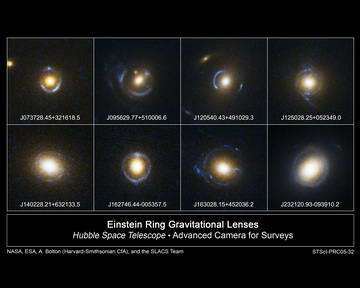
Astronomers have combined two powerful astronomical assets, the Sloan Digital Sky Survey (SDSS) and NASA's Hubble Space Telescope, to identify 19 new "gravitationally lensed" galaxies. Among these 19, they have found eight new so-called "Einstein rings," which are perhaps the most elegant manifestation of the lensing phenomenon. Only three such rings had previously been seen in visible light.
In gravitational lensing, light from distant galaxies is deflected on its way to Earth by the gravitational field of any massive object that lies in the way. Because of this light bending, we see the galaxy distorted into an arc or multiple separate images. When both galaxies are exactly lined up, the light forms a bull's-eye pattern, called an Einstein ring, around the foreground galaxy.
Besides producing odd shapes, gravitational lensing gives astronomers the most direct probe of the distribution of dark matter in elliptical galaxies. Dark matter is an invisible and exotic form of matter that has not yet been directly observed. By searching for dark matter in galaxies, astronomers hope to gain insight into galaxy formation, which must have started around lumpy concentrations of dark matter in the early universe.
The newly discovered lenses come from an ongoing project called the Sloan Lens ACS Survey (SLACS). A team of astronomers, led by Adam Bolton of the Harvard-Smithsonian Center for Astrophysics in Cambridge, Mass., and Leon Koopmans of the Kapteyn Astronomical Institute in the Netherlands, selected the candidate lenses from among several hundred thousand optical spectra of elliptical galaxies in the Sloan Digital Sky Survey.
The team was looking for clear evidence of emission from galaxies twice as far from Earth and directly behind the closer galaxies. They then used Hubble's Advanced Camera for Surveys to snap images of 28 of these candidate lensing galaxies. By studying the arcs and rings produced by 19 of these candidates, the astronomers can precisely measure the mass of the foreground galaxies. These new discoveries add significantly to the approximately 100 gravitational lenses previously known.
"Being able to study these and other gravitational lenses as far back in time as several billion years allows us to see directly whether the distribution of invisible and visible mass changes with cosmic time," says Koopmans. "With this information, we can test the commonly held idea that galaxies form from collision and mergers of smaller galaxies."
The initial findings of the survey will appear in the February 2006 issue of the Astrophysical Journal and in two other papers that have been submitted to that journal.
As Albert Einstein developed his theory of general relativity nearly a century ago, he proposed that the gravitational field from massive objects could dramatically warp space and deflect light. But he thought the effect was unobservable because the optical distortions produced by foreground stars warping space would be too small to ever be measurable by the largest telescopes of his time.
Source: Space Telescope Science Institute (STScI)


