New maps emphasize the human factor in wildfire management
As wildfires put more and more human lives and property at risk, people are looking to fire managers for protection.
Typically, fuel is the sole consideration used to decide the location of site treatments - where trees and shrubs are cleared away or burned in order to minimize the risk of a future fire. However, people also strongly affect wildfires.
This influence is not well understood, and is often overlooked when making management decisions.
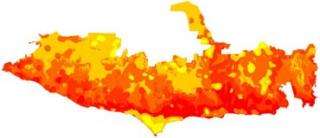
To help fire managers identify the best locations for site treatments in one particularly fire-prone region in Southern California, a University of Wisconsin-Madison team developed a map that incorporates both environmental and human factors to pinpoint where the most devastating wildfires are likely to start in the Santa Monica Mountains, located just north of Los Angeles.
"The vegetation in Southern California is extremely flammable. In some places, it's like there is a continuous blanket of fuel on the ground," says Alexandra Syphard, a postdoctoral researcher in the UW-Madison department of forest ecology and management, who will give the talk. She notes that this fuel is easy tinder for cigarette butts, campfires run amok and the intentional flames of arsonists. Through these and other means, humans cause 95 percent of fires in southern California.
Most of these fires occur near the wildland-urban interface, where houses and other structures commingle with forests and other wild vegetation. "The wildland-urban interface is where houses are most vulnerable to fire because they are intermingled with fuel. The problem is that this is also where humans are most likely to start fires," says Syphard.
To generate her computer models, Syphard utilized a variety of data describing the Santa Monica Mountain region, including information about fire ignitions and the area burned by fires, the locations of human-built structures, roads, trails and the wildland-urban interface, as well as data about the local climate and terrain. Syphard collaborated with the U.S. Forest Service's Northern Research Station in Evanston, Ill., to create the computer models.
"We found that, in terms of fire ignitions, the vast majority of fires are starting near human infrastructure or along roads in the wildland-urban interface. But, ultimately, the area burned by a fire is more a function of other biophysical variables such as the type of terrain, climate or vegetation," says Syphard.
By combining data about where fire ignitions are likely to occur with information about where fires are most likely to spread, Syphard identified and mapped places where the most destructive fires are likely to start in the Santa Monica Mountains. These spots are obvious targets for site interventions that will save structures and lives, while maximizing the limited resources designated for this purpose.
"The underlying issue here is that as we add more houses to the wildland-urban interface, we will get more fires," says Volker Radeloff, associate professor of forestry at the UW-Madison, who oversees the laboratory where Syphard works. "Alex's work shows us that at some point we'll have to make tough land use planning decisions in order to control wildfires."
"We need actions at all levels-by individual landowners, communities and at the federal level," says Radeloff. "We need federal policies that, at the very least, do not foster sprawl in the wildland-urban interface."
Source: University of Wisconsin-Madison


