Robot Discovers Itself, Adapts to Injury
November 16, 2006 Robot Discovers Itself and Adapts to Injury

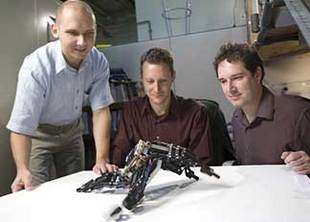
Graduate student Viktor Zykov, former student Josh Bongard, now a professor at the University of Vermont, and Hod Lipson, Cornell assistant professor of mechanical and aerospace engineering, watch as a starfish-like robot pulls itself forward, using a gait it developed for itself. the robot's ability to figure out how it is put together, and from that to learn to walk, enables it to adapt and find a new gait when it is damaged. Credit: Lindsay France/Cornell University

Nothing can possibly go wrong ... go wrong ... go wrong ... The truth behind the old joke is that most robots are programmed with a fairly rigid "model" of what they and the world around them are like. If a robot is damaged or its environment changes unexpectedly, it can't adapt.

So Cornell researchers have built a robot that works out its own model of itself and can revise the model to adapt to injury. First, it teaches itself to walk. Then, when damaged, it teaches itself to limp.

Although the test robot is a simple four-legged device, the researchers say the underlying algorithm could be used to build more complex robots that can deal with uncertain situations, like space exploration, and may help in understanding human and animal behavior.

The research, reported in the latest issue (Nov. 17) of the journal Science, is by Josh Bongard, a former Cornell postdoctoral researcher now on the faculty at the University of Vermont, Cornell graduate student Viktor Zykov and Hod Lipson, Cornell assistant professor of mechanical and aerospace engineering.

Instead of giving the robot a rigid set of instructions, the researchers let it discover its own nature and work out how to control itself, a process that seems to resemble the way human and animal babies discover and manipulate their bodies. The ability to build this "self-model" is what makes it able to adapt to injury.

"Most robots have a fixed model laboriously designed by human engineers," Lipson explained. "We showed, for the first time, how the model can emerge within the robot. It makes robots adaptive at a new level, because they can be given a task without requiring a model. It opens the door to a new level of machine cognition and sheds light on the age-old question of machine consciousness, which is all about internal models."

The robot, which looks like a four-armed starfish, starts out knowing only what its parts are, not how they are arranged or how to use them to fulfill its prime directive to move forward. To find out, it applies what amounts to the scientific method: theory followed by experiment followed by refined theory.

It begins by building a series of computer models of how its parts might be arranged, at first just putting them together in random arrangements. Then it develops commands it might send to its motors to test the models. A key step, the researchers said, is that it selects the commands most likely to produce different results depending on which model is correct. It executes the commands and revises its models based on the results. It repeats this cycle 15 times, then attempts to move forward.

"The machine does not have a single model of itself -- it has many, simultaneous, competing, different, candidate models. The models compete over which can best explain the past experiences of the robot," Lipson said.

The result is usually an ungainly but functional gait; the most effective so far is a sort of inchworm motion in which the robot alternately moves its legs and body forward.

Once the robot reaches that point, the experimenters remove part of one leg. When the robot can't move forward, it again builds and tests 16 simulations to develop a new gait.

The researchers limited the robot to 16 test cycles with space exploration in mind. "You don't want a robot on Mars thrashing around in the sand too much and possibly causing more damage," Bongard explained.

The underlying algorithm, the researchers said, could be applied to much more complex machines and also could allow robots to adapt to changes in environment and repair themselves by replacing parts. The work also could have other applications in computing and could lead to better understanding of animal cognition. In a way, Bongard said, the robot is "conscious" on a primitive level, because it thinks to itself, "What would happen if I do this?"

"Whether humans or animals are conscious in a similar way -- do we also think in terms of a self-image, and rehearse actions in our head before trying them out -- is still an open question," he said.

Source: Cornell University


print this article email this article download pdf blog this article bookmark this article     Stumble it Digg this share on Facebook retweet share on Reddit add to delicious
Rate this story - 4.8 /5 (216 votes)

Rank Filter

Move the slider to adjust rank threshold, so that you can hide some of the comments.


Display comments: newest first

  • HackerMike - Aug 04, 2009
    • Rank: not rated yet
    This is a concept that I've thought about and wanted to develop: a neural net that learned to maximize velocity. It would need to adapt to whatever appendages it had available to it. The problem with extending this idea is it's easy to define walking = maximizing velocity, but what about more elaborate actions? What rule do you apply for it to, say, avoid bullets or move when a gun is pointed at it? Higher levels of programming will be needed. Ideally, heirarchical neural nets must be developed:
    gun detection
    human detection
    human-using-gun detection
    walking (needed to get out of the way if all prior conditions exist -- as developed)

    So, these various nets must be specifically taught and the rule to walk when all condition are met (so it can get out of the way). Their adaptive walking robot is great, but doesn't come close to building multiple, disparate nets for the robot to truly evolve its thinking.

    Herein lies the problem!

November 16, 2006 all stories

Comments: 1

4.8 /5 (216 votes)
  • Stumble this up

  • Digg this

  • share this

  • hide
  • Related Stories

  • UCI robot to aid brain research
    created Nov 04, 2009 | popularity not rated yet | comments 0
  • Quantum computing may actually be useful, after all
    created Oct 09, 2009 | popularity not rated yet | comments 0
  • Research isolates liver cancer stem cells prior to tumor formation
    created Sep 17, 2009 | popularity not rated yet | comments 0
  • Secrets of insect flight revealed
    created Sep 17, 2009 | popularity not rated yet | comments 0
  • The robot children
    created Sep 15, 2009 | popularity not rated yet | comments 0


  • hide
  • Relevant PhysicsForums posts

  • Relative pressure & specific volume
    created 6 hours ago
  • Making 4'x8' sign inkjet printer - need nozzles - help?
    created Nov 06, 2009
  • Calculating Velocity
    created Nov 06, 2009
  • shear stress distribution in triangular steel profile
    created Nov 06, 2009
  • More from Physics Forums - General Engineering

Other News

Samsung launches a new vacuuming robot

Samsung launches a new vacuuming robot

Electronics / Consumer & Gadgets

created Nov 06, 2009 | popularity 4.4 / 5 (7) | comments 8

(PhysOrg.com) -- Samsung Electronics has launched its latest autonomous robot vacuum cleaner, the Tango, which is capable of vacuuming hardwood floors, carpets, and even beds without human assistance.


new iphone

Touchscreen smartphones being snatched up in US

Electronics / Consumer & Gadgets

created Nov 03, 2009 | popularity 2.7 / 5 (3) | comments 3

US smartphone buyers can't wait to get their hands on touchscreen devices, according to figures released Tuesday by industry tracker comScore.


Robot fish could monitor water quality

Robot fish could monitor water quality

Electronics / Robotics

created Nov 02, 2009 | popularity not rated yet | comments 2

Nature inspires technology for an engineer and an ecologist teamed up at Michigan State University. They're developing robots that use advanced materials to swim like fish to probe underwater environments.


Review: Motorola's Droid is a serious smart phone (AP)

Review: Motorola's Droid is a serious smart phone

Electronics / Consumer & Gadgets

created Nov 04, 2009 | popularity 4.6 / 5 (5) | comments 0

(AP) -- Since its debut in 2007, millions of people have gravitated toward Apple's iPhone, wooed by its sleek hardware, simple user interface and abundance of applications.


UCI robot to aid brain research

UCI robot to aid brain research

Electronics / Robotics

created Nov 04, 2009 | popularity 5 / 5 (1) | comments 0

(PhysOrg.com) -- A robot powered by a computerized model of a rodent brain will help researchers from UC Irvine and UC San Diego understand how people recognize and adapt to change.