Fires in Far Northern Forests to Have Cooling, Not Warming, Effect
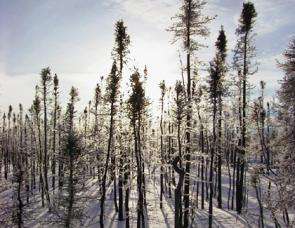
Droughts and longer summers tied to global warming are causing more fires in the Earth’s vast northernmost forests, a phenomenon that will spew a steadily increasing amount of carbon dioxide into the atmosphere.
Many scientists have predicted that the result of this influx of greenhouse gas will be even more warming, followed by even more fires and so on – a vicious climactic cycle.
But a team of scientists, including two University of Florida ecologists, has arrived at just the opposite conclusion. Their research shows that while the carbon released by burning high-latitude forests of North America, Europe and Russia will no doubt have a warming effect, it will be less than an unexpected cooling effect. That will come from millions of new deciduous trees reflecting the sun’s light away from Earth with their light green leaves in the summer. In the winter, these trees lose their leaves, and white snow on the ground will reflect even more light.
A paper about the research is set to appear Friday in the journal Science.
“The reflectivity effect in the long run is larger than the carbon effect,” said Michelle Mack, a co-author and a UF assistant professor of ecology in the botany department.
The research is of broad interest because it calls for a re-examination of strategies to reduce carbon dioxide emissions through human-wrought changes to ecosystems, such as forest management and tree plantations. These strategies have been widely discussed since the 1990s. The study doesn’t suggest that such so-called “carbon sequestration” plans will never work. Indeed, reducing atmospheric carbon is generally a good idea, say Mack and Ted Schuur, a UF assistant professor of ecology in the botany department and a co-author.
Rather, the study implies that scientists need to look at the entire chain of events in a plan to manage climate effects using ecosystems before concluding how the plan will contribute to, or offset, a warming effect.
“What we’re showing,” Schuur said, “is that if you are going to manage an ecosystem to have an effect on the climate via carbon sequestration, you need to consider all the other climate forcing factors you may be changing at the same time.”
Northern, or boreal, forests occupy 5.7 million square miles, or 14.5 percent, of the earth’s land surface. They store 30 percent of Earth’s “carbon pool” in plants and soils.
Scientists agree that the effects of global warming are most severe nearest the poles, and boreal forests are already facing longer summers and more prolonged dry periods. This has spurred many large fires, with the most massive forest fires in recorded Alaskan history occurring in the summer 2004.
While carbon emissions from these fires have long been thought to contribute to global warming, the UF and other researchers decided to look at other associated climate effects of fires. They focused on both the single year after an Alaska fire and for an 80-year period during which plants and trees would re-grow over the burnt landscape.
Seventeen researchers from at least nine universities and research institutes conducted a wide range of investigations for the study, which examined the site of the 1999 Donnelly Flats crown fire, a fire that burned about 18,780 acres in Alaska’s interior.
At UF, Mack measured the amount of carbon released in the burning of black spruce, the most common tree species in North American boreal forest, and the re-growth of new vegetation. Schuur studied the exchange of carbon dioxide between boreal soils and the atmosphere. Other scientists examined the so-called “albedo,” or amount of light reflected from spruce, burned soils and broad-leaved trees.
The scientists plugged their field observations and satellite data into computer models, which extended the results eight decades. The first year following fire was warmer, due in part to added carbon, aerosol and ozone from burning, the researchers found. But the models came to the opposite conclusion relatively quickly, within 10 to 15 years.
The main reason was that the first trees to replace the burnt conifers were aspen, birch and other deciduous trees, with large light-green leaves. These leaves reflected more of the sun’s energy than did the dark green, thin-needled black spruce, and as a result, less of the incoming energy went into heating the ecosystem. Even more important, in the winter the birches and other deciduous trees lose their leaves – revealing even more reflective white snow. The black spruce would eventually grow back, but it will take a long time to dominate the deciduous trees and reduce the reflected light, the researchers said.
Source: University of Florida


