Planck instruments ready for integration
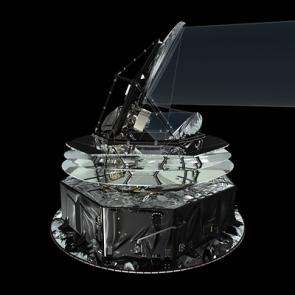
Engineers are ready to begin integrating the scientific instruments into ESA's Planck satellite. The pair of instruments will allow the spacecraft to make the most precise map yet of the relic radiation left behind by the formation of the Universe.
The integration of Planck's two instruments marks a major milestone for the mission. "We have been working on the design of these instruments for 14 years. For most of that time we have been living in a paper world; to finally have them as pieces of hardware feels great," says Jan Tauber, the Planck Project Scientist.
The instruments are the key to the mission. Working in tandem, they will significantly advance our knowledge of the Big Bang. During the Big Bang, all of space was a tremendously hot furnace, filled with particles and radiation. In the approximately 13 thousand million years since then, the Universe has expanded and the radiation has cooled to become microwaves.
The Planck spacecraft will use a 1.5 metre mirror to systematically collect the cosmic microwave background radiation from the whole sky, and feed it to the two instruments.
The two instruments detect the collected radiation in different ways. The Low Frequency Instrument (or LFI) will convert the lower energy microwaves into electrical voltages, rather like a transistor radio.
The High Frequency Instrument (or HFI) works by converting the higher energy microwaves to heat, which is then measured by a tiny electrical thermometer.
These signals will be analysed for tiny differences in strength. Such variations indicate differences in the density of matter in the early Universe. Slightly denser regions became the galaxies we see today, whereas the less dense areas became the great voids that fill parts of space. This pattern is influenced by the amount of normal matter, dark matter and dark energy that fills the Universe. So using Planck's maps, astronomers will be able to place the most stringent limits yet on the quantities of these three universal components.
There is even a possibility that Planck will detect a slight distortion of the microwave background caused by a suspected period in cosmic history, known as the inflationary epoch. Inflationary theory postulates that the entire Universe underwent a period of enormously accelerated expansion just after the Big Bang. If so, it would cause the whole of space to ripple in a highly specific way. This slight ripple might show up in the Planck data. "Of all the exciting science that we will do, this is the most exciting possible measurement of all," says Tauber.
Between now and Planck's launch in mid-2008, there remain a number of important, additional milestones. For example, the entire spacecraft must be tested at a special cryogenic facility built at the Centre Spatial de Liège, Université de Liège, Belgium. "This will be a big test for us and the satellite," says Tauber.
"The test is necessary because the instruments must be operated at extremely cold temperatures," says Thomas Passvogel, ESA Project Manager for Herschel and Planck. "In the case of HFI, the operating temperature is just one tenth of a degree above absolute zero."
On launch day itself, Planck will be lofted into space by an Ariane 5 rocket from Europe's spaceport in Kourou, French Guiana. Inside the nose cone, Planck will be keeping company with ESA's Herschel infrared space telescope. With a 3.5 metre mirror, Herschel will be the orbiting telescope with the largest mirror ever deployed in space. Together Planck and Herschel will survey the cold Universe. Instead of looking for the formation of the Universe, however, Herschel's primary mission will be to see the formation of stars and galaxies.
Source: ESA


