Geologists Find New Origins of Appalachian Mountains
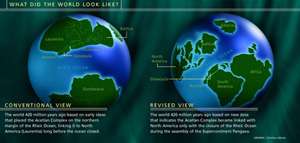
Geologists have developed a new theory to explain how and when the Appalachian Mountain range was created. Their research redraws the map of the planet from 420 million years ago.
The scientists recently discovered a piece of the Appalachian Mountains in southern Mexico, a location geologists long had assumed was part of the North American Cordillera. The Cordillera is a continuous sequence of mountain ranges that includes the Rocky Mountains. It stretches from Alaska to Mexico and continues into South America.
For the past decade, geologists have collected information from Mexico’s Acatlán Complex, a rock outcropping the size of Massachusetts. As they uncovered each new piece of data from the complex, evidence contradicting earlier assumptions about the origins of that part of Mexico emerged.
“It was a story that had the Appalachians written all over it,” said Damian Nance, Ohio University professor of geological sciences and lead author of an article detailing the findings, which was published in the October issue of Geology. “This will change the way geologists look at Mexico.”
It also changes existing theory regarding the creation of the Appalachians, which has radically altered scientists’ understanding of the planet’s geography, said Nance. Age data, newly unearthed fossils and chemical analysis of the rocks show that the complex is much younger than previously thought. It records a pivotal part of the Appalachian story not preserved elsewhere.
According to the conventional map of 420 million years ago, two main land masses were separated by the Rheic Ocean. In the south sat Gondwana, a supercontinent consisting of South America, Africa, India, Australia and Antarctica. To the north was Laurussia, made up of North America, Greenland, Europe and part of Asia. The old map showed the Acátlan Complex attached to Laurussia. The complex broke off Gondwana about 80 million years earlier, drifted toward North America along with the other land masses, closing an older ocean, known as the Iapetus Ocean, as it did so. The collision created the Appalachian Mountains.
The new map looks rather different.
Evidence collected by Nance and his colleagues from rocks in the Acatlán Complex shows that its collision with Laurussia actually occurred about 120 million years later. The rocks once existed on an ancient ocean floor, but this ocean has proven to be the Rheic, not Iapetus as previously thought.
The explanation, Nance and his fellow authors say, is that the Acatlán Complex was originally attached to Gondwana. Gondwana and the complex eventually slammed into North America, closing the Rheic Ocean in the process. This cataclysmic crunch of continental plates formed the goliath land mass known as Pangea, Nance said, and created the Appalachian Mountains.
“We believe we have found the missing piece of the Rheic suture where Gondwana and North America converged,” said Nance. “All the evidence point to that and, as far as we know, it is the best preserved piece of this puzzle in North America.”
Now geologists from around the world, funded by the United Nations Educational, Scientific and Cultural Organization (UNESCO), are expanding the search for evidence of the Rheic Ocean in order to unravel its history from initial opening to final closure.
“We want to see if the ocean opened and closed everywhere at the same time or at different times like a jaw opening and closing. We want to understand the mechanics of these processes,” said Nance.
Source: Ohio University


