Probing Question: Why are some strains of E. coli resistant to antibiotics?
November 16, 2006
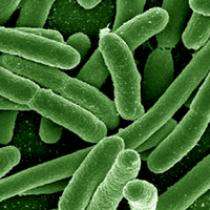
Photo: NIAID
Although they're among the simplest organisms, bacteria are some of the most creative life forms on earth. Just ask molecular biologist Chobi DebRoy, director of Penn State's Gastroenteric Disease Center. "We receive bacterial samples from all over the world -- from veterinary clinics, medical centers, zoos, farms," DebRoy said. Her lab works to identify disease-causing strains of E. coli and to determine whether they are antibiotic-resistant.
Bacteria such as Escherichia coli can alter their genetic makeup with astonishing rapidity. They do this, said DebRoy, "through mutations in normal cellular genes, by acquiring foreign-resistance genes from the environment or by a combination of those mechanisms."
Consider an animal -- a human or a cow, say -- with the usual suite of bacteria in the gastroenteric system (the stomach and intestines). If a strain of bacteria starts to overcome the body's immune system, a doctor or a veterinarian may administer an antibiotic to fight the infection. But if not enough of the antibiotic is given or if treatment is stopped too soon, the drugs may fail to kill all of the bacteria. Low levels of antibiotics are sometimes given to patients, so they won't develop infections, and to animals used for milk and meat production, so they won't get sick and so they'll grow faster. These "subtherapeutic levels" of antibiotics also may help antibiotic-resistant bacteria to emerge.
Some antibiotics work by binding to the cell walls of bacteria, breaking down the walls and killing the microbes. Resistant bacteria change their cell walls slightly, so the antibiotics cannot attach or they produce enzymes to disable the antibiotics. Other drugs target the ribosomes of bacteria -- particles of RNA and protein inside the unicellular organisms that help in the synthesis of proteins necessary for reproduction. Some bacteria evolve slight changes in their ribosomes so that the drugs cannot bind to the particles.
A strain of E. coli may acquire genes from a highly resistant Salmonella strain in the same environment. The genetic material may arrive through plasmids -- circular, double-stranded units of DNA, or it may be transferred inside a phage, a virus that infects bacteria. Recently, scientists have discovered a previously unknown vehicle, dubbed a "gene cassette" or an "integron," that bacteria use to acquire and disseminate the genes conferring antibiotic resistance.
When a bacterial sample comes in the door at the Gastroenteric Disease Center, DebRoy and her colleagues use serotyping analysis to examine the kinds of O and H antigens present on the surface of the bacteria -- antigens that spell the difference between a bacterium that's benign or one that's virulent. "Bacterial genes have been widely mapped, cloned and sequenced," noted DebRoy. "Scientists have determined the sequences of the genes that encode for virulence. We can detect the presence of those genes by using a technique called Polymerase Chain Reaction."
Recently the center has participated in surveillance studies to detect the presence of pathogenic E. coli in meat, fruits and vegetables. The center helps petting zoos and other facilities draw up guidelines for human/animal interactions. "Our center is one of the largest repositories of E. coli strains in North America," said DebRoy. "We have more than 70,000 isolates, collected over the last 40 years from a variety of hosts, including humans, cows, pigs, birds and the greater environment." Scientists at Penn State and elsewhere use samples from the collection to establish relatedness between strains of bacteria -- and to chart the frightening trend toward antimicrobial drug resistance shown in recent years by these adaptable life forms.
Source: By Charles Fergus, Research Penn State
-
Protein study gives fresh impetus in fight against superbugs
Jan 31, 2012 |
not rated yet |
0
-
Dealing with stress: New research highlights the survival skills of disease-causing E. coli
Jan 30, 2012 |
not rated yet |
0
-
First complete 3D visualization of vitamin D receptor
Jan 24, 2012 |
5 / 5 (2) |
0
-
Patterns of antibiotic-resistant bacteria found in Galapagos reptiles
Jan 23, 2012 |
not rated yet |
0
-
Student team's glucose sensor uses DNA instead of chemicals
Dec 28, 2011 |
not rated yet |
0
-
Engineers build first sub-10-nm carbon nanotube transistor
Feb 01, 2012 |
4.9 / 5 (31) |
30
-
Something old, something new: Evolution and the structural divergence of duplicate genes
Jan 31, 2012 |
4.6 / 5 (7) |
1
-
The hidden nanoworld of ice crystals: Revealing the dynamic behavior of quasi-liquid layers
Jan 30, 2012 |
5 / 5 (3) |
1
-
Stock market network reveals investor clustering
Jan 27, 2012 |
3.9 / 5 (23) |
8
-
Of microchemistry and molecules: Electronic microfluidic device synthesizes biocompatible probes
Jan 26, 2012 |
5 / 5 (1) |
0
-
Classical and Quantum Mechanics via Lie algebras
Apr 15, 2011
- More from Physics Forums - Independent Research
More news stories
Complex wiring of the nervous system may rely on a just a handful of genes and proteins
Researchers at the Salk Institute have discovered a startling feature of early brain development that helps to explain how complex neuron wiring patterns are programmed using just a handful of critical genes. ...
8 hours ago |
4.9 / 5 (9) |
0
|
Both maternal and paternal age linked to autism
Older maternal and paternal age are jointly associated with having a child with autism, according to a recently published study led by researchers at The University of Texas Health Science Center at Houston (UTHealth).
Medicine & Health / Psychology & Psychiatry
12 hours ago |
4.3 / 5 (3) |
0
|
New understanding of DNA repair could eventually lead to cancer therapy
A research group in the Faculty of Medicine & Dentistry at the University of Alberta is hoping its latest discovery could one day be used to develop new therapies that target certain types of cancers.
12 hours ago |
4.8 / 5 (5) |
0
|
Curry spice component may help slow prostate tumor growth
Curcumin, an active component of the Indian curry spice turmeric, may help slow down tumor growth in castration-resistant prostate cancer patients on androgen deprivation therapy (ADT), a study from researchers ...
13 hours ago |
4.4 / 5 (8) |
0
|
Team isolates nerve cells involved in storing long term memory and gene proteins associated with them
(Medical Xpress) -- A research team in Taiwan has succeeded in isolating two nerve cells in fruit fly brains that are believed to be the major players in allowing for the formation of long term memories. Furthermore, ...
Google users warned of threat to smartphone wallets
Users of Google smartphone wallets were being warned on Friday that there is a way to crack pass codes intended to thwart thieves from going on illicit shopping sprees.
Anonymous knocks CIA website offline (Update)
The website of the Central Intelligence Agency was inaccessible on Friday after the hacker group Anonymous claimed to have knocked it offline.
New error-correcting codes guarantee the fastest possible rate of data transmission
Error-correcting codes are one of the triumphs of the digital age. Theyre a way of encoding information so that it can be transmitted across a communication channel such as an optical fiber o ...
Humans may have helped the decline of African rainforests 3000 years ago
(PhysOrg.com) -- Large areas of rainforests in Central Africa mysteriously disappeared over three thousand years ago, to be replaced by savannas. The prevailing theory has been that the cause was a change ...
New power source discovered
(PhysOrg.com) -- Researchers at the Massachusetts Institute of Technology (MIT) and RMIT University have made a breakthrough in energy storage and power generation.
The power of estrogen -- male snakes attract other males
A new study has shown that boosting the estrogen levels of male garter snakes causes them to secrete the same pheromones that females use to attract suitors, and turned the males into just about the sexiest ...