Not YouTube, HUGETube: Purdue researchers stream massive Internet video
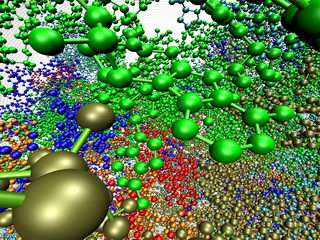
Researchers at Purdue University's Envision Center for Data Perceptualization have transmitted what may be the largest movie ever streamed over the Internet.
The two-minute animated video, which was a scientific visualization of a cell structure from a bacterium, was streamed at a rate of 7.5 gigabits per second with a peak transfer rate of 8.4 gigabits per second. At that speed, the researchers could have transmitted approximately 12 movie DVDs in the same two minutes.
Laura Arns, associate director and research scientist at the Envision Center, said the speedy transfer demonstrated a cost-effective method for providing access to scientific visualizations.
"The video was not compressed and it wasn't done using expensive, highly specialized equipment," she said. "The equipment could have been purchased off the shelf for less than $100,000."
Arns said the technique could allow researchers to collaborate in real time on projects such as drug discovery or viewing massive images from the Hubble telescope.
She said there also could be future applications for the entertainment industry.
"Using this, new release movies could be streamed into theaters all at the same time," she said. "Or, the movie studios could use this technique to move films that are in production so that people could work on them collaboratively in real time."
The video measured 4096 pixels by 3072 pixels, which is the equivalent of 12 17-inch computer monitors arranged in a grid three monitors high and four monitors wide. The video was displayed on Purdue Envision Center's large tiled display.
The project was a demonstration at the SC|06 conference in Tampa, Fla., and the data was transmitted over the high-speed National LambdaRail research network as part of the conference's High Performance Computing (HPC) Bandwidth Challenge. The HPC Bandwidth Challenge is a competition among advanced computing institutions to fully use a 10-gigabit network from the SC|06 conference in Tampa back to their home institution to demonstrate the capabilities of current high-speed research networks. In the challenge, the two-minute video was played in a loop so that it ran for 20 minutes.
Purdue's project was done in collaboration with Apple Computer, Advanced Clustering Technologies Inc., and useours.com. Apple provided six Xserve Raid storage devices and Advanced Clustering Technologies provided six rack-mounted server machines.
Dwight McKay, director of systems engineering for Information Technology at Purdue, says the video could be stopped, replayed and zoomed in real time.
"It's like a digital video recorder, or DVR, in how it works," he said. "This cell structure has about 90,000 atoms, and the video zooms in at some points to show more detail."
McKay said that because the network speed was faster than that of the disks, the seven-person research team and 11 supporting staff members simulated the transmission before it was tried.
"This is actually technically tricky to do. You have to have multiple data readers sending the video into the pipe and multiple readers receiving information on the other end," McKay said. "We've created a way to break this animation into segments, one for each tile of the tiled display, send it across the country and then have it reassemble on the display as one piece, all in real time."
Arns said that the project provided researchers with insights that will help in other areas as well.
"The longer we do it, the more cool things we find," she said. "We learned a lot about how to optimize data to move on the network, and we've already been applying that to some of our large collaborative scientific projects at Purdue."
The video and more information about the project are available online.
Source: Purdue University's, by Steve Tally


