BaBar Re-feathers its Nest
November 16, 2006 BaBar Re-feathers its Nest

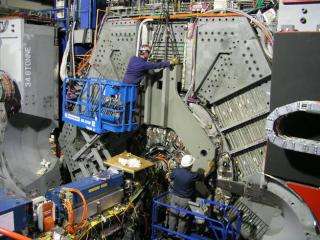
Workers install a yoke on the front of the BaBar detector to help carry the load of the electromagnetic calorimeter while the muon system is upgraded. Credit: SLAC

Like a bird in molt, the BaBar detector is temporarily vulnerable while it acquires better plumage.

At the end of the summer, crews opened the "doors" that seal the front end of the detector, exposing its belly. In a delicate operation, the collaboration has been putting new muon detectors in four of the six sides of the 3-story-tall hexagon that makes up the overall detector's outer layer. With the final sextant successfully installed on Monday, BaBar now sports a vastly improved system for identifying muons and reconstructing rare but important decays.

"This is the most invasive change to BaBar in its history. The detector was not designed to be taken apart. It's tricky," said LST commissioner Mark Convery.

The performance of the original muon detectors, called Resistive Plate Chambers, declined unexpectedly and steadily soon after BaBar turned on in 1999. By 2002 it had become clear they could not be saved.

"We had no choice but to replace them, even though the project would require an enormous effort by BaBar and SLAC engineering and technical staff under severe time pressure," reported Stewart Smith of Princeton University, BaBar's spokesperson at the time the decision was made.

"A lot of the physics we're going after at this point requires identifying muons. The detectors were losing one percent efficiency a month. Without replacing the muon system, there would be no efficiency left before the experiment's scheduled end," said BaBar Technical Coordinator Bill Wisniewski.

An Italian-US collaboration designed and built Limited Streamer Tubes (LSTs), tubes filled with gas that ionizes as particles stream through. LSTs were placed in the top and bottom sextants of the hexagon during the down time in 2004.

"The LSTs have had excellent performance so far, restoring BaBar's muon identification capability in these sextants," said Roberto Calabrese of the University of Ferrara, LST system co-manager, along with Smith.

Completing the job this year was far more complex than two years ago, partly because the remaining four sextants are on an angle, and thousands of cables needed to be moved and disconnected.

One of the toughest engineering challenges has been supporting the weight of one of the inner layers, the over 30-ton electromagnetic calorimeter, so crews could remove its regular supports to get to and remove layers of steel that otherwise block the slots where the LSTs slide in. In the hexagon, called the Instrumented Flux Return, layers of iron alternate with slots that now hold LSTs and brass. The iron shapes the magnetic field in the inner layers to measure momentum. The brass, a new addition, helps soak up pions, making it even easier to distinguish between muons and pions.

The detector will be sealed again by January 5, fully ready for the remaining two years of BaBar operations.

Source: By Heather Rock Woods, SLAC Today


Rate this story - 4.3 /5 (6 votes)


November 16, 2006 all stories

Comments: 0

4.3 /5 (6 votes)

  • hide
  • Related Stories

  • Particles from Space Test New Muon Detection System
    created Dec 14, 2006 | popularity not rated yet | comments 0
  • Inside BaBar's Control Room
    created Jul 18, 2006 | popularity not rated yet | comments 0
  • BaBar Collaboration Completes Data Reprocessing
    created Dec 18, 2008 | popularity not rated yet | comments 0
  • Physicists Discover New Particle: the Bottom-most 'Bottomonium'
    created Jul 10, 2008 | popularity not rated yet | comments 0
  • The B-Factory Returns for its Last Hurrah
    created Dec 12, 2007 | popularity not rated yet | comments 0


  • hide
  • Relevant PhysicsForums posts

  • How to fing tatic friction
    created 39 minutes ago
  • Calculating decible increases
    created 7 hours ago
  • Coefficients of friction
    created 7 hours ago
  • Deduction of centripetal force
    created 8 hours ago
  • More from Physics Forums - General Physics

Other News

Extra large carbon

Extra large carbon

Physics / General Physics

created 7 hours ago | popularity 4.7 / 5 (9) | comments 5 | with audio podcast

An exotic form of carbon has been found to have an extra large nucleus, dwarfing even the nuclei of much heavier elements like copper and zinc, in experiments performed in a particle accelerator in Japan. ...


Scientist explore future of high-energy physics

Scientist explore future of high-energy physics

Physics / General Physics

created 13 hours ago | popularity 4.9 / 5 (10) | comments 6 | with audio podcast

In a 1954 speech to the American Physical Society, the University of Chicago's Enrico Fermi fancifully envisioned a particle accelerator that encircled the globe. Such would be the ultimate theoretical outcome, ...


Leaf veins inspire a new model for distribution networks (w/ Video)

Physics / General Physics

created 10 hours ago | popularity 5 / 5 (2) | comments 0 | with audio podcast

(PhysOrg.com) -- Following the straight and narrow may be good moral advice, but it’s not a great design principle for a distribution network. In new research, a team of biophysicists describe a complex netting of interconnected ...


High-performance microring resonator developed by INRS researchers

Physics / Optics & Photonics

created 6 hours ago | popularity not rated yet | comments 0

A new, more efficient low-cost microring resonator for high speed telecommunications systems has been developed and tested by Professor Roberto Morandotti's INRS team in collaboration with Canadian, American, and Australian ...


New magnetic tuning method enhances data storage

New magnetic tuning method enhances data storage

Physics / General Physics

created 14 hours ago | popularity 4.3 / 5 (3) | comments 0 | with audio podcast

Researchers in Chicago and London have developed a method for controlling the properties of magnets that could be used to improve the storage capacity of next-generation computer hard drives.