What’s in an Isotope? Quite a Lot
A new technique developed by researchers at the Lamont-Doherty Earth Observatory now allows scientists to use an isotope of manganese not abundant on Earth to understand the record of millions of years of changes to the Earth’s surface. According to the study's lead scientists, the new technique relies on measuring extremely small amounts of the nuclide that accumulates as cosmic rays strike exposed rock surfaces over long periods of time. This will allow scientists to track processes such as erosion and glaciation that shaped the landscape over millions of years.
The study, which was published in the current issue of the journal Earth and Planetary Science Letters, was lead by Joerg Schaefer and Gisela Winckler at Lamont-Doherty, a part of The Earth Institute at Columbia University, in collaboration with colleagues at the Munich University of Technology, Rutgers University, University of Berne, Switzerland and the University of Bratislava, Slovakia. It also marked the first time that another stable isotope formed by cosmic rays, 3He, was analyzed at Lamont-Doherty.
This first systematic study of terrestrial 53Mn showed that the minute amounts of the substance formed when cosmic rays strike iron atoms can be used as a clock to measure the how long a rock surface has been exposed to open sky. Such studies are important in understanding the precise timing and manner that continental glaciers retreated in different parts of the world or the rate at which landscapes eroded over millions of years. Scientists can combine such information with knowledge about the Earth's past climate to draw a clearer picture of how the entire climate system operates and how the Earth’s surfaces reacted to past climate changes. Measurements of 53Mn could also one day help answer questions about non-Earth processes.
"Whenever the first rock samples come back from Mars, this could be the prime tool for understanding when water stopped flowing across the planet surface," said Schaefer.
The first measurements of 53Mn were made in the 1960s from pieces of meteorites and were only possible because the iron-rich samples had been bombarded by high doses of cosmic rays outside the Earth's atmosphere. Early methods proved difficult to apply and unable to detect low levels of the substance. As a result, only a very few examples of 53Mn in terrestrial rock samples, which are exposed to much lower levels of cosmic rays, have ever been reported.
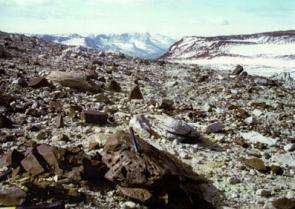
Using their new technique, Schaefer and his colleagues measured the amount of 53Mn in samples taken from the Dry Valleys of Antarctica, one of the oldest landscapes on Earth and a region known to have the world's highest concentration of other isotopes produced by cosmic rays. By knowing how much iron the rocks contained, as well as the overall time that the samples were exposed, which they derived from measurements of cosmogenic 3He, they were able to calculate the rate at which 53Mn forms. This is the key factor in applying the new chronometer more widely to questions about Earth surface processes. Because of its long half-life, 53Mn-dating will allow scientists to study geologic processes over the past 10 to 15 million years, nearly twice as long as existing cosmogenic radio-nuclide techniques.
Source: Earth Institute


