New materials for better hydrogen traps
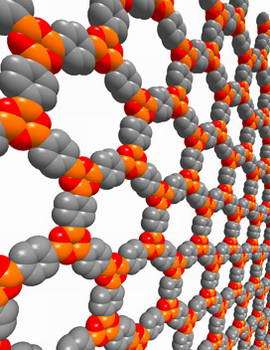
Using building blocks that make up ordinary plastics, but putting them together in a whole new way, University of Michigan researchers have created a class of lightweight, rigid polymers they predict will be useful for storing hydrogen fuel.
The work is described in today's (Nov. 17) issue of the journal Science.
Image: Crystalline sheets produced in covalent organic frameworks (COFs)
The trick to making the new materials, called covalent organic frameworks (COFs), was coaxing them to assume predictable crystal structures---something that never had been done with rigid plastics.
"Normally, rigid plastics are synthesized by rapid reactions that randomly cross-link polymers," said postdoctoral fellow Adrien Côté, who is first author on the Science paper. "Just as in anything you might do, if you do it really fast, it can get disorganized." For that reason, the exact internal structures of such materials are poorly understood, making it difficult to predict their properties. But Côté and colleagues tweaked reaction conditions to slow down the process, allowing the materials to crystallize in an organized fashion instead of assembling helter skelter.
As a result, the researchers can use X-ray crystallography to determine the structure of each type of COF they create and, using that information, quickly assess its properties.
"Once we know the structure and properties, our methodology allows us to go back and modify the COF, making it perform better or tailoring it for different applications," said Côté.
Côté collaborated on the work with Omar Yaghi, who is the Robert W. Parry Collegiate Professor of Chemistry at U-M. Over the past 15 years, Yaghi has taken a similar approach to producing materials called metal-organic frameworks (MOFs). On the molecular level, MOFs are scaffolds made up of metal hubs linked together with struts of organic compounds. By carefully choosing and modifying the chemical components used as hubs and struts, Yaghi and his team have been able to define the angles at which they connect and design materials with the properties they want.
Like MOFs, COFs can be made highly porous to increase their storage capacity. But unlike MOFs, COFs contain no metals. Instead, they're made up of light elements – hydrogen, boron, carbon, nitrogen and oxygen – that form strong links (covalent bonds) with one another.
"Using light elements allows you to generate lightweight materials," said Côté. "That's very important for hydrogen fuel storage, because the lighter the material, the more economical it is to transport around in a vehicle. The strong covalent bonds also make COFs very robust materials." Although the main thrust of the current research is creating materials for gas storage in fuel cells, Côté, Yaghi and colleagues also are exploring variations of COFs that might be suitable for use in electronic devices or catalytic applications.
"This is the first step to what we think is going to be a very large and useful class of materials," Côté said.
Source: UM


