Rare lightshow seen in deep ocean
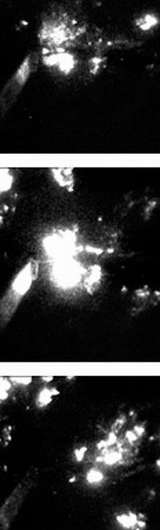
Rare footage of marine creatures putting on deep sea 'lightshows' on the floor of the Atlantic Ocean has been captured by scientists using the latest technology. So many animals were squirting luminescence into the water that football-sized balls of light were seen by the scientific team. These super-luminescent ‘hotspots’ were discovered off the West coast of Ireland at 1000m depth.
Many deep sea animals have light-producing organs on their bodies but observation of these lights in action has been very rare. Normally these lights are seen as flashes which have been stimulated by the agitation of water by boats or submarines.
Dr Julian Partridge, expert in animal vision from the University of Bristol, explained: “People tend to think of bioluminescence as something that happens at the surface of the sea, because that is where they usually see it. But in the deep oceans, this light is all many animals ever see because sunlight is too dim.
“Millions deep sea of animals have evolved visual systems for communication using only brief flashes of dim light. It is often not known why the animals produce light, but the squirting of luminescent material is likely to be a defence mechanism.”
The team from the University of Bristol, Oceanlab at the University of Aberdeen, and the National Oceanography Centre in Southampton used a vehicle called a lander to record spontaneous light displays or bioluminescence produced by small abyssal creatures which were feeding at bait attached to the lander.
Professor Monty Priede, Director of Oceanlab, said: “This is the first time anyone has recorded spontaneous light emissions by bottom-living animals on the deep sea floor.
“Previously, people had observed flashes of light from animals in the water disturbed by the approach of the submarine. Our lander stayed still, making no noise, and we got unique recordings of natural reactions of deep sea animals to food and each other.
“We have seen three kinds of displays - animals swimming along producing repeated flashes of light, single flashes of light, and animals squirting a luminescent substance into the water.”
On the deep sea floor of the Atlantic Ocean the team found that on average the number of light bursts decreased as they went deeper. They recorded 30 such events per hour at 1,000m depth but only three per hour at 4,000m.
Professor Priede said: “We started this work when we noted that even the deepest living fishes in the oceans have eyes, but we had no idea what they might be looking at.
“We now know that throughout the abyssal sea floor there are occasional flashes of light but, where animals congregate at a food source, such as our bait, animals are communicating with one another through light. We imagine a dead whale that has fallen to the sea floor would be surrounded by lights making a vivid display in the darkness of the abyss which might attract predatory fishes. “
The researchers have found two hotspots of deep sea bioluminescence in the Atlantic Ocean. One at 3200m depth off tropical West Africa where during one of the observations, two animals were recorded flashing and squirting luminescence apparently responding to one another. The hotspot discovered off the West Coast of Ireland is near deep cold-water coral reefs and produces the most spectacular displays.
Professor Priede commented: “It was amazing to discover something so spectacular so close to home in waters we thought we knew very well”
The source of these lights in the deep remains a mystery but one likely explanation is small shrimp-like creatures swimming just above the sea floor. The team think they have identified the culprits off the West of Ireland but are waiting for independent checking of their work by scientific referees.
Professor Priede added: “While the predators are blinded or distracted by the ball of light, the shrimp makes its escape. So far we have only discovered two hotspots of deep sea light, we are convinced there is much more to be discovered”.
Source: University of Bristol


