Fighting Like a Girl or Boy Determined By Gene in Fruit Flies
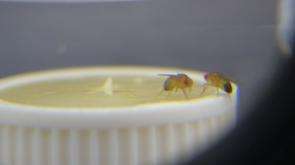
Fighting like a girl or fighting like a boy is hardwired into fruit fly neurons, according to a study in the Nov. 19 Nature Neuroscience advance online publication by a research team from Harvard Medical School and the Institute of Molecular Pathology in Vienna. The results confirm that a gene known as “fruitless” is a key factor underlying sexual differences in behavior. The findings mark a milestone in an unlikely new animal model for understanding the biology of aggression and how the nervous system gives rise to different behaviors.
“Aggression is a very serious problem in society, and it’s a problem with a biological and genetic component,” said co-author Edward Kravitz, the George Packer Berry professor of neurobiology at HMS, who developed the fruit fly fighting model used. “We want to understand that. I can’t think of a better system to study than fruit flies. And no one gets hurt.”
The fruitless gene is known for its role in male courtship. The large gene makes a set of male-specific proteins found exclusively in the nervous system of fruit flies, in about 2 percent of neurons. The proteins are necessary for normal courting. Males missing the proteins do not court females, and they sometimes court males, other research groups have shown. Females with a male version of the gene perform the male courting ritual with other females.
The same gene directs another sex-specific behavior – fighting patterns, the new study shows. Female fighting, for example, largely involves head butts and some shoving. Males prefer lunges; they rear up on their back legs and snap their forelegs down hard – sometimes nailing an opponent that is slow to retreat.
The flies undergo a major role reversal when the male and female gene versions are switched. With a feminine fruitless gene, male flies adopt more ladylike tactics, mostly the head butt and some shoving. With the masculine fruitless gene, females instinctively lunge to the exclusion of their usual maneuvers.
The gender-bending fruit flies were first developed to study courtship in the Austrian lab of co-author Barry Dickson, director of the Institute of Molecular Pathology. Dickson created male flies with the female version of the gene and female flies with the male version.
In Dickson’s courtship studies, male fruit flies with the female fruitless gene were not acting like males, but it wasn’t clear that they were acting like females, either. (Ultimately, courtship behavior is constrained by pheromones and anatomy, which do not change.) He contacted Kravitz, hoping that aggression studies would resolve the lingering question of male behavior changes.
Meanwhile, co-author Steven Nilsen, a postdoctoral fellow in Kravitz’s lab, had similar questions and was staging contests between another line of mutant fruitless flies without such clear brain-switching genetics. So Austrian postdoctoral fellow Eleftheria Vrontou, the lead author, packed up their flies and took them to the Boston fruit fly fight club.
For the past five years, researchers in Kravitz’s lab have been methodically scoring fruit fly fights to determine the normal aggression patterns with the long-term goal of documenting how genes and molecules change those patterns. They stage male fights on bottle-cap-sized food cups decorated with a headless female (a live female will fly away, leaving males nothing to fight over). Female flies fight over an extra dab of fresh yeast paste – their version of dark chocolate, Kravitz said. The flies are videotaped. The movies are replayed in slow motion to record each move and countermove.
“Ed has systematically developed reproducibly aggressive behavior in flies and paved the way for serious analysis,” said Laurie Tompkins, program director at the National Institute of General Medical Sciences, which funds the work. The fruit fly aggression model is part of a new trend to use fruit flies as models to study complex behaviors, including sleep and responses to painful stimuli, Tompkins said. “Drosophila have marvelous advantages in terms of genetic tricks,” she said, “and flies in many respects behave and respond similarly to humans.”
The findings provide a welcome guidepost to help enable future research to track down the underlying neural circuitry, said Bruce Baker, a biology professor at Stanford who first linked the fruitless gene to male-specific courtship behavior. “That’s a pretty big thing,” Baker said. “We can think about understanding in molecular detail how we go from the initial genes and the proteins they encode to the nervous system that causes our body to respond in certain ways.” More generally, he said, such studies form a potential bridge between systems neuroscience studies of behavior and modern molecular neuroscience research into individual neurons and synapses.
Source: Harvard Medical School


