Touch tracking bypasses mind control
November 20, 2006 Touch tracking bypasses mind control

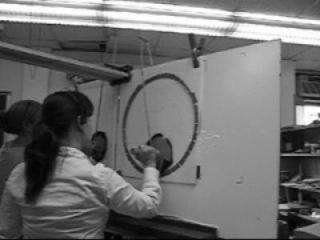
Researcher traces circle in haptic tracing experiment. Credit: David Rosenbaum, Penn State

For people unable to simultaneously rub their stomach while patting their head, a new twist may be at hand. Touch, rather than concentration, could let people multi-task with their hands, and this may also potentially help improve the performance of people with coordination problems, according to psychologists.

"Most normal people cannot simultaneously draw a circle with one hand and a square with the other," says David Rosenbaum, distinguished professor of psychology and director of Penn State's Laboratory For Cognition and Action. "It is a fundamental limitation that the nervous system seems to impose on the hands for reasons that are not fully understood."

Rosenbaum thinks the key to the problem lies in the higher neural centers responsible for concentration on multiple tasks. "When you perform one task, you conceptualize it as one," he explains, "but when you have two tasks to do at the same time that you can't think of as one, it gets complicated because the mind has to shift attention back and forth from one task to the other."
Touch tracking bypasses mind control

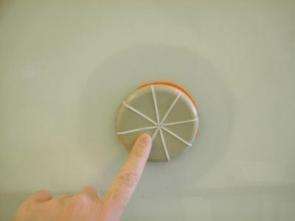
Magnetic button used by subjects to perform haptic tracing experiment. Credit: David Rosenbaum, Penn State

To test this idea, Rosenbaum and his Penn State colleagues, Amanda Dawson, a recent Ph.D. recipient, and John Challis, associate professor of kinesiology, set up an experiment in which participants could track moving objects with light touch and without having to concentrate on the tracking.

Volunteer participants who kept their eyes closed during the experiment tried to keep their hands in contact with two moving disks. The participants could independently trace the paths of the disks, even when the disks moved in ways that are normally very hard for people to produce on their own. For example, they could trace a square and a circle at the same time, which is normally impossible.

The disks were driven by moving magnets on the other size of an opaque pane of glass. "If the person exerted little more than a feather touch on the disks, the magnets decoupled and the experiment came to a stop. So the participants' hands were not simply being dragged along by the magnetic force on the disks," explains Rosenbaum, whose findings appear in the November/December issue of the Journal of Experimental Psychology.

Researchers say the test provides the strongest evidence yet that the reason most persons are unable to voluntarily multi-task with their two hands is that their mind gets in the way.

"We created a situation where each hand simply reacts to the motion of the object being felt, so in effect we bypassed the high-level cognitive system. The excellent performance displayed by our participants took no training whatsoever," added Rosenbaum. "Using haptics, we managed to get into the motor system through the backdoor."

Researchers say the findings could benefit people with coordination problems, and that haptic tracking might help such persons learn to better control their irregular hand movements.

Source: Penn State


print this article email this article download pdf blog this article bookmark this article     Stumble it Digg this share on Facebook retweet share on Reddit add to delicious
Rate this story - 3.1 /5 (12 votes)


November 20, 2006 all stories

Comments: 0

3.1 /5 (12 votes)
  • Stumble this up

  • Digg this

  • share this

  • hide
  • Related Stories

  • Is the Milky Way doomed to be destroyed by galactic bombardment? Probably not
    created Aug 31, 2009 | popularity not rated yet | comments 0
  • 'Chair disease' -- give it a rest
    created Apr 10, 2009 | popularity not rated yet | comments 0
  • The Physics of Pizza Tossing
    created Apr 09, 2009 | popularity not rated yet | comments 0
  • Scientists Produce First Movie of Individual Carbon Atoms in Action (w/Videos)
    created Mar 31, 2009 | popularity not rated yet | comments 0
  • Asus Releases 8.9 Inch Eee PC 900
    created Apr 17, 2008 | popularity not rated yet | comments 0


  • hide
  • Relevant PhysicsForums posts

  • Multiple Sclerosis & CCSVI
    created 17 hours ago
  • 23 Years in a Vegetative State....or not?
    created Nov 25, 2009
  • Has the H1N1 vaccine been scientifically proven to work?
    created Nov 24, 2009
  • nesfatin
    created Nov 22, 2009
  • More from Physics Forums - Medical Sciences

Other News

eye

Over-the-counter eye drops raise concern over antibiotic resistance

Medicine & Health / Medications

created 9 hours ago | popularity 3.5 / 5 (2) | comments 1

(PhysOrg.com) -- The use of antibiotic eye drops for conjunctivitis has increased by almost half since they became available over the counter at chemists in 2005, data obtained by Oxford University researchers ...


Overeating can set stage for obesity, researchers say

Medicine & Health / Health

created 2 hours ago | popularity not rated yet | comments 0

It doesn't seem like a fair fight. In one corner loomed the Thanksgiving table, groaning with poultry, pie and mashed potatoes.


Nuclear science to fight sleeping sickness

Medicine & Health / Diseases

created 5 hours ago | popularity not rated yet | comments 0

The International Atomic Energy Agency on Friday announced an agreement to help African nations battle the tsetse fly, the main carrier of parasites that causes sleeping sickness with its bites.


A costly diagnosis: Alzheimer's disease takes toll on memories, and money too

Medicine & Health / Health

created 6 hours ago | popularity not rated yet | comments 0

Alzheimer's disease takes a devastating emotional toll on families but it also is one of the most expensive conditions to treat because of its progressive nature, requiring increasing assistance with eating, bathing and other ...


New tools for prediction of disease progression in acute childhood leukemia

Medicine & Health / Cancer

created 3 hours ago | popularity not rated yet | comments 0

(PhysOrg.com) -- Researchers at Uppsala University and University Children’s Hospital in Uppsala have devised powerful new tools for typing cells from children with acute lymphatic leukemia and for prediction of how children ...