Male chimpanzees prefer mating with old females
November 20, 2006 Male chimpanzees prefer mating with old females

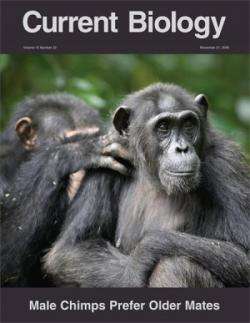
Imoso, the highest-ranking male in the Kanyawara community of Kibale National Park, Uganda, grooms Outamba, a middle-aged female. Male chimpanzees at Kanyawara consistently prefer the oldest females in their community as mating partners, suggesting that the preference that human men exhibit for youthful women is a recent evolutionary phenomenon. For more information, see the Report by Muller et al. in the November 21 Current Biology. Credit: Photograph by Jean-Michel Krief

Researchers studying chimpanzee mating preferences have found that although male chimpanzees prefer some females over others, they prefer older, not younger, females as mates. The findings uncover a stark contrast between chimpanzee behavior and that of humans, their primate cousins.

The basis for this difference may lie in the fact that whereas chimpanzees participate in a relatively promiscuous mating system, humans form unusually long-term mating bonds, thereby making young females more valuable as mates with greater reproductive potential. The findings, reported by Martin Muller of Boston University and colleagues at Harvard University, appear in the November 21st issue of Current Biology.

Theoretical explanations for the preference of human males for young females as mates include the facts that humans tend to form long-term mating partnerships, and that female fertility is limited by menopause and, therefore, age. The converse of such an explanation suggests that species that appear to lack long-term pair bonding and menopause (such as chimpanzees) should not exhibit such strong preferences by males for young females.

In the new work, researchers examined this idea by studying male mate preferences within the Kanyawara chimpanzee community in Kibale National Park in Uganda. The researchers found that, in contrast to humans, male chimpanzees prefer older females to younger ones. They found that, compared to younger females, older females were more likely to be approached for copulation, were more often in association with males during estrous periods, copulated more frequently with high-ranking males, and gave rise to higher rates of male-on-male aggression in mating contests.

The findings, in addition to supporting the idea that long-term pair bonding and menopause may contribute to the preference of human males for young females, also suggest that this characteristic may be an evolutionarily derived trait that arose in the human lineage sometime after the lineages giving rise to humans and chimpanzees diverged.

Source: Cell Press


print this article email this article download pdf blog this article bookmark this article     Stumble it Digg this share on Facebook retweet share on Reddit add to delicious
Rate this story - 3.8 /5 (24 votes)


November 20, 2006 all stories

Comments: 0

3.8 /5 (24 votes)
  • Stumble this up

  • Digg this

  • share this

  • hide
  • Related Stories

  • Hormone that affects finger length key to social behavior
    created Nov 04, 2009 | popularity not rated yet | comments 0
  • Wild chimpanzees exchange meat for sex
    created Apr 08, 2009 | popularity not rated yet | comments 0
  • Female chimps keep the bullies at bay
    created Mar 07, 2007 | popularity not rated yet | comments 0
  • China sends panda expert to Taiwan to aid breeding
    created Nov 08, 2009 | popularity not rated yet | comments 0
  • Mom was right: Why nice guys usually get the girls
    created Nov 05, 2009 | popularity not rated yet | comments 0


Other News

Judge says seals can stay in California cove (AP)

Judge says seals can stay in California cove

Biology / Ecology

created 19 hours ago | popularity 4 / 5 (1) | comments 0

(AP) -- The seals can stay and play at a La Jolla swimming cove.


Rasberry crazy ant

Rapacious Rasberry ants march north

Biology / Plants & Animals

created Nov 13, 2009 | popularity 4.3 / 5 (7) | comments 10

Poor Texas. First it was killer bees, then fire ants. Now, it's the Rasberry ants.


Ancient penguin DNA raises doubts about accuracy of genetic dating techniques

Ancient penguin DNA raises doubts about accuracy of genetic dating techniques

Biology / Evolution

created Nov 10, 2009 | popularity 4.8 / 5 (22) | comments 12

Penguins that died 44,000 years ago in Antarctica have provided extraordinary frozen DNA samples that challenge the accuracy of traditional genetic aging measurements, and suggest those approaches have been ...


Striped skunk

Skunk's Strategy Not Just Black and White

Biology / Plants & Animals

created Nov 10, 2009 | popularity 4.3 / 5 (4) | comments 4

Predators with experience of skunks avoid them both because of their black-and-white coloration and their distinctive body shape, according to UC Davis wildlife researcher Jennifer Hunter. The study was published ...


What is the meaning of 'one'? Evolutionary biologists argue for new meaning of 'organismality'

Biology / Evolution

created Nov 09, 2009 | popularity 4.8 / 5 (6) | comments 3

Rice University evolutionary biologists David Queller and Joan Strassmann argue in a new paper that high cooperation and low conflict between components, from the genetic level on up, give a living thing its "organismality," ...