Level of important greenhouse gas has stopped growing
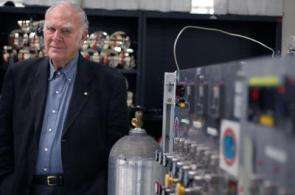
Scientists at UC Irvine have determined that levels of atmospheric methane -- an influential greenhouse gas -- have stayed nearly flat for the past seven years, which follows a rise that spanned at least two decades.
This finding indicates that methane may no longer be as large a global warming threat as previously thought, and it provides evidence that methane levels can be controlled. Scientists also found that pulses of increased methane were paralleled by increases of ethane, a gas known to be emitted during fires. This is further indication that methane is formed during biomass burning, and that large-scale fires can be a big source of atmospheric methane.
Professors F. Sherwood Rowland and Donald R. Blake, along with researchers Isobel J. Simpson and Simone Meinardi, believe one reason for the slowdown in methane concentration growth may be leak-preventing repairs made to oil and gas lines and storage facilities, which can release methane into the atmosphere. Other reasons may include a slower growth or decrease in methane emissions from coal mining, rice paddies and natural gas production.
"If one really tightens emissions, the amount of methane in the atmosphere 10 years from now could be less than it is today. We will gain some ground on global warming if methane is not as large a contributor in the future as it has been in the past century," said Rowland, Donald Bren Research Professor of Chemistry and Earth System Science, and co-recipient of the 1995 Nobel Prize for discovering that chlorofluorocarbons in products such as aerosol sprays and coolants were damaging the Earth's protective ozone layer.
The methane research will be published in the Nov. 23 online edition of Geophysical Research Letters.
Methane, the major ingredient in natural gas, warms the atmosphere through the greenhouse effect and helps form ozone, an ingredient in smog. Since the Industrial Revolution in the late 1700s, atmospheric methane has more than doubled. About two-thirds of methane emissions can be traced to human activities such as fossil-fuel extraction, rice paddies, landfills and cattle. Methane also is produced by termites and wetlands.
Scientists in the Rowland-Blake lab use canisters to collect sea-level air in locations from northern Alaska to southern New Zealand. Then, they measure the amount of methane in each canister and calculate a global average.
From December 1998 to December 2005, the samples showed a near-zero growth of methane, ranging from a 0.2 percent decrease per year to a 0.3 percent gain. From 1978 to 1987, the amount of methane in the global troposphere increased by 11 percent -- a more than 1 percent increase each year. In the late 1980s, the growth rate slowed to between 0.3 percent and 0.6 percent per year. It continued to decline into the 1990s, but with a few sharp upward fluctuations, which scientists have linked to non-cyclical events such as the eruption of Mt. Pinatubo in 1991 and the Indonesian and boreal wildfires in 1997 and 1998.
Along with methane, the UCI scientists also measured levels of other gases, including ethane, a by-product of petroleum refining that also is formed during biomass burning, and perchloroethylene, a chlorinated solvent often used in the dry cleaning process. Ethane levels followed the peaks and valleys of methane over time, but perchloroethylene had a different pattern. This finding provides evidence that biomass burning on occasion, as in Indonesia in 1997 and Russia in 1998, can be a large source of atmospheric methane.
The researchers say there is no reason to believe that methane levels will remain stable in the future, but the fact that leveling off is occurring now indicates that society can do something about global warming. Methane has an atmospheric lifetime of about eight years. Carbon dioxide -- the main greenhouse gas that is produced by burning fossil fuels for power generation and transportation -- can last a century and has been accumulating steadily in the atmosphere.
"If carbon dioxide levels were the same today as they were in 2000, the global warming discussion would leave the front page. But to stabilize this greenhouse gas, we would have to cut way back on emissions," Rowland said. "Methane is not as significant a greenhouse gas as carbon dioxide, but its effects are important. The world needs to work hard to reduce emissions of all greenhouse gases."
Source: University of California - Irvine


