Supercomputer study shows Milky Way's halo of dark matter in unprecedented detail
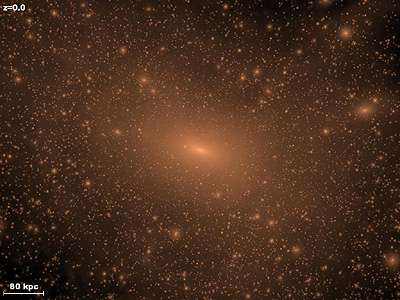
Researchers at the University of California, Santa Cruz, have used NASA's most powerful supercomputer to run the largest simulation to date of the formation and evolution of the dark matter halo that envelopes the Milky Way galaxy. Their results show substructures within the halo in unprecedented detail, providing a valuable tool for understanding the evolutionary history of our galaxy.
Every galaxy is surrounded by a halo of mysterious dark matter that can only be detected indirectly by observing its gravitational effects. The invisible halo is much larger and more spherical than the luminous galaxy at its center. Recent computer simulations have shown that the halo is surprisingly clumpy, with relatively dense concentrations of dark matter in gravitationally bound 'subhalos' within the halo. The new study, which has been accepted for publication in the Astrophysical Journal, shows much more extensive substructure than any previous study.
"We find almost 10,000 subhalos, about one order of magnitude more than in any past simulations, and some of our subhalos exhibit 'subsubstructure.' This was expected theoretically, but we have shown it for the first time in a numerical simulation," said Piero Madau, professor of astronomy and astrophysics at UCSC and a coauthor of the paper.
Jürg Diemand, a Hubble postdoctoral fellow at UCSC and first author of the paper, said the new results exacerbate what is known as the "missing satellite problem." The problem is that the clumpiness of the normal matter in and around our galaxy--in the form of dwarf satellite galaxies--does not match the clumpiness of the dark matter seen in the simulation.
"Astronomers keep discovering new dwarf galaxies, but there are still only about 15 or so, compared to about 120 dark matter subhalos of comparable size in our simulation. So which ones host the dwarf galaxies, and why?" Diemand said.
Theoretical models in which star formation is restricted to certain types of dark matter halos--sufficiently massive or early-forming ones--may help to resolve the discrepancy, Madau said.
Although the nature of dark matter remains a mystery, it appears to account for about 82 percent of the matter in the universe. As a result, the evolution of structure in the universe has been driven by the gravitational interactions of dark matter. The "normal" matter that forms gas and stars has fallen into the "gravitational wells" created by clumps of dark matter, giving rise to galaxies in the centers of dark matter halos.
Initially, gravity acted on slight density fluctuations present shortly after the Big Bang to pull together the first clumps of dark matter. These grew into larger and larger clumps through the hierarchical merging of smaller progenitors. This is the process the UCSC researchers simulated on the Columbia supercomputer at the NASA Ames Research Center, one of the fastest computers in the world. The simulation took a couple of months to complete, running on 300 to 400 processors at a time for 320,000 "cpu-hours," Diemand said.
Coauthor Michael Kuhlen, who began working on the project as a graduate student at UCSC and is now at the Institute for Advanced Study in Princeton, said the researchers set the initial conditions based on the most recent results from the Wilkinson Microwave Anisotropy Probe (WMAP) experiment. Released in March, the new WMAP results provide the most detailed picture ever of the infant universe.
The simulation starts at about 50 million years after the Big Bang and calculates the interactions of 234 million particles of dark matter over 13.7 billion years of cosmological time to produce a halo on the same scale as the Milky Way's. The clumps within the halo are the remnants of mergers in which the cores of smaller halos survived as gravitationally bound subhalos orbiting within the larger host system.
The simulation produced five massive subhalos (each more than 30 million times the mass of the Sun) and many smaller ones within the inner 10 percent of the host halo. Yet only one known dwarf galaxy (Sagittarius) is that close to the center of the Milky Way, Diemand said.
"There are big clumps of dark matter in the same region where the disk of the Milky Way would be. So even in the local neighborhood of our solar system, the distribution of dark matter may be more complicated than we have assumed," he said.
Astronomers may be able to detect clumps of dark matter within the Milky Way's halo with future gamma-ray telescopes, but only if the dark matter consists of the types of particles that would give rise to gamma-ray emissions. Certain dark matter candidates--such as the neutralino, a theoretical particle predicted by supersymmetry theory--could annihilate (that is, be mutually destroyed) in collisions, generating new particles and emitting gamma rays.
"Existing gamma-ray telescopes have not detected dark matter annihilation, but upcoming experiments will be more sensitive, so there is some hope that individual subhalos may produce an observable signature," Kuhlen said.
In particular, astronomers look forward to interesting results from the Gamma Ray Large Area Space Telescope (GLAST), scheduled for launch in 2007, he said.
The simulation also provides a useful tool for observational astronomers studying the oldest stars in our galaxy by providing a link between current observations and earlier phases of galaxy formation, Diemand said.
"The first small galaxies formed very early, about 500 million years after the Big Bang, and there are still today stars in our galaxy that formed at this early time, like a fossil record of early star formation. Our simulation can provide the context for where those old stars came from and how they ended up in dwarf galaxies and in certain orbits in the stellar halo today," Diemand said.
Source: University of California, Santa Cruz


