'Nymph of the sea' reveals remarkable brood
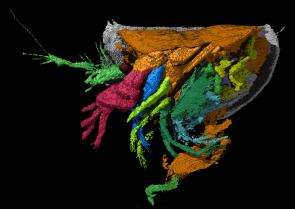
The scientists discovered the mother complete with her brood of some 20 eggs and 2 possible juveniles inside, together with other details of her soft part anatomy including legs and eyes.
The research team consisted of David Siveter from the University of Leicester, Derek Siveter from Oxford, Mark Sutton from Imperial College London and Derek Briggs from Yale.
The team has made a digital image of the fossil - an ostracod (a relative of the shrimps) - which is preserved exceptionally in volcanic ash rocks in Herefordshire. Their findings are published on line in the Proceedings of the Royal Society.
Professor David Siveter, of the Department of Geology at the University of Leicester, said : "Ostracods are common, pin-head sized crustaceans known from thousands of living species in garden ponds to oceans and from countless fossil shells up to 500 million years old; however, their fossilized soft-parts are exceedingly rare.
"Supposed examples of fossil invertebrate eggs are also few. The fossil we have found contains soft-part anatomy such as legs and eyes and also includes about twenty eggs, each about half a millimetre in size, and two possible juveniles.
"The fossil has been christened Nymphatelina gravida, meaning' a pregnant young woman of the sea'. This remarkable discovery provides an unequivocal and unique view of parental brood care in the invertebrate fossil record, it allows gender to be determined in an animal as old as the Silurian period of geological time, and indicates a remarkably conserved egg brooding reproductive strategy."
Source: University of Leicester


