Researchers shine light on atomic transistor
November 22, 2006
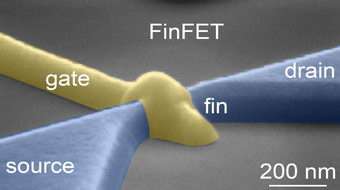
Electronmicroscopic image of FinFET transistor that was used for the research. Credit: TU Delft
Researchers from TU Delft and the FOM Foundation (Netherlands) have successfully measured transport through a single atom in a transistor. This research offers new insights into the behaviour of so-called dopant atoms in silicon.
The researchers are able to measure and manipulate a single dopant atom in a realistic semi-conducting environment. The individual behaviour of dopant atoms is a stumbling block to the further miniaturisation of electronics.
The researchers have published their findings in the Physical Review Letters.
The electronic industry uses a semiconducting material, dominantly silicon, that contains dopant atoms. This 'contamination' is necessary for giving the silicon the desired electronic characteristics. Owing to the continuing process of miniaturisation, a situation has arisen in which the characteristics of two chips, despite both being manufactured in a totally identical way, still differ from each other.
The number of dopant atoms per transistor has in fact become so small (only a few dozen) that they can no longer be regarded as a continuum. The position and effect of each individual atom influences how the entire transistor works. Effectively, this means that even perfectly manufactured transistors will not behave identically. This is an especially alarming situation for the electronics industry, which has already been feeling the pinch for a number of years.
Researchers Sellier, Lansbergen, Caro and Rogge of TU Delft's Kavli Institute of Nanoscience and the FOM Foundation have successfully managed to measure a single dopant atom in an actual semi-conducting environment. The researchers, who work in the Photronic Devices, transported a charge through one atom. Moreover, they successfully measured and manipulated the quantum mechanical behaviour of a single dopant atom. They were able for example to place one or two electrons in a particular shell of the atom.
The Delft researchers used an advanced industrial transistor (a MOSFET), which was made as a prototype by IMEC, a research centre in Leuven, Belgium. In this transistor, which consists of approximately 35 nanometre-wide silicon nanowires, the electrical current flows through a single dopant atom (in this case, arsenic). The nanowire is connected to a 'gate'; by applying a voltage to the gate, the researchers enable the electrons to flow through the arsenic atom (from the 'source' to the 'drain'). By detailed measurements of the electrical current's behaviour, researchers can observe the remarkable effects.
This research however does not offer an immediate solution to the problems previously mentioned relating to miniaturisation, but it does provide the industry with greater insights into the (quantum mechanical) behaviour of transitions on the nano level. The research conducted at the Kavli Institute of Nanoscience Delft is also extremely interesting from a purely physics point of view.
The transistor that was researched not only provided new insights into the atomic physics occurring inside a solid, but this also resembles a structures that is needed to build a certain type of quantum computer. This still purely theoretical computer–the Kane design–is based on dopant atoms in silicon. One of the advantages of using dopants in silicon is that the realization of such a quantum computer can rely on the extremely well developed silicon nanotechnology.
Citation: H. Sellier, G. P. Lansbergen, J. Caro, and S. Rogge, N. Collaert, I. Ferain, M. Jurczak, and S. Biesemans, "Transport Spectroscopy of a Single Dopant in a Gated Silicon Nanowire", Physical Review Letters volume 97 issue 20, page 206805, 2006. See http://dx.doi.org/ … tt.97.206805
Source: TU Delft
-
A new class of electron interactions in quantum systems
Jan 23, 2012 |
4.8 / 5 (14) |
0
-
Chemists propose explanation for superconductivity at high temperatures
Dec 15, 2011 |
4.9 / 5 (19) |
27
-
Study compares fundamental techniques for doping graphene sheets
Nov 07, 2011 |
5 / 5 (2) |
0
-
Scientists get first detailed look at nitrogen doping in single-layer graphene
Sep 21, 2011 |
5 / 5 (3) |
1
-
Coexistence of superconductivity and magnetism
Jun 17, 2011 |
4.3 / 5 (4) |
1
-
Engineers build first sub-10-nm carbon nanotube transistor
Feb 01, 2012 |
4.9 / 5 (31) |
30
-
Something old, something new: Evolution and the structural divergence of duplicate genes
Jan 31, 2012 |
4.6 / 5 (7) |
1
-
The hidden nanoworld of ice crystals: Revealing the dynamic behavior of quasi-liquid layers
Jan 30, 2012 |
5 / 5 (3) |
1
-
Stock market network reveals investor clustering
Jan 27, 2012 |
3.9 / 5 (23) |
8
-
Of microchemistry and molecules: Electronic microfluidic device synthesizes biocompatible probes
Jan 26, 2012 |
5 / 5 (1) |
0
-
Questions about Equivalence principle & Einstein Elevator?
1 hour ago
-
Kinetic energy of gas
3 hours ago
-
Understanding induced emfs
5 hours ago
-
What is the precise definition of a year?
6 hours ago
-
Universe as a cellular automaton
7 hours ago
-
Question about Newton's laws
8 hours ago
- More from Physics Forums - General Physics
More news stories
Explained: Sigma
It's a question that arises with virtually every major new finding in science or medicine: What makes a result reliable enough to be taken seriously? The answer has to do with statistical significance -- but ...
Feb 09, 2012 |
5 / 5 (19) |
66
Quantum physicist explains $100K offer for proof scaled-up quantum computing is impossible
(PhysOrg.com) -- MIT researcher Scott Aaronson has certainly riled the physics community with his offer this past Friday, of $100,000 to anyone who can prove that scaled-up quantum computing is impossible. ...
Diamond light, brighter than the sun
Its the size of five football pitches and generates light 10 billion times brighter than the sun. As the Diamond Light Source celebrates its tenth anniversary this year, Penny Bailey visits one of the ...
Feb 07, 2012 |
4.3 / 5 (7) |
15
|
Physicists 'record' magnetic breakthrough
An international team of scientists has demonstrated a revolutionary new way of magnetic recording which will allow information to be processed hundreds of times faster than by current hard drive technology.
Feb 07, 2012 |
4.5 / 5 (41) |
14
|
Hints of the Higgs - papers are submitted
Back in December 2011, the ATLAS and CMS experiments at CERN presented some exciting results that provided tantalising hints of the Higgs boson.
Feb 08, 2012 |
4.1 / 5 (7) |
10
Walney offshore wind farm is world's biggest (for now)
(PhysOrg.com) -- The Walney wind farm on the Irish Sea--characterized by high tides, waves and windy weather--officially opened this week. The farm is treated in the press as a very big deal as the Walney ...
GPS court ruling leaves US phone tracking unclear
A US Supreme Court decision requiring a warrant to place a GPS device on the car of a criminal suspect leaves unresolved the bigger issue of police tracking using mobile phones, legal experts say.
Europeans protest controversial Internet pact
Tens of thousands of people marched in protests in more than a dozen European cities Saturday against a controversial anti-online piracy pact that critics say could curtail Internet freedom.
Europe stakes billion-dollar bet on new rocket
A pencil-slim rocket is scheduled to lift into space from South America on Monday, carrying a billion-dollar bet that Europe can grab a juicy slice of the market to place satellites in low orbit.
Study finds that anti-diabetic medication can prevent the long-term effects of maternal obesity
In a study to be presented today at the Society for Maternal-Fetal Medicine's annual meeting, The Pregnancy Meeting, in Dallas, Texas, researchers will report findings that show that short therapy with the anti-diabetic medication ...
Netflix settlement trims 14 pct off 4Q earnings
(AP) -- Netflix pressed the rewind button on its fourth-quarter earnings after settling allegations that the video subscription service violated a consumer-privacy law.