Early Earth Likely Had Livable Continents
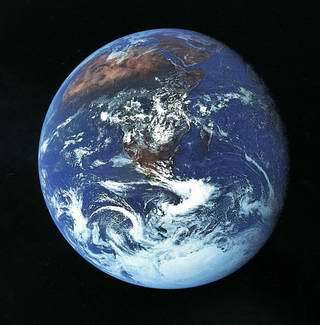
November 21, 2005 Earth from space

A surprising new study by an international team of researchers has concluded Earth's continents most likely were in place soon after the planet was formed, overturning a long-held theory that the early planet was either moon-like or dominated by oceans.

The team came to the conclusion following an analysis of a rare metal element known as hafnium in ancient minerals from the Jack Hills in Western Australia, thought to be among the oldest rocks on Earth. Hafnium is found in association with zircon crystals in the Jack Hills rocks, which date to almost 4.4 billion years ago.

"These results support the view that the continental crust had formed by 4.4-4.5 billion years ago and was rapidly recycled into the mantle," the researchers wrote in Science Express. Led by Professor Mark Harrison of the Australian National University, the team also included University of Colorado Assistant Professor Stephen Mojzsis and researchers from the University of California, Los Angeles and Ecole Normale Superieure University in France.

The researchers used hafnium as a "tracer" element, using isotopes to infer the existence of early continental formation on Earth dating to Hadeon Eon, which took place during the first 500 million years of Earth's history, said Mojzsis, an assistant professor of geological sciences at CU-Boulder. Mojzsis also is a member of CU-Boulder's Center for Astrobiology.

"The evidence indicates that there was substantial continental crust on Earth within its first 100 million years of existence," said Mojzsis. "It looks like the Earth started off with a bang."

A 2001 study led by Mojzsis published in the journal Nature showed evidence for the presence of water on Earth's surface roughly 4.3 billion years ago. "The view we are taking now is that Earth's crust, oceans and atmosphere were in place very early on, and that a habitable planet was established rapidly," said Mojzsis.

Copyright 2005 by Space Daily, Distributed United Press International


print this article email this article download pdf blog this article bookmark this article     Stumble it Digg this share on Facebook retweet share on Reddit add to delicious
Rate this story - 4.5 /5 (14 votes)


November 21, 2005 all stories

Comments: 0

4.5 /5 (14 votes)
  • Stumble this up

  • Digg this

  • share this

  • hide
  • Related Stories


Other News

The shore of Deception Island in Antarctica, in 2008

Antarctic ice loss vaster, faster than thought: study

Space & Earth / Earth Sciences

created 7 hours ago | popularity 2.9 / 5 (10) | comments 8

The East Antarctic icesheet, once seen as largely unaffected by global warming, has lost billions of tonnes of ice since 2006 and could boost sea levels in the future, according to a new study.


Astronaut's baby daughter born as he circles Earth (AP)

Astronaut's baby daughter born as he circles Earth

Space & Earth / Space Exploration

created 7 hours ago | popularity 5 / 5 (1) | comments 0

(AP) -- Astronaut Randolph Bresnik jubilantly welcomed his new daughter into the world Sunday as he floated 220 miles above it.


Denmark: 65 world leaders for UN climate summit (AP)

Denmark: 65 world leaders for UN climate summit

Space & Earth / Environment

created 7 hours ago | popularity 1 / 5 (2) | comments 2

(AP) -- Sixty-five world leaders have said they will attend the Copenhagen climate summit in December, and several more have responded positively to invitations, Danish officials said Sunday.


Commuters wait on the platform shrouded by fog in London

Climate change not man-made, say majority of Britons: poll

Space & Earth / Environment

created Nov 15, 2009 | popularity 3.4 / 5 (16) | comments 46

Less than half of Britons believes that human activity is to blame for global warming, according to a poll carried out for The Times newspaper and published on Saturday.


Mysteriously warm times in Antarctica

Mysteriously warm times in Antarctica

Space & Earth / Earth Sciences

created Nov 18, 2009 | popularity 4.2 / 5 (21) | comments 31

(PhysOrg.com) -- A new study of Antarctica's past climate reveals that temperatures during the warm periods between ice ages (interglacials) may have been higher than previously thought. The latest analysis ...