November 22, 2006 feature
The evolution of intelligence, and why our brains have shrunk
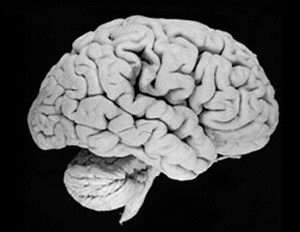
One of the main differences between humans and other animals is our larger brain size—but what prompted and guided this growth? Wanting to better understand the origins of human uniqueness, scientists from the University of Tennessee have recently modeled the evolution of the brain, based on previous explanations of intelligence as the individual’s quest to achieve greater social and reproductive success.
“One of the two challenges in this research was to find a mathematical representation of verbal arguments underlying the Machiavellian intelligence hypothesis,” co-author Sergey Gavrilets told PhysOrg.com. “Second, we had to perform a thorough numerical study of the mathematical model that we built, which required using a very large number of powerful computers. We found that the mathematical model strongly supports previous verbal arguments, which adds a lot of credibility to the latter.”
Acknowledging that their model base is controversial, scientists Gavrilets and co-author Aaron Vose focused primarily on the effects of social factors on the evolution of brain size (other possible factors include climate and ecology). Sometimes called “Machiavellian intelligence,” the hypothesis suggests that social power and competition for mates was driving human males to invent strategies that increase cerebral capacity on an evolutionary timescale. (The current study neglected females for simplicity.)
In their model, Gavrilets and Vose described “intelligence” as “the ability to learn and use different ideas to the individual’s own benefit.” Two factors defined intelligence in the study: “learning ability,” which is how easily a brain learns new strategies; and “cerebral capacity,” which measures the number of different ideas that a brain can learn and use. These traits get passed on genetically, with the more socially intelligent humans winning mates and reproducing more offspring, who inherit their progenitors’ intelligent genes. Secondary benefits of a complex brain include technological, linguistic, environmental and other skills.
Three phases of evolutionary intelligence
According to their model simulation, which ran through about 30,000 generations of humans, Gavrilets and Vose identified three phases of the dynamics of intelligence. In the “dormant phase,” the only route to an individual’s increased intelligence is to invent an idea in his lifetime. However, large brains are advantageous only if they also have learned some ideas which are not happening during the dormant phase.
“The dormant phase is when nothing much happens,” said Gavrilets. “In a sense, this is a default state from which we start simulations.”
Not until the “cognitive explosion phase”—5 to 20 thousand generations later—does increased learning ability and cerebral capacity offer advantages. At this time, much of the population has received both genes, promoting rapid expansion of the ideas. Interestingly, the scientists found that cerebral capacity evolves more rapidly than learning ability, suggesting that potential is more important than ability. Also, even though complex ideas are more beneficial for the population, individuals largely gain simple ideas during this phase—which was a surprise to the scientists.
“[T]he complexity of memes [ideas] present in the population does not increase but, on the contrary, decreases in time,” the scientists wrote in their study. “This happens as a result of intense competition among memes: whereas complex memes give advantage to individuals on a longer (biological) time scale, they lose competition to simpler memes on a shorter (social) time scale.”
After a while, though, the increasing brain becomes difficult to afford, partly due to high-risk births as well as energy consumption. Although accounting for only 2% of the body weight, the brain uses about 20% of a resting body’s metabolism. Therefore, cerebral expansion cannot last forever, and a “saturation phase” occurs, usually a couple hundred thousand generations later. Throughout this process, natural selection causes a competition between simple and complex ideas, where simple ideas always win because they spread easier. Other conditions that emerge in this phase promote postponing brain growth until after birth, and reducing the size of the guts.
Diminishing IQ-sex correlation
Historically, males with greater social intelligence generate more offspring, corresponding with the evolution of more intelligent humans. In modern times, however, it’s fairly obvious that intelligence and reproductive fecundity don’t generally correlate. This change, the scientists found, along with exposure to a large number of ideas, could throw a curve ball to evolution’s increasingly intelligent humans.
“As the extent to which social success translates into reproductive success declines in modern societies, cognitive abilities are expected to be significantly reduced by natural selection,” the scientists wrote in their study.
This was also one of the most eyebrow-raising results for Gavrilets.
“Surprisingly, the competition for social/reproductive success was a very large driving force in the whole process,” he said. “Personally, I didn’t expect to find that the model would predict a reduction in intelligence.”
The Human Uniqueness Factor
Before trying to relate these dynamics to our modern society, however, Gavrilets and Vose caution that they did not develop this model for direct application to the history of Homo sapiens. Rather, the model combines several explanations for human brain size, and determines the outcome when taken together. As Gavrilets explained, the model has identified key parameters, factors (e.g., competition for reproductive success), patterns (e.g., the three phases), and time scales (10 to 20 thousand generations) for human brain evolution.
Still, the scientists aren’t sure why these large brain dynamics occurred for humans, but not other animals.
“This is ‘The Question’, Gavrilets said. “There is not much agreement on this in the scientific literature. Alexander and others argue that the fact that humans managed to reach a state of ‘ecological dominance’ was crucial. To me, Alexander's arguments make a lot of sense. Others will strongly disagree and will interpret the data differently.”
Citation: Gavrilets, Sergey and Vose, Aaron. “The dynamics of Machiavellian intelligence.” Proceedings of the National Academy of Sciences. November 7, 2006, vol. 103, no. 45, 16823-16828.
By Lisa Zyga, Copyright 2006 PhysOrg.com


