Mind the gap: New information on the hydrophobic water gap
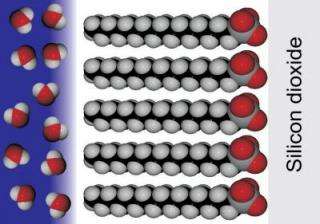
Researchers have found a gap between water and a water-repelling surface that can give new insight into the way water and oil separate. By using high-energy X-rays at the ESRF, an international team defined the size and characteristics of this gap. The knowledge of the structure of a hydrophobic interface is important because they are crucial in biological systems, and can give insight in protein folding and stability. The researchers publish their results this week in PNAS Early Online Edition.
The repulsion of water is a phenomenon present in many aspects of our lives. Detergent molecules made up of components attracted to water (hydrophilic) and others that repel it (hydrophobic). Proteins also use the interaction with water to assemble into complexes. However, studying hydrophobic structures and what occurs when they encounter water is not entirely straightforward as it is influenced by certain factors. Early studies of the gap formed between water and a hydrophobic surface did not show a coherent picture.
Scientists from the Max Planck Institute for Metals Research (Germany), the University of South Australia (Adelaide) and the ESRF carried out experiments on silicon wafers covered by a water-repulsive layer at the surface. The wafers were then immersed in water by a special cell. Studies of the water structure at the interface of the hydrophobic layer confirmed that a gap is formed between the layer and water and that its size is the diameter of a water molecule, somewhere between 0.1 and 0.5 nanometer. The integrated density deficit at the interface amounts to half a monolayer of water molecules.
The scientists did further experiments in order to test the influence of gas, which is naturally present in water, on the hydrophobic water gap. During all their experiments they kept the water ultra clean (unlike water in nature) and they introduced gas into the cell until saturation. The result shows that, contrary to previous reports, gas does not play a role in the structure of water at flat interfaces.
This is the first time that high energy synchrotron X-rays have been used as a tool to measure the properties of this gap. "Some teams have used neutrons, but they didn't have enough resolution, after all, the gap is extremely small and difficult to track," explained Harald Reichert, the paper’s corresponding author. Despite the superior quality of the X-ray beam, the experiment was still a challenge: the water-repellent layer on the silicon wafer can survive only 50 seconds under the beam, so measurements had to be completed very quickly.
The next step for the team is to produce porous structures and study the properties of water at confined pore interfaces. "These studies will increase our knowledge of how water behaves in different environments. The structure of water in these environments is still, somewhat a mystery to us, despite the fact that our world is surrounded by water", declared Reichert.
Source: European Synchrotron Radiation Facility


