On the cutting edge: Carbon nanotube cutlery
November 22, 2006 On the cutting edge: Carbon nanotube cutlery

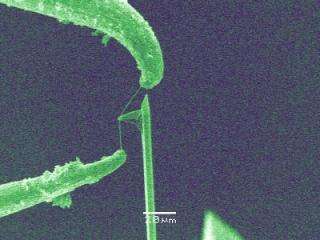
Scanning electron micrograph of a prototype 'nanoknife' shows a single carbon nanotube stretched between two tungsten needles. Triangular probe is the tip of an atomic force cantilever used to determine the breaking point of the knife. (Color added for clarity.) Credit: NIST/CU

Researchers at the National Institute of Standards and Technology and the University of Colorado at Boulder have designed a carbon nanotube knife that, in theory, would work like a tight-wire cheese slicer.

In a paper presented this month at the 2006 International Mechanical Engineering Congress and Exposition, the research team announced a prototype nanoknife that could, in the future, become a tabletop tool of biology, allowing scientists to cut and study cells more precisely than they can today.

For years, biologists have wrestled with conventional diamond or glass knives, which cut frozen cell samples at a large angle, forcing the samples to bend and sometimes later crack. Because carbon nanotubes are extremely strong and slender in diameter, they make ideal materials for thinly cutting precise slivers of cells. In particular, scientists might use the nanoknife to make 3D images of cells and tissues for electron tomography, which requires samples less than 300 nanometers thick.

By manipulating carbon nanotubes inside scanning electron microscopes, 21st-century nanosmiths have begun crafting a suite of research tools, including nanotweezers, nanobearings and nano-oscillators. To design the nanoknife, the NIST and CU scientists welded a carbon nanotube between two electrochemically sharpened tungsten needles. In the resulting prototype, the nanotube stretches between two ends of a tungsten wire loop. The knife resembles a steel wire that cuts a block of cheese.

To begin demonstrating the feasibility of their knife design, the researchers assessed its mechanical strength in force tests, applying increasing pressure to the device. The team found that the welds were the weakest point of the nanoknife, and they are now experimenting with alternative welding techniques. The researchers plan to test the nanoknife on a block of wax later this year (cells typically are immobilized in wax for dissection and microscopy.)

Reference: G. Singh, P. Rice, R.J. McIntosh and R.L. Mahajan. Fabrication and mechanical characterization of carbon nanotube based nanoknives. Proceedings of IMECE2006, 2006 ASME International Mechanical Engineering Congress and Exposition. November 2006.

Source: National Institute of Standards and Technology


print this article email this article download pdf blog this article bookmark this article     Stumble it Digg this share on Facebook retweet share on Reddit add to delicious
Rate this story - 4.3 /5 (49 votes)


November 22, 2006 all stories

Comments: 0

4.3 /5 (49 votes)
  • Stumble this up

  • Digg this

  • share this

  • hide
  • Related Stories

  • Tiny Music Player Made from Wire Bridge (w/ Video)
    created Nov 04, 2009 | popularity not rated yet | comments 0
  • Breakthrough in industrial-scale nanotube processing
    created Nov 02, 2009 | popularity not rated yet | comments 0
  • What Comes After Hard Drives?
    created Oct 23, 2009 | popularity not rated yet | comments 0
  • Improved Electric Propulsion Could Boost Satellite Lifetimes
    created Oct 21, 2009 | popularity not rated yet | comments 0
  • Advance in 'nano-agriculture': Tiny stuff has huge effect on plant growth
    created Oct 21, 2009 | popularity not rated yet | comments 0


  • hide
  • Relevant PhysicsForums posts

  • A quick question about startling forces?
    created 1hour ago
  • speed of propagation of waves
    created 6 hours ago
  • Total Energy calculation of permanent magnet
    created 10 hours ago
  • Standing waves in a metal rod
    created 10 hours ago
  • More from Physics Forums - General Physics

Other News

Researchers invent new method for graphene growth

Researchers invent new method for graphene growth

Nanotechnology / Nanomaterials

created 1hour ago | popularity 5 / 5 (5) | comments 0

(PhysOrg.com) -- A Cornell research team has invented a simple way to make graphene electrical devices by growing the graphene directly onto a silicon wafer.


New transparent insulating film could enable energy-efficient displays

New transparent insulating film could enable energy-efficient displays

Nanotechnology / Nanomaterials

created 20 hours ago | popularity 4.9 / 5 (7) | comments 0

Johns Hopkins materials scientists have found a new use for a chemical compound that has traditionally been viewed as an electrical conductor, a substance that allows electricity to flow through it. By orienting ...


Engineers image nanostructure of a solid acid catalyst and boost its catalytic activity

Nanotechnology / Nanomaterials

created 16 hours ago | popularity 5 / 5 (1) | comments 2

The catalytic processes that facilitate the production of many chemicals and fuels could become much more environmentally friendly thanks to a breakthrough achieved by researchers from Lehigh and Rice Universities.


Ideal nanoparticle cancer therapies surf the bloodstream

Nanotechnology / Bio & Medicine

created 20 hours ago | popularity 5 / 5 (1) | comments 0

Eric Shaqfeh studies blood at Stanford University, using computer models that simulate how the fluid and the cells it contains move around. On November 11 at a meeting of the scientific society AVS, he will present his latest ...


New Digital 'Electronics' Concept May Continue Moore's Law

New Digital 'Electronics' Concept May Continue Moore's Law

Nanotechnology / Nanophysics

created Nov 05, 2009 | popularity 4.6 / 5 (57) | comments 9

(PhysOrg.com) -- Computers of the future could be operating not on electrons, but on tiny waves traveling through an electron "fluid," if a new proposal is successful. The new circuit design, recently introduced ...