Coral reefs are increasingly vulnerable to angry oceans
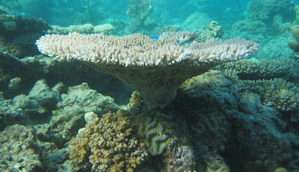
Size and shape may predict the survival of corals around the world when the weather churns the oceans in the years to come, according to a new model that relies on engineering principles.
The increasing violence of storms associated with global climate change, as well as future tsunamis, will have major effects on coral reefs, according to a paper published this week in the international scientific journal Nature. Shape and size of the corals are key variables, according to the authors.
"Coral reef experts have long had a general sense of which coral shapes are more vulnerable during storms than others," said first author Joshua Madin, a scientist with the National Center for Ecological Analysis and Synthesis (NCEAS) at the University of California, Santa Barbara. "However, to really predict how these events impact the dynamics of coral reefs we needed a way to quantify these vulnerabilities."
The authors created the world's first engineering model to predict how much damage a reef is likely to suffer when confronted with the might of an angry sea. They used mathematical models to calculate the forces that coral is subjected to –– events such as waves, storm surges, or tsunamis –– and the probability of the colonies being ripped from the seabed.
Working with co-author Sean Connolly, Madin developed the model at the Centre of Excellence for Coral Reef Studies (CoECRS) at James Cook University, Australia. Connolly is also a senior lecturer at James Cook University.
How coral assemblages respond to the power of the sea is essential for understanding the natural distribution of coral types on present-day reefs as well as for projecting how they will change in response to more violent or frequent storms, according to the researchers.
"Our study offers a solution to this longstanding problem by factoring in the shape of different coral colonies, the strength of the sea-bed to which they attach, and the change in force of the waves as they move across the reef," said Madin. "This enables us to predict the likely changes in composition of the coral in response to present and future storms or tsunamis."
The researchers explained that managers can use this information to better understand how the world's coral reefs might change under a more unpredictable climate.
"The predictive tool we have developed allows managers to assess the vulnerability of their reefs to extreme wave events," said Madin. "The ability to estimate the potential damage on a reef for different disaster scenarios could help managers plan for economic losses as well as promote strategies to help the reef recover."
The researchers used mathematical models borrowed from engineering theory to translate the movement of storm waves into mechanical stresses on the coral in different parts of the reef, incorporating the various shapes of coral colonies, and then calculated whether or not they will be dislodged during extreme weather.
The study introduces a new concept, "colony shape factor," to translate the myriad shapes and sizes of coral colonies onto a simple scale that measures their vulnerability to being dislodged. Any severe event, like a hurricane, imposes a threshold that can be scored on the same scale, allowing scientists to determine which coral will live and which will die.
The scientists found that the most vulnerable corals are "table" corals, which have a broad flat top supported by a narrow stalk, making them more susceptible to strong wave forces than bushy or mounded corals. Vulnerability also depends on whether the coral grows on the front, crest, flat or the back of the reef, where the force of the waves progressively dies away.
The team ran a field test at Lizard Island, in the northern part of the Great Barrier Reef, taking digital photographs of corals, and calculating their vulnerability. They found that the threshold imposed by the previous year's biggest storm predicted the pattern of coral sizes and shapes almost perfectly.
"There were a lot of table corals present that went right up to the threshold from the last big storm, and then suddenly nothing above it," said Connolly. "They even followed the predicted trends from the reef crest to the reef back."
The researchers say that more severe storms, by themselves, would probably not pose a large threat to reefs. "Corals are adapted to life in stormy seas. Even the vulnerable species are quite stable when they're young," said Connolly. "They also tend to grow and mature quickly, so the species can recover before the next big storm arrives."
However, one effect of the increased production of greenhouse gases is an increase in the acidity of the ocean. This is likely to reduce the stability of coral reefs, and amplify the damage done by tropical storms in coming decades. Other effects of global warming could limit the capacity of the reefs to bounce back from periods of high wave forces, according to the researchers. For example, episodes of unusually hot temperatures can cause corals' cells to become toxic, or bleached. Another problem is overfishing, which can deplete the fish that eat dead coral and keep the reef clear for the next generation of corals.
Source: University of California - Santa Barbara


