Daily grind: Fossil molars add to Neanderthal debate
November 22, 2006
Daily grind: Fossil molars add to Neanderthal debate

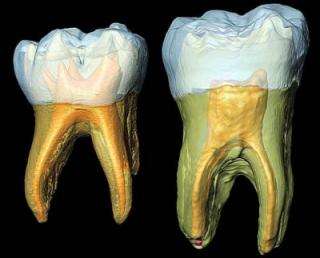
Three-dimensional virtual reconstruction of the deciduous and permanent Neanderthal molars. Both enamel and dentin are rendered in transparency to show the pulp chamber and the root canals. Credit: Luca Bondiolli and Arnaud Mazurier

Palaeontologists have fired a new round in a verbal battle over the Neanderthals, the hominids who were our closest evolutionary cousins before they met a strange and possibly tragic end.

Scientists from the United Kingdom, France and Italy have studied teeth from Neanderthals with X-rays from the European Synchrotron Radiation Facility. They found that the dental development of Neanderthals is very similar to modern humans.

Neanderthals first appeared in Europe approximately 200,000 years ago and became extinct about 25,000 years ago. These predecessors of modern humans have always been considered genetically closer to us than any other members of the genus Homo. It has even been suggested that Neanderthals achieved adulthood faster than modern humans do today.

A research team from the United Kingdom, France and Italy has recently shed new light on this theory by studying this species’ teeth. Teeth express genetic differences found between individuals and different populations more efficiently than any other tissues preserved in the fossil record. Studies with teeth can identify a timescale on the entire period of dental development that occurs from before birth until adulthood.

Scientists used the ESRF X-rays to study the enamel dentine junction of a deciduous and a permanent Neanderthal molar tooth (approximately 130,000 years old) that was found on a site in France. The technique used to image the teeth is high-resolution tomography. The researchers noticed that the samples showed more complex folding of the enamel dentine junction than their modern human counterparts. Some of the unique surface morphologies of Neanderthal molars clearly showed a deep embryological origin and are likely to have been functionally significant.

Thin ground sections of the same Neanderthal molars revealed that the crowns and roots did not grow faster than those of modern humans. The permanent molar tooth studied had completed its root growth at about 8.7 years of age, which is typical of many modern human children today.

Almost all deciduous teeth contained an accentuated birth line, or neonatal line that results from the changing physiology and stress of birth. The Neanderthal deciduous also showed a neonatal line with evidence of the usual perinatal physiological stress but with no signs of additional postnatal stress.

Among anthropoid primates there is a close relationship between brain growth and tooth eruption. Scientists predicted that the first permanent molar eruption in this Neanderthal (6.8 years) fits a dental development schedule similar to those found in modern humans.

The next step in the research is to find out whether Neanderthal teeth from sites dated to more recent times will reveal evidence of the demographic pressures that overcame the Neanderthals as they approached extinction.

Source: European Synchrotron Radiation Facility

4.4 /5 (29 votes)  

Rank 4.4 /5 (29 votes)
Tags

Relevant PhysicsForums posts

More news stories

The power of estrogen -- male snakes attract other males

A new study has shown that boosting the estrogen levels of male garter snakes causes them to secrete the same pheromones that females use to attract suitors, and turned the males into just about the sexiest ...

Biology / Plants & Animals

created 7 hours ago | popularity 5 / 5 (3) | comments 0 | with audio podcast

Experts reveal how plants don't get sunburn

(PhysOrg.com) -- Experts at the University of Glasgow have discovered how plants survive the harmful rays of the sun.

Biology / Cell & Microbiology

created 7 hours ago | popularity 5 / 5 (2) | comments 0 | with audio podcast

Protein libraries in a snap

(PhysOrg.com) -- A Rice University undergraduate will depart with not only a degree but also a possible patent for his invention of an efficient way to create protein libraries, an important component of biomolecular ...

Biology / Cell & Microbiology

created 11 hours ago | popularity 5 / 5 (2) | comments 0 | with audio podcast

Grass to gas: Researchers' genome map speeds biofuel development

Researchers at the University of Georgia have taken a major step in the ongoing effort to find sources of cleaner, renewable energy by mapping the genomes of two originator cells of Miscanthus x giganteus, a large perenn ...

Biology / Biotechnology

created 4 hours ago | popularity 3.7 / 5 (3) | comments 0 | with audio podcast

Miami battling invasion of giant African snails

No one knows how they got there. But an invasion of African giant snails has southern Florida in a panic over potential crop damage, disease and general yuckiness surrounding the slimy gastropods.

Biology / Ecology

created 11 hours ago | popularity not rated yet | comments 2


NASA sees wide-eyed cyclone Jasmine

Cyclone Jasmine's eye has opened wider on NASA satellite imagery, as it moves through the Southern Pacific Ocean.

NASA sees Giovanna reach cyclone strength, threaten Madagascar

Tropical Storm 12S built up steam and became a cyclone on February 10, 2012 as NASA's Terra satellite passed overhead. Residents of east-central Madagascar should prepare for this cyclone to make landfall ...

CIA website offline, Anonymous takes credit

The website of the Central Intelligence Agency was unresponsive on Friday after the hacker group Anonymous claimed to have knocked it offline.

Complex wiring of the nervous system may rely on a just a handful of genes and proteins

Researchers at the Salk Institute have discovered a startling feature of early brain development that helps to explain how complex neuron wiring patterns are programmed using just a handful of critical genes. ...

New error-correcting codes guarantee the fastest possible rate of data transmission

Error-correcting codes are one of the triumphs of the digital age. They’re a way of encoding information so that it can be transmitted across a communication channel — such as an optical fiber o ...

Humans may have helped the decline of African rainforests 3000 years ago

(PhysOrg.com) -- Large areas of rainforests in Central Africa mysteriously disappeared over three thousand years ago, to be replaced by savannas. The prevailing theory has been that the cause was a change ...