Spacewalkers Tee Off on Science, Mechanics
November 23, 2006 Spacewalkers Tee Off on Science, Mechanics

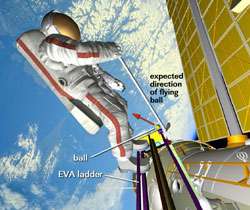
Artist's rendering of the golf task during Expedition 14's spacewalk on Nov. 22, 2006. Credit: NASA

Two International Space Station crew members wrapped up a 5-hour, 38-minute spacewalk from the Pirs docking compartment airlock at 12:55 a.m. EST Thursday. The spacewalk included a golf shot that merited a high-flying birdie rating.

Flight Engineer Mikhail Tyurin was the lead spacewalker, EV1, and Commander Mike Lopez-Alegria was EV2. They wore Russian Orlan spacesuits.

Golf was the first major spacewalk activity. Lopez-Alegria put the tee on the ladder outside Pirs. Tyurin set up a camera and then stepped up and addressed the ball for his one-handed shot. Lopez-Alegria helped secure Tyurin's feet.

The golf was a commercial activity sponsored by a Canadian golf company through a contract with the Russian Federal Space Agency. The ball left the station toward the right side instead of to the rear, a substantial slice.

The ball weighs just 3 grams, a tenth of an ounce or about three times the weight of a dollar bill, compared to 1.62 ounces for a standard golf ball. At that weight it was unlikely to damage any station components if the shot had gone awry. The ball will have a short stay in orbit, perhaps three days.

Inspection of a Kurs antenna on the Progress 23 unpiloted cargo carrier that docked at the aft end of the station's Zvezda Service Module Oct. 26 was the next task. Final latching of the spacecraft to the station was delayed by more than three hours because Mission Control Moscow was not sure the antenna was completely retracted.

Tyurin and Lopez-Alegria moved to the rear of Zvezda and photographed the antenna. It was still fully extended, so Tyurin used a screwdriver to release a latch and tried to retract the antenna. Russian flight controllers also tried to retract it by activating a drive. Neither succeeded, and the task was abandoned.

Next they relocated a WAL antenna, which will guide the unpiloted European cargo carrier to docking with the station. That vehicle, the Automated Transfer Vehicle, is scheduled to make its first flight next year. In its previous position the antenna interfered with a cover for a Zvezda booster engine.

Then the two installed a BTN neutron experiment, which characterizes charged and neutral particles in low Earth orbit. Atop Zvezda, its readings during solar bursts should be of special interest to scientists.

Two thermal covers from the BTN were jettisoned before the spacewalkers returned to the Pirs airlock.

A final scheduled task, an inspection of bolts on one of two Strela hand-operated cranes on the docking compartment, was postponed.

The scheduled 6 p.m. EST start of the spacewalk was delayed because of a cooling issue in Tyurin's suit. Tyurin got out of the suit and straightened a suspect hose which apparently had become kinked. A balky hatch further delayed start of the spacewalk.

This was the first spacewalk during Expedition 14, the sixth for Lopez-Alegria and the fourth for Tyurin.

Source: NASA


print this article email this article download pdf blog this article bookmark this article     Stumble it Digg this share on Facebook retweet share on Reddit add to delicious
Rate this story - 3.5 /5 (6 votes)


November 23, 2006 all stories

Comments: 0

3.5 /5 (6 votes)
  • Stumble this up

  • Digg this

  • share this

  • hide
  • Related Stories

  • Fore! ISS crew to shag a golf ball
    created Nov 17, 2006 | popularity not rated yet | comments 0
  • Astronauts get extra work done in 1st spacewalk (Update)
    created Nov 19, 2009 | popularity not rated yet | comments 0
  • Astronauts take mission's 3rd and final spacewalk
    created Sep 06, 2009 | popularity not rated yet | comments 0
  • Spacewalk No. 2 unfolds on 40th moon anniversary
    created Jul 20, 2009 | popularity not rated yet | comments 0
  • Astronauts deal with flooded toilet in orbit
    created Jul 19, 2009 | popularity not rated yet | comments 0


  • hide
  • Relevant PhysicsForums posts

  • Question about 2-body gravity
    created Nov 24, 2009
  • life on Mars
    created Nov 24, 2009
  • Semi-major axis from cartesian co-ordinates
    created Nov 23, 2009
  • Primary Mirror grinding
    created Nov 23, 2009
  • More from Physics Forums - General Astronomy

Other News

Monster Waves on the Sun are Real

Monster Waves on the Sun are Real (w/ Video)

Space & Earth / Astronomy

created 7 hours ago | popularity 5 / 5 (8) | comments 1

Sometimes you really can believe your eyes. That's what NASA's STEREO (Solar Terrestrial Relations Observatory) spacecraft are telling researchers about a controversial phenomenon on the sun known as the "solar ...


Cosmic 'dig' reveals vestiges of the Milky Way's building blocks

Cosmic 'Dig' Reveals Vestiges of the Milky Way's Building Blocks

Space & Earth / Astronomy

created 12 hours ago | popularity 4.9 / 5 (13) | comments 1

(PhysOrg.com) -- Peering through the thick dust clouds of our galaxy's "bulge" (the myriads of stars surrounding its center), a team of astronomers has unveiled an unusual mix of stars in the stellar grouping ...


No Wheel Stall in Diagnostic Drive

Spirit Mars Rover: No Wheel Stall in Diagnostic Drive

Space & Earth / Space Exploration

created 7 hours ago | popularity 4.5 / 5 (2) | comments 0

(PhysOrg.com) -- On Sol 2095 (Tuesday, Nov. 24), Spirit performed a set of diagnostic actions related to a stall of the right-rear wheel on the previous drive, three days earlier.


Climate experts debate strategies for reducing atmospheric carbon and future warming

Climate experts debate strategies for reducing atmospheric carbon and future warming

Space & Earth / Environment

created 8 hours ago | popularity 2.8 / 5 (6) | comments 7

(PhysOrg.com) -- Reducing carbon dioxide to safe levels may require extracting carbon from the air, says Cornell climate researcher.


Oceanic crust formation is dynamic after all

Oceanic crust formation is dynamic after all

Space & Earth / Earth Sciences

created 11 hours ago | popularity 4.6 / 5 (5) | comments 0

Imagine the Earth's crust as the planet's skin: Some areas are old and wrinkled while others have a fresher, more youthful sheen, as if they had been regularly lathered with lotion.