Mesmerized by Moondust
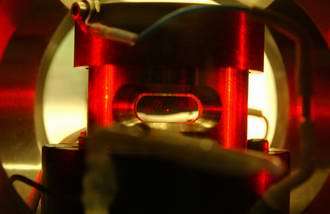
Each morning, Mian Abbas enters his laboratory and sits down to examine--a single mote of dust. Zen-like, he studies the same speck suspended inside a basketball-sized vacuum chamber for as long as 10 to 12 days.
Image: A single grain of moondust hangs suspended in Abba's vacuum chamber.
The microscopic object of his rapt attention is not just any old dust particle. It's moondust. One by one, Abbas is measuring properties of individual dust grains returned by Apollo 17 astronauts in 1972 and the Russian Luna-24 sample-return spacecraft that landed on the Moon in 1976.
"Experiments on single grains are helping us understand some of the strange and complex properties of moondust," says Abbas. This knowledge is important. According to NASA's Vision for Space Exploration, astronauts will be back on the moon by 2018--and they'll have to deal with lots of moondust.
The dozen Apollo astronauts who walked on the moon between 1969 and 1972 were all surprised by how "sticky" moondust was. Dust got on everything, fouling tools and spacesuits. Equipment blackened by dust absorbed sunlight and tended to overheat. It was a real problem.
Many researchers believe that moondust has a severe case of static cling: it's electrically charged. In the lunar daytime, intense ultraviolet (UV) light from the sun knocks electrons out of the powdery grit. Dust grains on the moon's daylit surface thus become positively charged.
Eventually, the repulsive charges become so strong that grains are launched off the surface "like cannonballs," says Abbas, arcing kilometers above the moon until gravity makes them fall back again to the ground. The moon may have a virtual atmosphere of this flying dust, sticking to astronauts from above and below.
Or so the theory goes.
But do grains of lunar dust truly become positively charged when illuminated by ultraviolet light? If so, which grains are most affected--big grains or little grains? And what does moondust do when it's charged?
These are questions Abbas is investigating in his "Dusty Plasma Laboratory" at the National Space Science and Technology Center in Huntsville, Alabama. Along with colleagues Paul Craven and doctoral student Dragana Tankosic, Abbas injects a single grain of lunar dust into a chamber and "catches" it using electric force fields. (The injector gives the grain a slight charge, allowing it to be handled by electric fields.) With the grain held suspended literally in mid-air, they "pump the chamber down to 10-5 torr to simulate lunar vacuum."
Next comes the mesmerizing part: Abbas shines a UV laser on the grain. As expected, the dust gets "charged up" and it starts to move. By adjusting the chamber's electric fields with painstaking care, Abbas can keep the grain centered; he can measure its changing charge and explore its fascinating characteristics.
Like the Apollo astronauts, Abbas has already discovered some surprises--even though his experiment is not yet half done.
"We've found two things," says Abbas. "First, ultraviolet light charges moondust 10 times more than theory predicts. Second, bigger grains (1 to 2 micrometers across) charge up more than smaller grains (0.5 micrometer), just the opposite of what theory predicts."
Clearly, there's much to learn. For instance, what happens at night, when the sun sets and the UV light goes away?
That's the second half of Abbas's experiment, which he hopes to run in early 2006. Instead of shining a UV laser onto an individual lunar particle, he plans to bombard dust with a beam of electrons from an electron gun. Why electrons? Theory predicts that lunar dust may acquire negative charge at night, because it is bombarded by free electrons in the solar wind--that is, particles streaming from the sun that curve around behind the moon and hit the night-dark soil.
When Apollo astronauts visited the Moon 30+ years ago, they landed in daylight and departed before sunset. They never stayed the night, so what happened to moondust after dark didn't matter. This will change: The next generation of explorers will remain much longer than Apollo astronauts did, eventually setting up a permanant outpost. They'll need to know, how does moondust behave around the clock?
Stay tuned for answers from the Dusty Plasma Lab.
Source: Science@NASA (by Trudy E. Bell & Dr. Tony Phillips)


