Focus on Photosynthesis
Coal, oil or natural gas: all fossil fuels contain the energy of sunlight, stored with the aid of photosynthesis in energy-rich chemical compounds. A researcher at the Max Planck Institute for Bioinorganic Chemistry in Mülheim on the Ruhr working with colleagues from the Technical University in Berlin, the Free University in Berlin and the Lawrence Berkeley National Laboratory has shed light on an important detail in this process.
The scientists have determined the structure of the complex in photosystem II, in which water is split with the energy of sunlight. This creates, in addition to molecular oxygen, protons and electrons which in principle can be combined to create hydrogen. If it were possible to copy this process, an inexhaustible source of carbon dioxide-free energy would become available (Science, November 3, 2006).
Artificial photosynthesis could provide the energy source of the future - hydrogen. To accomplish this, however, researchers must fully understand how plants and photosynthetic microorganisms split water with the energy of sunlight - only then would they be able to copy the process one day. Together with his colleagues, Dr. Johannes Messinger has now determined the precise structure of the part of the cluster containing manganese in which water is split into its component parts. Up to now it has been technically impossible to efficiently recreate this crucial step.
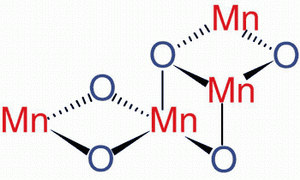
There are four manganese, one calcium and at least five oxygen atoms linked together in the complete cluster. "The secret is in their geometric arrangement. We discussed at least 18 models for the arrangement of just the manganese and oxygen atoms," said Johannes Messinger, senior research scientist at the Max Planck Institute in Mülheim. With their experimental and theoretical work, the scientists have put an end for now to speculation about the correct geometrical arrangement. According to their findings, the cluster is constructed of three linked rhombi. Two of the manganese and oxygen atom rhombi share an edge, so that both one manganese and one oxygen atom have three bond partners. Another manganese atom is even surrounded by four bridging oxygen atoms as the third rhombus is attached to it. "We have also calculated the distances between the individual manganese atoms," said Johannes Messinger. Previously, scientists knew that the manganese atoms were not all separated by the same distance. The international team of researchers has now found out which manganese atoms are closer and which are further apart.
Messinger and his colleagues have derived these findings from experiments (particularly those with EXAFS measurements) and from theoretical considerations. They used a computer to compare all the theoretically possible atom arrangements with the results of the experiments and were successful. "In the end there was only one arrangement for the four manganese atoms with the bridging oxygen atoms," said Messinger. "This takes us a crucial step further." There remain only two details to be cleared up: the new findings allow for three possibilities for the orientation of the cluster in the protein of photo system II, which gives four possible positions for the calcium.
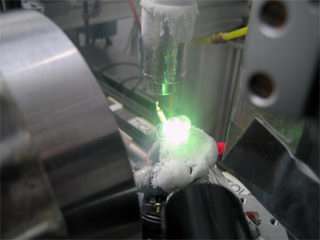
The scientists in the international group developed the EXAFS (Extended X-ray Absorption Fine Structure) measurement system further for their investigations. This determines exactly the types of atoms and the distance between them and provided them with an insight that is denied crystallographers. In the past, when crystallographers tried to reveal the blueprint for the manganese cluster using X-ray structure analysis, the necessarily high doses of radiation destroyed the structure of the cluster [Yano et.al. Proceedings of the National Academy of Sciences of the USA, 102 (2005) 12047-12052]. To protect the cluster from a similar fate, the scientists used the low radiation doses of the EXAFS method and replaced the crystal repeatedly after short periods of measuring in the synchrotron beam.
"We now have a structural basis with which to understand the different stages of reactions in the process that uses sunlight to split water," says Messinger. "This is an important step towards developing artificial catalysts for regenerative hydrogen production."
Citation: Junko Yano, Jan Kern, Kenneth Sauer, Matthew J. Latimer, Yulia Pushkar, Jacek Biesiadka, Bernhard Loll, Wolfram Saenger, Johannes Messinger, Athina Zouni, Vittal K. Yachandra, Where Water is Oxidized to Dioxygen: Structure of the Photosynthetic Mn4Ca Cluster, Science, 3. November 2006
Source: Max Planck Institute for Bioinorganic Chemistry


