Evolution of typhoid bacteria
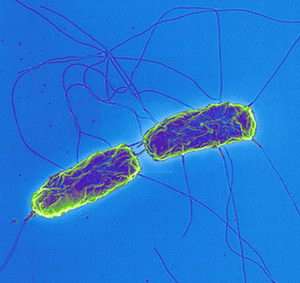
In a study published in the latest issue of Science (24 November, 2006), an international consortium from the Max-Planck Society, Wellcome Trust Institutes in Britain and Vietnam, and the Institut Pasteur in France have elucidated the evolutionary history of Salmonella Typhi. Typhi is the cause of typhoid fever, a disease that sickens 21 million people and kills 200,000 worldwide every year. The results indicate that asymptomatic carriers played an essential role in the evolution and global transmission of Typhi.
The rediscovered importance of the carrier state predicts that treatment of acute disease, including vaccination, will not suffice to eradicate this malady. The results also illuminate patterns leading to antibiotic resistance after the indiscriminate use of antibiotics. Fluoroquinolone treatment in southern Asia over two decades has resulted in the emergence of multiple, independent nalidixic acid-resistant mutants, of which one group, H58, has multiplied dramatically and spread globally. The prevalence of these bacteria hampers medical cure of clinical disease via antibiotics.
Typhoid fever remains a major health problem in the developing world and continues to cause disease in Europe and on the american continent. The evolutionary history and population structure of Typhi were poorly understood, partly because these bacteria show little genetic diversity. Now a team led by Mark Achtman and Philippe Roumagnac from the Max Planck Institute for Infection Biology, Berlin, has applied population genetic experience from prior work with Yersinia pestis, Escherichia coli, Helicobacter pylori and Neisseria meningitidis to provide novel insights into the evolution of this pathogen.
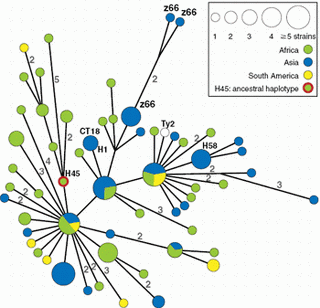
The team combined its resources to assemble for the first time a globally representative collection of 105 strains of Typhi and investigated the sequence diversity within 90,000 base pairs per strain. Eighty-eight informative sequence differences were detected, showing that the population structure has evolved over the last 10,000 to 43,000 years. Amazingly, the ancestral strain continues to exist today, as do many of its direct descendents, indicating a neutral population structure, whereas normally selective forces lead to extinction of intermediate genotypes. Furthermore, these bacteria are distributed globally, demonstrating that Typhi has spread inter-continentally on multiple occasions.
The authors propose that the unusual population structure of Typhi reflects long-term carriage by asymptomatic carriers, who reached public notoriety at the beginning of the 20th century with "Mr. N the milker" in England and Typhoid Mary (Mary Mallon) in the U.S.A. These individuals infected 100s of people over the decades while they worked in the food production industry. Healthy carriers may have allowed Typhi to survive in hunter-gatherer populations prior to the Neolithic expansion of city states and facilitated its intercontinental spread. Healthy carriers are also consistent with the observation that individual genotypes of Typhi persist for many decades within each country.
Increasing resistance to antibiotics in recent decades has hampered efforts of clinicians to cure typhoid fever. The indiscriminate use of fluoroquinolones, which is a cost-effective, standard treatment for typhoid fever, has been accompanied by a frightening increase in the numbers of resistant Typhi. Investigations of a large strain collection from southern Asia revealed that many different genotypes independently acquired resistance to nalidixic acid, a quinolone. One of these genotypes, H58, has become predominant throughout southern Asia and has even spread to Africa. In Vietnam, up to 95% of Typhi are now resistant to nalidixic acid and many other antibiotics. Although these cases can still be treated with newer antibiotics, those antibiotics are much more expensive than standard fluoroquinolones, which raises the cost of medical treatment. Furthermore, it is likely that Typhi will develop resistance to these antibiotics as well.
The combination of these investigations raises problems for public health measures. Indiscriminate antibiotic usage results in real-time evolution of bacteria that resist treatment. Furthermore, the healthy carrier state provides a safe reservoir for these bacteria which allows them to evade short-term antibiotic treatment and vaccination, indicating that typhoid fever will remain a major health problem for the foreseeable future.
The research was carried out collaboratively by the Max Planck Institute for Infection Biology in Berlin, the Wellcome Trust Sanger Institute, Hinxton Hall, the Institut Pasteur, Paris, and the Oxford University Clinical Research Unit, Ho Chi Minh City, with assistance from hospitals in Ho Chi Minh City and Hanoi and the International Vaccine Institute in Seoul. Financial support was by the Wellcome Trust, UK.
Citation: Philippe Roumagnac, François-Xavier Weill, Christiane Dolecek, Stephen Baker, Sylvain Brisse, Nguyen Tran Chinh, Thi Anh Hong Le, Camilo J. Acosta, Jeremy Farrar, Gordon Dougan & Mark Achtman, Evolutionary history of Salmonella Typhi, Science, November 24 2006.
Source: Max Planck Institute for Infection Biology


