Researchers make world's smallest piano wire
November 25th, 2006 Researchers make world's smallest piano wire

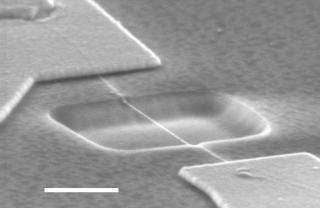
SEM image of a suspended nanotube. Credit: TU Delft

Researchers from Delft University of Technology and FOM Foundation (Netherlands) have successfully made and 'tuned' the world's smallest piano wire. The wires are made of carbon nanotubes that measure approximately 2 nanometers in diameter. The researchers have published an article on the subject this week in the scientific journal Nano Letters.

The researchers at the Kavli Institute of Nanoscience Delft and the FOM Foundation made the small wires from carbon nanotubes, measuring approximately 1 micrometer long and approximately 2 nanometres in diameter. The tubes were attached to electrodes and initially placed above a layer of silicon oxide. This layer of silicon oxide was then partially etched away with acid, which caused the tubes to detach and hang.

A layer of silicon is contained beneath the silicon oxide. A strong and frequently variable alternating current is applied to this layer, which causes the hanging nanotubes to vibrate. The suspended tube is alternately attracted and repelled. The largest measured deviation for one tube was 8 nanometres. The distance of the nanotubes to the layer of silicon influences the electrical capacity to the layer of silicon. The movement of the nanowires is derived from these changes in capacity.

When the frequency of the applied current approaches the level of the suspended tube's eigenfrequency, it begins to vibrate more powerfully. The order of magnitude of these frequencies amounts to a few tens of MHz. By varying the strength and frequency of the applied current, the research group led by Professor Herre van der Zant succeeded in transposing the wire from a freely suspended state, to a state in which it is taut and vibrates. Van der Zant: "And as such it is like tightening a piano wire or guitar string. You can, as it were, tune the wire."

The Delft researchers have developed a model that can satisfactorily predict the vibrations of the nanotubes. The vibrating nanotubes are not only interesting from a scientific standpoint; in future they can also be used for other specific applications. Van der Zant identifies one possibility as a hypersensitive mass sensor. "The nanotubes are extremely lightweight. If you suspend something from the tube that is also extremely lightweight, like a virus, then the change in mass is rendered by a different vibration pattern. From this, you can determine the size of the extra mass and deduce if it involves the virus concerned." The vibrating tubes may also be of interest for GSM-related applications (which now use resonators that vibrate in the GHz-field.)

Citation: http://dx.doi.org/10.1021/nl062206p
Bending-Mode Vibration of a Suspended Nanotube Resonator - Benoit Witkamp, Menno Poot, and Herre S. J. van der Zant. Nano Lett.; 2006; ASAP Web Release Date: 22-Nov-2006.

Source: TU Delft


print this article email this article download pdf blog this article bookmark this article     Digg this Stumble it share on Facebook share on Reddit add to delicious save to Yahoo! bookmarks
3.9/5 after 46 votes


November 25th, 2006 all stories
Nanotechnology / Nanophysics

Comments: 0
Rank: 3.9/5 after 46 votes

  • Stumble this up

  • Digg this

  • Share it:
  • share on Facebook
  • share on MySpace
  • share on Slashdot
  • rss-newsfeed
  • share on Google
  • share on Reddit
  • add to delicious
  • save to Yahoo! bookmarks
  • share on Windows Live
  • Add to Mixx!
Rating: 3.9/5 after 46 votes

  • Related Stories

  • Scientists report significant advances in flexible electronics research
    created Jun 18, 2009 | popularity not rated yet | comments 0
  • New radiation therapy promises relief for overheating laptops
    created Apr 13, 2009 | popularity not rated yet | comments 0
  • Graphene could lead to faster chips
    created Mar 19, 2009 | popularity not rated yet | comments 0
  • Researchers create atomic-sized one-stop shop for nanoelectronics (Video)
    created Feb 19, 2009 | popularity not rated yet | comments 0
  • Carbon-Nanotube Memory that Really Competes
    created Jan 26, 2009 | popularity not rated yet | comments 0

Tags


  • Physicists Demonstrate Quantum Memory with Matter Qubits
    Physicists Demonstrate Quantum Memory with Matter Qubits
    Physics / General Physics
    created 19 hours ago | popularity 4.5 / 5 (11) | comments 1
  • 'Holey' Nanosheets for Wastewater Dye Removal
    Nanotechnology / Nanomaterials
    created Jul 01, 2009 | popularity 5 / 5 (5) | comments 1
  • Jellyfish Robot Swims Like its Biological Counterpart
    Jellyfish Robot Swims Like its Biological Counterpart
    Electronics / Robotics
    created Jun 26, 2009 | popularity 4.4 / 5 (7) | comments 1
  • Could Maxwell's Demon Exist in Nanoscale Systems?
    Could Maxwell's Demon Exist in Nanoscale Systems?
    Physics / General Physics
    created Jun 24, 2009 | popularity 4.4 / 5 (18) | comments 29
  • Living Safely with Robots, Beyond Asimov's Laws
    Living Safely with Robots, Beyond Asimov's Laws
    Electronics / Robotics
    created Jun 22, 2009 | popularity 4.6 / 5 (51) | comments 39
  • Other News

    Harnessing Nanoparticles To Track Cancer Cell Changes

    Nanotechnology / Bio & Medicine

    created 18 hours ago | popularity not rated yet | comments 0

    The more dots there are, the more accurate a picture you get when you connect them. Cancer researchers adopting that philosophy have developed a new imaging technology that could give scientists the ability to simultaneously ...


    A 'quantum of sol' -- how nanotechnology could hold the key to a solar-powered future

    A 'quantum of sol' -- how nanotechnology could hold the key to a solar-powered future

    Nanotechnology / Nanomaterials

    created Jun 30, 2009 | popularity 3.5 / 5 (11) | comments 16

    (PhysOrg.com) -- A new generation of 'nano-structured' millimetre-sized solar cells that could convert the sun's energy to electricity more than twice as efficiently as current technology, is the subject of ...


    Australian researchers are set to begin human trials of a tiny nano-cell that acts as a "Trojan horse" against cancer

    Hi-tech 'Trojan horse' can kill cancer cells: researchers

    Nanotechnology / Bio & Medicine

    created Jun 29, 2009 | popularity 4.6 / 5 (11) | comments 7

    Australian researchers are set to begin human trials of a tiny nano-cell that acts as a "Trojan horse" against cancer cells, a breakthrough they say may curb the need for debilitating chemotherapy.


    'Holey' Nanosheets for Wastewater Dye Removal

    Nanotechnology / Nanomaterials

    created Jul 01, 2009 | popularity 5 / 5 (5) | comments 1

    (PhysOrg.com) -- Researchers have discovered that extremely thin sheets of nickel oxide with hexagonally shaped holes can absorb hazardous dyes from wastewater nearly as well as the best traditional methods, but are recyclable. ...


    Implant bacteria, beware: Researchers create nano-sized assassins

    Implant bacteria, beware: Researchers create nano-sized assassins

    Nanotechnology / Bio & Medicine

    created Jun 26, 2009 | popularity 4.9 / 5 (7) | comments 0

    Staphylococcus epidermidis is quite an opportunist. Commonly found on human skin, the bacteria pose little danger. But S. epidermidis is a leading cause of infections in hospitals. From catheters to prosthetic ...