Integral catches a new erupting black hole
November 27, 2006 Integral catches a new erupting black hole

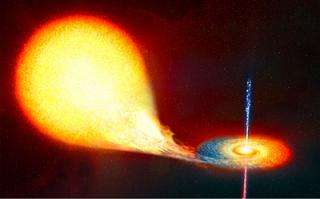
Artist's representation of an X-ray nova. The compact object on the right - a neutron star or a black hole – ‘swallows’ gas from a companion star. The gas swirls in a disk around the compact object at very high velocity (close to the speed of light) and emits X-rays. Credits: ESA

ESA's gamma-ray observatory, Integral, has spotted a rare kind of gamma-ray outburst. The vast explosion of energy allowed astronomers to pinpoint a possible black hole in our galaxy.

The outburst was discovered on 17 September 2006 by staff at the Integral Science Data Centre (ISDC), Versoix, Switzerland. Inside the ISDC, astronomers constantly monitor the data coming down from Integral because they know the sky at gamma-ray wavelengths can be a swiftly changing place.

"The galactic centre is one of the most exciting regions for gamma ray astronomy because there are so many potential gamma-ray sources," says Roland Walter, an astronomer at the ISDC, and lead author of these results.

To reflect the importance of this region, Integral is now running a Key Programme, in which almost four weeks of its observing time is given over to the study of the galactic centre. This is allowing astronomers to understand the gamma-ray characteristics of the galactic centre and its celestial objects, better than ever before.
Integral catches a new erupting black hole

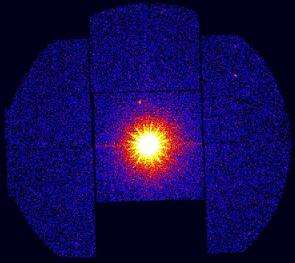
This X-ray image was obtained by ESA's XMM-Newton satellite during the night of 22-23 September 2006, and shows the intense X-ray emission of the X-ray nova IGR J17497-2821. The X-ray nova was first spotted by ESA’s Integral gamma-ray observatory. Credits: ESA/EPIC/ISDC

It was during one of the first of these observations that astronomers saw the outburst take place. An unexpected event of this kind is known as a 'target of opportunity'. At first they did not know what kind of eruption they had detected. Some gamma ray outbursts last for only a short period of time and so they immediately alerted other observatories around the world of the outburst’s position, allowing them to target the explosion, too. Fortunately, Integral has the capability to pinpoint the position of such a very bright event incredibly accurately.

In this case, the outburst continued to rise in brightness for a few days before beginning a gradual decline that lasted for weeks. The way the brightness of an outburst rises and falls is known to astronomers as a light curve. "It was only after a week that we could see the shape of the light curve and realised what a rare event we had observed," says Walter.

Comparing the shape of the light curve to others on file revealed that this was an eruption thought to come from a binary star system in which one component is a star like our Sun whereas the other is a black hole.

In these systems, the gravity of the black hole is ripping the Sun-like star to pieces. As the doomed star orbits the black hole, it lays down its gas in a disc, know as an accretion disc, surrounding the black hole.

Occasionally, this accretion disc becomes unstable and collapses onto the black hole, causing the kind of outburst that Integral witnessed. Astronomers are still not sure why the accretion disc should collapse like this but one thing is certain: when it does collapse, it releases thousands of times the energy than at other times.

Because such active star–black hole binaries are thought to be rare in the Galaxy, astronomers expect Integral to see such an outbursts only once every few years. That makes each and every one a precious resource for astronomers to study.

Thanks to the quick reactions of the astronomers at ISDC, observations were taken with satellites and observatories all around the world. ESA's XMM-Newton X-ray observatory, NASA's Chandra and Swift space telescopes, numerous ground-based telescopes captured the elusive radiation from this cataclysmic event. Now astronomers are hard at work, understanding what it all means.

Source: European Space Agency


print this article email this article download pdf blog this article bookmark this article     Stumble it Digg this share on Facebook retweet share on Reddit add to delicious
Rate this story - 4.7 /5 (34 votes)


November 27, 2006 all stories

Comments: 0

4.7 /5 (34 votes)
  • Stumble this up

  • Digg this

  • share this

  • hide
  • Related Stories

  • Dissecting a stellar explosion
    created Apr 03, 2009 | popularity not rated yet | comments 0
  • Faint gamma-ray bursts do actually exist
    created Oct 13, 2008 | popularity not rated yet | comments 0
  • Integral discovers the galaxy’s antimatter cloud is lopsided
    created Jan 09, 2008 | popularity not rated yet | comments 0
  • LIGO Sheds Light on Cosmic Event
    created Dec 21, 2007 | popularity not rated yet | comments 0
  • Science with Integral -- 5 years on
    created Oct 17, 2007 | popularity not rated yet | comments 0


  • hide
  • Relevant PhysicsForums posts

  • Semi-major axis from cartesian co-ordinates
    created 7 hours ago
  • Primary Mirror grinding
    created 10 hours ago
  • dark energy can escape black holes.
    created 19 hours ago
  • Are there green, purple and pink stars?
    created Nov 22, 2009
  • Sideral question
    created Nov 21, 2009
  • Doppler shifted blackbody spectrum
    created Nov 21, 2009
  • More from Physics Forums - General Astronomy

Other News

New computer-developed map shows more extensive valley network on Mars

New computer-developed map shows more extensive valley network on Mars

Space & Earth / Space Exploration

created 9 hours ago | popularity 4.4 / 5 (5) | comments 0

New research adds to the growing body of evidence suggesting the Red Planet once had an ocean.


Supervolcano eruption -- in Sumatra -- deforested India 73,000 years ago

Supervolcano eruption -- in Sumatra -- deforested India 73,000 years ago

Space & Earth / Earth Sciences

created 11 hours ago | popularity 4.3 / 5 (8) | comments 1

A new study provides "incontrovertible evidence" that the volcanic super-eruption of Toba on the island of Sumatra about 73,000 years ago deforested much of central India, some 3,000 miles from the epicenter, ...


Spitzer Telescope Observes Baby Brown Dwarf

Spitzer Telescope Observes Baby Brown Dwarf

Space & Earth / Astronomy

created 8 hours ago | popularity 4.9 / 5 (7) | comments 0

(PhysOrg.com) -- NASA's Spitzer Space Telescope has contributed to the discovery of the youngest brown dwarf ever observed -- a finding that, if confirmed, may solve an astronomical mystery about how these ...


Is global warming unstoppable?

Space & Earth / Environment

created 20 hours ago | popularity 3.8 / 5 (24) | comments 23

In a provocative new study, a University of Utah scientist argues that rising carbon dioxide emissions - the major cause of global warming - cannot be stabilized unless the world's economy collapses or society builds the ...


Scientist: Leak of climate e-mails appalling

Space & Earth / Environment

created 14 hours ago | popularity 3.3 / 5 (8) | comments 8

(AP) -- A leading climate change scientist whose private e-mails are included in thousands of documents that were stolen by hackers and posted online said Sunday the leaks may have been aimed at undermining next month's ...