First results describing the nature of dark energy (Update)
The genius of Albert Einstein, who added a "cosmological constant" to his equation for the expansion of the universe but later retracted it, may be vindicated by new research. The enigmatic dark energy that drives the accelerating expansion of the universe behaves just like Einstein's famed cosmological constant, according to the Supernova Legacy Survey. Their observations reveal that the dark energy behaves like Einstein's cosmological constant to a precision of 10 per cent.
The SuperNova Legacy Survey collaboration started the largest survey yet launched to measure the distance to far supernovae. Distant supernovae are powerful tools to measure cosmological distances. The first results of the survey, to be published in Astronomy & Astrophysics, place strong constraints on cosmological models. In the near future, this new Legacy Survey will possibly help us understand the nature of dark energy.
The SuperNova Legacy Survey is an international collaboration involving about 40 researchers, that aims to discover several hundred far supernovae and mesure their distance. The team's first results will be published in a coming issue of Astronomy & Astrophysics.
The SuperNova Legacy Survey is the largest observational project of its kind. It started in 2003 and will last for five years. So far, the team has measured the distance to 71 supernovae that exploded between 2 and 8 billion years ago. Many of the largest telescopes worldwide are involved in this project; the imaging part of the programme is carried out at the Canada-France-Hawaii Telescope (CFHT), in the framework of the CFHT Legacy Survey. Spectroscopic observations are obtained at the ESO/Very Large Telescope , the Gemini and Keck observatories.
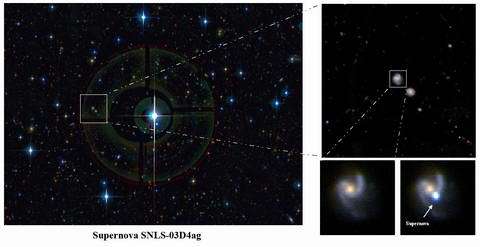
This supernova is as bright as 100 billion Sun-like stars. It exploded 3 billion years ago. At the maximum of its brightness, it was 25 000 times less bright than the blue star seen in the middle of the image. This central blue star is 100 times less bright than the faintest star visible with the naked eye. Copyright CFHTLS/SNLS/Terapix
Measuring the distance to faraway supernovae is a key tool for cosmologists. Supernovae are exploding stars, known to have similar brightnesses whatever their location in other galaxies. Observing these exploding stars can thus make it possible to measure their distances: they are known as “standard candles” for measuring long distances in the Universe.
Measurement of these distances revealed a startling phenomenon; in the late 1990s, astronomers found that the expansion of the Universe is accelerating. This expansion was first discovered in 1929 by American astronomer Edwin Hubble. The expansion of the Universe was thought to be slowing down because of the gravitational attraction of matter. Astronomers were thus very surprised to discover this was not the case at all. Theorists then attempted to explain the acceleration of expansion through various cosmological models. These models all involved the so-called “dark energy” concept, which is a kind of repulsive force against gravitational attraction. Nobody knows what dark energy is, but we can make an attempt to understand how it behaves.
In recent years, cosmological observations have supported that the Universe is made of about 25 % of matter and 75 % of dark energy. Unlike matter, which dilutes with expansion, dark energy appears to stay roughly constant. The new results, to be published by the SuperNova Legacy Survey team, put strong constraints on the absence of dilution of dark energy. Such a kind of dark energy was already foreseen by Einstein himself when he introduced the famous “cosmological constant” into his General Relativity equations. Such a constant was needed for the equations to be consistent with a static universe, as it was believed to be at that time. When the Universe was discovered to be expanding, it seemed that the cosmological constant was no longer needed in the equations.
Later, Einstein refered to it as his “greatest blunder”. The discovery of the accelerating Universe expansion suggested the need for a cosmological constant that might, among other models, explain the acceleration of the expansion. The first results of the Legacy Survey indeed show that the existence of a cosmological constant is the best way to fit their observations. Once completed, by the end of 2008, their Survey will bring even more restrictive constraints to these cosmological models. It will help us better understand the physical nature of this cosmological constant: 80 years later, “Einstein’s greatest blunder” is perhaps less of a blunder after all.
Source: Journal Astronomy and Astrophysics, University of Toronto


