Brilliant growth without gold
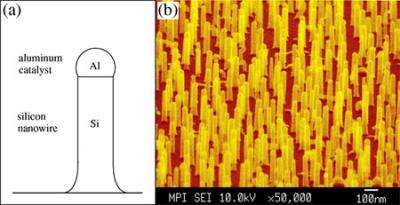
Silicon nanowires can help to further reduce the size of microchips. Scientists at the Max Planck Institute for Microstructure Physics in Halle have for the first time developed single crystal silicon nanowires that fulfil the key criteria to this end. The researchers used aluminium as a catalyst to grow the nanowires. To date, scientists have usually deployed gold for this purpose. However, even traces of the precious metal have a drastically detrimental effect on the function of semiconductor components.
This is not the case with other metals, which catalyse the process, but only at temperatures that would not enable economically viable processes. On the other hand, aluminium is an effective catalyst even at relatively low temperatures and does not impair the quality of electronic components (Nature Nanotechnology, online: November 26, 2006).
In its never-ending quest to develop more efficient and more powerful microchips, the semiconductor industry is constantly advancing the miniaturization of circuits. Currently, the transistors lie on the surface of the substrate. Vertical silicon nanowires would reduce the space requirement considerably.
Researchers at the Max Planck Institute for Microstructure Physics have now grown silicon nanowires on aluminium particles for the first time. Such nanowires are suitable for applications in the micro-chip industry, unlike nanowires which form on gold, the material that has mostly been used as a catalyst material up to now. Gold reduces the quality of microelectronic components drastically, and must not even come close to the production machines.
Aluminium on the other hand does not have a detrimental effect on chip properties and it is already in use in the semi-conductor industry. Furthermore, it causes silicon nanowires of particularly high quality to "sprout" at relatively low temperatures, around 450 °C, which is a precondition in keeping the lid on process costs. "The new process fulfils the most important criteria for the production of silicon nanowires on an industrial scale," says Dr. Stephan Senz, one of the scientists involved.
In order to break aluminium down into such small particles that fine wires are formed, the researchers heat a thin film on a silicon substrate. The film tears into tiny pieces. Subsequently, the scientists carry out a familiar procedure: they direct silane, a gas containing silicon, onto the surface, where it is converted to elementary silicon on the catalyst particle. The silicon dissolves in the aluminium particle. When the particle cannot absorb any more silicon, it crystallises out again on the underside. This causes a single crystal silicon nanowire, diameter approximately 40 nanometers, to grow, bearing a catalyst particle on its tip.
This promising research on semiconductor nanowires straddles the interface between basic research and technical applications. "Apart from the possibility of using them in the semiconductor industry, the nanowires are very interesting for basic research, as little is as yet known about their properties and their growth," explains Senz. "If the dimensions were just a little smaller, we would even see quantum effects."
Source: Max Planck Institute for Microstructure Physics


