Magnetic needles turn somersaults
November 28, 2006 Magnetic needles turn somersaults

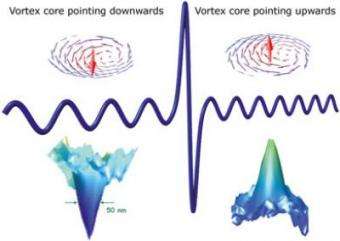
Figure 1: Dynamical reversal of the vortex core: The upper section shows the "magnetic needles" of the vortex core, pointing down on the left and up on the right. The lower section shows these two magnetization directions of the vortex core in two images, taken with a magnetic scanning X-ray microscope at the Advanced Light Source in Berkeley, Calif. In the center is the bipolar magnetic field pulse (250 MHz, 1.5 milli-Tesla at the peak) which causes the vortex core to reverse. Credit: Max Planck Institute of Metals Research in Stuttgart

For about ten years now, tiny magnetic structures measuring a few millionths of a millimetre have met with growing interest from the worlds of science and technology, particularly on account of their potential applications in magnetic storage. A fascinating quantum mechanical phenomenon occurs in these structures: the vortex core, which has been predicted in theory for forty years, but which experiments revealed only four years ago.

In small magnetic plates, the magnetised areas often come together to form level closed magnetic circuits - these are the vortices. Imagine walking with an atom-sized compass in a vortex. The compass needle would always be level, unless you approached its centre, the vortex. There the atomic magnetic compass needles rise from the surface and a magnetic field is created over a tiny radius of around 20 atoms, the largest possible in the material.

The magnetic needles can point either up or down in the vortex core (fig. 1). However, if this property is to be used for magnetic storage, a way must be found to combat the enormous stability typical of vortex structures. Up to now, very high external magnetic fields of around half a Tesla were required to reverse the vortex core. That is approximately one third of the field that the strongest permanent magnet is capable of delivering.
Magnetic needles turn somersaults

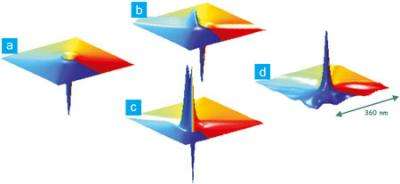
Figure 2: Micromagnetic simulation of the reversal of the vortex core with a short magnetic pulse. (a) Initial status: vortex core points downwards; (b) additional upwards magnetization becomes visible; (c) a double peak forms: a vortex-antivortex pair; (d) final status: after the original vortex has been eliminated by the antivortex, a vortex core pointing upwards remains. Credit: Max Planck Institute of Metals Research

Researchers at the Max Planck Institute of Metals Research have now found an elegant solution which reverses vortex cores much more easily. Using time-resolved magnetic scanning X-ray microscopy, developed by Hermann Stoll's group in Professor Schutz's department at the Institute, they have discovered a previously unknown mechanism - dynamic reversal of the vortex core. A magnetic pulse (see fig. 1) is used to build a magnetic field at right angles to the vortex, so that the whole structure is stimulated to execute a collective spin movement. As micromagnetic simulations show (fig. 2), this creates an opposite magnetisation at the edge of the original vortex, whereby virtually no energy is used. The result is a vortex-antivortex pair. The antivortex cancels out the original vortex which leaves just one vortex with reverse polarisation.

In this way, the Max Planck scientists, together with researchers from the University of Ghent, the Advanced Light Source in Berkeley, California, the Jülich Research Centre and the Universities of Regensburg and Bielefeld, succeeded in efficiently and deliberately reversing the vortex core with magnetic pulses that were approximately 300 times weaker, but very short.

It is possible that this reversal mechanism, which has been observed here for the first time, can be used for a completely new magnetic storage concept. The directions of the small nanoscopic magnetic needles define a digital bit that is extremely stable in the face of frequently unavoidable external factors such as heat or interference from magnetic fields. With the newly discovered dynamic effect, the vortex core is easy to reverse, with no losses and, above all, extremely quickly.

Citation: B. Van Waeyenberge, A. Puzic, H. Stoll, K. W. Chou, T. Tyliszczak, R. Hertel, M. Fähnle, H. Brückl, K. Rott, G. Reiss, I. Neudecker, D. Weiss , C. H. Back , G. Schütz: Magnetic vortex core reversal by excitation with short bursts of an alternating field, Nature, 23rd November 2006

Source: Max-Planck-Gesellschaft


print this article email this article download pdf blog this article bookmark this article     Stumble it Digg this share on Facebook retweet share on Reddit add to delicious
Rate this story - 4 /5 (45 votes)


November 28, 2006 all stories

Comments: 0

4 /5 (45 votes)
  • Stumble this up

  • Digg this

  • share this

  • hide
  • Related Stories

  • New control of nanoscale 'magnetic tornadoes' holds promise for data storage
    created Feb 02, 2009 | popularity not rated yet | comments 0
  • Scientists discover quantum mechanical 'hurricanes' form spontaneously
    created Oct 15, 2008 | popularity not rated yet | comments 0
  • Manipulating Magnetism for Future Data-Storage Devices
    created Apr 30, 2007 | popularity not rated yet | comments 0
  • Speed record for magnetic switching predicted
    created Mar 15, 2007 | popularity not rated yet | comments 0
  • Physicists trap, map tiny magnetic vortex
    created Sep 07, 2006 | popularity not rated yet | comments 0


  • hide
  • Relevant PhysicsForums posts

Other News

carbon fiber

Ultra-Long Carbon Nanotubes Could Serve as Future Transmission Lines

Nanotechnology / Nanomaterials

created Nov 10, 2009 | popularity 4.9 / 5 (23) | comments 14

(PhysOrg.com) -- When it comes to carbon nanotubes, the majority of research so far has focused on small-scale applications. But now, a team of researchers from Rice University has created carbon nanotubes ...


Researchers turn algae into high-temperature hydrogen source

Researchers turn algae into high-temperature hydrogen source

Nanotechnology / Nanophysics

created Nov 12, 2009 | popularity 3.6 / 5 (7) | comments 5

In the quest to make hydrogen as a clean alternative fuel source, researchers have been stymied about how to create usable hydrogen that is clean and sustainable without relying on an intensive, high-energy ...


Argonne 'homegrown' hybrid solar cell aims for low-cost power

Argonne 'homegrown' hybrid solar cell aims for low-cost power

Nanotechnology / Nanomaterials

created Nov 10, 2009 | popularity 4.2 / 5 (11) | comments 3

(PhysOrg.com) -- Scientists at the U.S. Department of Energy’s (DOE) Argonne National Laboratory have refined a technique to manufacture solar cells by creating tubes of semiconducting material and then "growing" ...


Engineers image nanostructure of a solid acid catalyst and boost its catalytic activity

Nanotechnology / Nanomaterials

created Nov 09, 2009 | popularity 5 / 5 (3) | comments 2

The catalytic processes that facilitate the production of many chemicals and fuels could become much more environmentally friendly thanks to a breakthrough achieved by researchers from Lehigh and Rice Universities.


Scientists develop DNA origami nanoscale breadboards for carbon nanotube circuits

Scientists develop DNA origami nanoscale breadboards for carbon nanotube circuits

Nanotechnology / Nanomaterials

created Nov 10, 2009 | popularity 5 / 5 (7) | comments 0

In work that someday may lead to the development of novel types of nanoscale electronic devices, an interdisciplinary team of researchers at the California Institute of Technology has combined DNA's talent ...