Dark matter hides, physicists seek
Scientists don't know what dark matter is, but they know it's all over the universe. Everything humans observe in the heavens—galaxies, stars, planets and the rest—makes up only 4 percent of the universe, scientists say. The remaining 96 percent is composed of dark matter and its even more mysterious sibling, dark energy.
Scientists recently found direct evidence that dark matter exists by studying a distant galaxy cluster and observing different types of motion in luminous versus dark matter. Still, no one knows what dark matter is made of.
Now, a pioneering international project co-led by Stanford physicist Blas Cabrera may finally crack the case and pin down the elusive particles that form dark matter.
"It's harder and harder to get away from the fact that there is a substance out there that's making up most of the universe that we can't see," says Cabrera. "The stars and galaxies themselves are like Christmas tree lights on this huge ship that's dark and neither absorbs nor emits light."
Buried deep underground in a mineshaft in Minnesota lies Cabrera's project, called the Cryogenic Dark Matter Search II (CDMS II). University of California-Berkeley physicist Bernard Sadoulet serves as spokesperson for the effort. Fermilab's Dan Bauer is its project manager, and Dan Akerib from Case Western Reserve University is the deputy project manager. A team of 46 scientists at 13 institutions collaborates on the project.
To catch a WIMP
The experiment is the most sensitive in the world aiming to detect exotic particles called WIMPS (Weakly Interacting Massive Particles), which are one of scientists' best guesses at what makes up dark matter. Other options include neutrinos, theorized particles called axions or even normal matter like black holes and brown dwarf stars that are just too faint to see.
WIMPS are thought to be neutral in charge and weigh more than 100 times the mass of a proton. At the moment these elementary particles exist only in theory and have never been observed. Scientists think they haven't found them yet because they're excruciatingly difficult to capture. WIMPS don't interact with most matter—the shy particles pass right through our bodies—but CDMS II aims to catch them in a rare collision with the atoms in the project's special-made detectors.
"These particles mostly pass through the Earth without scattering," Cabrera says. "The only reason we even have a chance of seeing events is because [there are] so many of the particles that very rarely one will come [into the detector] and scatter."
The detectors are hidden under layers of earth in Minnesota's Soudan mine to protect them from cosmic rays and other particles that might collide with the detectors and be mistaken for dark matter. In fact, half the battle for the scientists working on CDMS II is to shield their instruments as much as possible from everything but WIMPS and to develop elaborate systems to tell the difference between dark matter and more mundane particles.
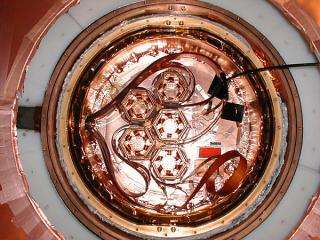
"Our detector is this hockey-puck-shaped thing that needs to live at 50 thousandths of a degree above absolute zero," says Walter Ogburn, a graduate student at Stanford who works on the project. "It's hard to make things that cold."
To that end, the instruments are nestled in a canister called an icebox, lined with six layers of insulation, from room temperature on the outside to coldest on the inside. This keeps the detectors so cold that even atoms can't shiver.
The detectors are made of crystals of solid silicon and solid germanium. The silicon or germanium atoms sit still in a perfect lattice. If WIMPS crash into them, they will wiggle and give off tiny packets of heat called phonons. When phonons rise to the surface of the detectors, they create a change in a very sensitive layer of tungsten, which the researchers can record. A second circuit on the other side of the detector measures ions, charged particles that would be released from a collision of a WIMP and an atom in the detector.
"Those two channels let us discriminate between different kinds of interactions," says Ogburn. "Some things make more ionization and some things make less, so you can tell the difference that way."
It takes a squad of scientists at multiple facilities to build the detectors. The team buys the crystals from an outside company, and researchers at Stanford's Center for Integrated Systems make measuring instruments on the surfaces of the detectors. "We use the same things to make these that people use to make microprocessors because those are also super tiny," says Matt Pyle, another graduate student in Cabrera's lab.
Clumps of clues
A subset of WIMPS, called neutralinos, are the lightest particles expected by supersymmetry, a theory that predicts a mate for every particle we've already observed. If CDMS II is successful in finding neutralinos, this would be the first evidence for supersymmetry. "Supersymmetry suggests there's a whole other sector out there of particles that are the partners to our existing particles," Cabrera says. "There are many ways in which supersymmetry looks very likely. But there's no direct evidence yet for any matching [supersymmetric] particle pair."
The weak interactions of WIMPS are why, even though dark matter particles have mass and obey the laws of gravity, they do not clump into galaxies and stars like normal matter. In order to clump, particles must crash and stick together. But WIMPS most often would fly right by each other. Plus, because WIMPS are neutral, they do not form atoms, which require the attraction of positively charged protons to negatively charged electrons.
"Dark matter permeates everything," Cabrera says. "It just never collapsed the way atoms did."
Since dark matter never formed stars and other familiar heavenly objects, for a long time scientists never knew it was there. The earliest indication of its existence came in the 1930s when Fritz Zwicky, a Swiss-American astronomer, observed clusters of galaxies. He added up the masses of galaxies and noticed that there was not enough mass to account for the gravity that must exist to hold the clusters together. Something else must provide the missing mass, he deduced.
Later in the 1970s, Vera Rubin, an American astronomer, measured the speeds of stars in the Milky Way and other nearby galaxies. As she looked farther out toward the edges of these galaxies, she found that the stars do not rotate more slowly as scientists expected. "That didn't make any sense," Cabrera says. "The only way you could understand it is if there was a lot more mass there than what you saw in the starlight."
Over the years, more and more evidence for dark matter has piled up. Although scientists don't yet know what it is, they have a better idea of where it is and how much of it there should be. "There's very little wiggle room left for having different quantities," Cabrera says.
"We've not seen anything that looks like an interesting signal to date," he says. But the CDMS II researchers continue the search. So, too, do other groups. ZEPLIN, an experiment run by physicists at the University of California-Los Angeles and the United Kingdom Dark Matter Collaboration, aims to catch WIMPs in liquid vats of xenon in a mine near Sheffield, England. And at the South Pole, a University of Wisconsin-Madison project called IceCube is under construction that will use optical sensors buried deep in the ice to look for neutrinos, high-energy particles that are signatures of WIMP annihilations.
Meanwhile, CDMS II continues to evolve. Its researchers are building bigger and bigger detectors to increase their chances of finding WIMPS. In the future, the team hopes to build a 1-ton detector that should be able to discover many of the most probable types of WIMPS, if they exist. "We're taking data now with more than twice as much target mass of germanium than we had before, so we're definitely exploring new territory right now," says Ogburn. "But there's a lot more to cover."
On the Net: Cryogenic Dark Matter Search II Website
Source: Stanford University, by Clara Moskowitz


