Night of the living enzyme
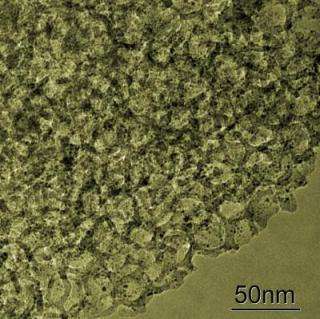
Inactive enzymes entombed in tiny honeycomb-shaped holes in silica can spring to life, scientists at the Department of Energy’s Pacific Northwest National Laboratory have found. The discovery came after salvaging enzymes that had been in a refrigerator long past their expiration date. Enzymes are proteins that are not actually alive but come from living cells and perform chemical conversions.
To the research team’s surprise, enzymes that should have fizzled months before perked right up when entrapped in a nanomaterial called functionalized mesoporous silica, or FMS. The result points the way for exploiting these enzyme traps in food processing, decontamination, biosensor design and any other pursuit that requires controlling catalysts and sustaining their activity.
“There’s a school of thought that the reason enzymes work better in cells than in solution is because the concentration of enzymes surrounded by other biomolecules in cells is about 1,000 to 10,000 time more than in standard biochemistry lab conditions,” said Eric Ackerman, PNNL chief scientist and senior author of a related study that appears today in the journal Nanotechnology. “This crowding is thought to stabilize and keep enzymes active.”
The silica-spun FMS pores, hexagons about 30 nanometers in diameter spread across a sliver of material, mimic the crowding of cells. Ackerman, lead author Chenghong Lei and colleagues said crowding induces an unfolded, free-floating protein to refold; upon refolding, it reactivates and becomes capable of catalyzing thousands of reactions a second.
The FMS is made first, and the enzymes are added later. This is important, the authors said, because other schemes for entrapping enzymes usually incorporate the material and enzymes in one harsh mixture that can cripple enzyme function forever.
In this study, the authors reported having “functionalized” the silica pores by lining them with compounds that varied depending on the enzyme to be ensnared—amine and carboxyl groups carrying charges opposite that of three common, off-the-shelf biocatalysts: glucose oxidase (GOX), glucose isomerase (GI) and organophosphorus hydrolase (OPH).
Picture an enzyme in solution, floating unfolded like a mop head suspended in a water bucket. When that enzyme comes into contact with a pore, the protein is pulled into place by the oppositely charged FMS and squeezed into active shape inside the pore. So loaded, the pore is now open for business; substances in the solution that come into contact with the enzyme can now be catalyzed into the desired product. For example, GI turns glucose to fructose, and standard tests for enzyme activity confirmed that FMS-GI was as potent or better at making fructose as enzyme in solution. OPH activity doubled, while GOX activity varied from 30 percent to 160 percent, suggesting that the enzyme’s orientation in the pore is important.
“It could be that in some cases the active site, the part of the enzyme that needs to be in contact with the chemical to be converted, was pointing the wrong way and pressed tightly against the walls of the pore,” Ackerman said.
To show that the enzymes were trapped inside the FMS pores, the team stained the protein-FMS complex with gold nanoparticles and documented the enzyme-in-pore complex through electron microscopy. A spectroscopic analysis of the proteins squeezed into their active conformation turned up no new folds, evidence that they had neatly refolded rather than been forcibly wadded into the pore.
Ackerman said that this new understanding combined with new cell-free techniques—making hundreds of designer enzymes a day with components derived from cells—will speed the development of task-specific enzymes. This could lead to “enzyme-based molecular machines in nanomaterials that carry out complex biological reactions to produce energy or remediate toxic pollutants.”
Source: Pacific Northwest National Laboratory


