November 29, 2006 feature
Tiniest modified opals ready to manipulate light flow as photonic crystals
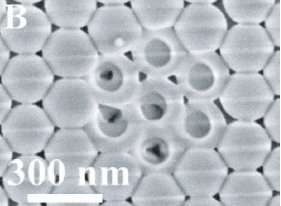
One of the most rapidly advancing areas of applied nanotechnology involves photonic crystals. With their ability to control light propagation, photonic crystals are predicted to replace other methods for devices such as display lasers, circuits and quantum computers. Although complex manufacturing has stunted their fabrication, scientists have recently found a new technique to control the size, shape and chemical flexibility of opals, a type of photonic crystal, to the smallest degree yet.
“The essence of our work is that we are able to control the shape of individually addressed nanoparticles inside artificial opals,” Léon Woldering, coauthor of the study, told PhysOrg.com. “We fabricate nanocavities in individual colloidal particles, and can change the position of these cavities and tune the diameter with nanometer precision. We thus realize a kind of nano-donut, or nano-bead.”
Woldering, and the rest of his group from the Netherlands, used a technique called focused ion beam milling (FIB) to “drill” (or “mill”) 80-nm-wide cavities into single colloids on artificial opals. The individual colloids, about 100 nm in radius, were grown through a self-assembly technique from silicon dioxide colloidal spheres. In their investigation, the scientists milled cavities for a duration between five and 30 seconds, and found that longer milling times corresponded to larger cavities.
“Not only is the nanotechnology to make these cavities extremely interesting in itself, but also the method we developed to mill these structures on a non-conducting substrate is novel and expands the possibilities of FIB in general,” said Woldering.
Usually, the FIB technique does not have a reputation for precise high resolution applications such as the fabrication of the nanobeads here. In the past, techniques using electron beams and laser beams could create large modifications in opal films, but not with this great detail. Although Woldering et al. encountered challenges due to the small, non-conductive opals made of easily loosened elements, they still succeeded in creating much smaller modifications than previous techniques.
“FIB on an insulating substrate is a challenge in general,” explained Woldering. “In our case, even more so, because milling on our substrates causes the individual colloidal spheres to charge, after which they repel each other and are ejected, thereby destroying the crystal. We were able to promote the diffusion of charges away from the milled area by deposition of a conducting carbon layer on top of the substrate, and by adapting an intermittent milling procedure. In this fashion, the breakdown of the photonic crystal was prevented, and we were able to obtain our nanocavities.”
As the scientists explain in their study, most nanotechnologies involve spherical nanoparticles, so different shapes—such as the beads—could offer new avenues of technology with their structural flexibility. In the case of photonic crystals, for example, a single modified colloidal particle inside the photonic crystal could act as an optical cavity to control light.
“Our motivation with these nanoparticles is the fabrication of an optical cavity in a three-dimensional photonic crystal by adding additional opal layers to the structures we fabricated, and subsequent inversion of the crystal,” said Woldering. “The inverse opal will be a silicon or titanium dioxide structure.
“In order to study the confinement of light, we plan to probe the emission from quantum dots placed near or inside the optical cavity,” he continued. “Alternatively, if the crystal surrounding a cavity in which light is confined is switched by modifying the refractive index, we may be able to release the confined photon at will. This will allow the fabrication of a photon-on-demand light source. A cavity could also act as a highly sensitive on-chip sensor of tiny amounts of matter in, e.g., chemical, biological, or even life-science issues.”
Still other applications, as Woldering et al. explain, could emerge in the development of solar cells with highly efficient light transmitters. Also, these opals could provide a resource for plasmonics devices, such as computer chips, and even optical microscopes that can focus on objects smaller than a wavelength of light.
Citation: Woldering, Léon A., Otter, A.M. (Bert), Husken, Bart H., and Vos, Willem L. “Focused ion beam milling of nanocavities in single colloidal particles and self-assembled opals.” Nanotechnology 17 (2006) 5717-5721.
By Lisa Zyga, Copyright 2006 PhysOrg.com


