Researchers discover hummingbird secret
November 29th, 2006 Researchers discover hummingbird secret

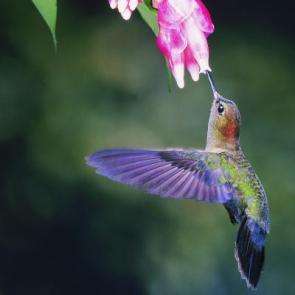
Hummingbird genera Doryfera. Credit: University of Alberta

University of Alberta researchers have pinpointed a section in the tiny hummingbird's brain that may be responsible for its unique ability to stay stationary mid-air and hover.

"This was a very exciting moment for us," said Dr. Doug Wong-Wylie, Canada Research Chair in Behavioural and Systems Neuroscience and psychology professor at the U of A. "As soon as we looked at these specimens it was obvious that something was different in the hummingbirds' brains than other species."

Wong-Wylie and Dr. Andrew Iwaniuk, also from the Department of Psychology in the Faculty of Science, compared hummingbird brains to 28 other bird species, obtained from the National Museum of Natural History, the Field Museum of Natural History, and the Louisiana State University Museum of Natural Science. Hummingbirds are well known for their wing speed and ability to hover and fly forward and backward with more precision than a helicopter. It is critical that the hummingbird remain perfectly still as it feeds itself while darting in and out of flower blossoms with pinpoint accuracy. The bird must be able to maintain a stable position space, despite the fact that their wings are beating 75 times per second and that disruptive effects such as wind gusts could throw them off.

Much work has been done on the hummingbirds' physiological make up—such as its enlarged heart, high metabolic rate and specialized wing kinematics--but nothing has been done on the neural specializations of the bird.

"Part of the reason this type of work hasn't been done before is because of access to the birds," said Iwaniuk. "In Canada especially they tend to be uncommon, they come from exotic locales and they are not easy to catch, so we were very fortunate to be able to study the specimens we did."

The scientists found that a specific nuclei—one that detects any movement of the entire visual world—was two to five times bigger in the hummingbird than in any other species, relative to brain size. The hummingbird's brain is smaller than a fingertip. "We reasoned that this nucleus helps the hummingbird stay stationary in space, even while they're flying," said Wong-Wylie. "These birds must have a good optomotor response considering they are stationary 90 per cent of the time. This specific nuclei is likely responsible for that."

Wong-Wylie and Iwaniuk plan to continue this line of research and have hummingbirds track visual motion while watching the nucleus to see how it reacts.

Source: University of Alberta


print this article email this article download pdf blog this article bookmark this article     Digg this Stumble it share on Facebook share on Reddit add to delicious save to Yahoo! bookmarks
4/5 after 24 votes

Rank Filter

Move the slider to adjust rank threshold, so that you can hide some of the comments.


Display comments: newest first

  • CDubb - Feb 16, 2009
    • Rank: not rated yet
    So I know it says that the pictured hummingbird is genera Doryfera but can someone get more descriptive with what type of hummingbird this is. The coloring is something that I can't find in general searches.

November 29th, 2006 all stories
Biology /

Comments: 1
Rank: 4/5 after 24 votes

  • Stumble this up

  • Digg this

  • Share it:
  • share on Facebook
  • share on MySpace
  • share on Slashdot
  • rss-newsfeed
  • share on Google
  • share on Reddit
  • add to delicious
  • save to Yahoo! bookmarks
  • share on Windows Live
  • Add to Mixx!
Rating: 4/5 after 24 votes


Tags


  • Physicists Demonstrate Quantum Memory with Matter Qubits
    Physicists Demonstrate Quantum Memory with Matter Qubits
    Physics / General Physics
    created Jul 03, 2009 | popularity 4.4 / 5 (17) | comments 1
  • 'Holey' Nanosheets for Wastewater Dye Removal
    Nanotechnology / Nanomaterials
    created Jul 01, 2009 | popularity 5 / 5 (5) | comments 1
  • Jellyfish Robot Swims Like its Biological Counterpart
    Jellyfish Robot Swims Like its Biological Counterpart
    Electronics / Robotics
    created Jun 26, 2009 | popularity 4.4 / 5 (8) | comments 1
  • Could Maxwell's Demon Exist in Nanoscale Systems?
    Could Maxwell's Demon Exist in Nanoscale Systems?
    Physics / General Physics
    created Jun 24, 2009 | popularity 4.4 / 5 (18) | comments 29
  • Living Safely with Robots, Beyond Asimov's Laws
    Living Safely with Robots, Beyond Asimov's Laws
    Electronics / Robotics
    created Jun 22, 2009 | popularity 4.6 / 5 (52) | comments 40
  • Other News

    California water plan aims to save Puget Sound orcas

    Biology / Ecology

    created 3 hours ago | popularity not rated yet | comments 0

    A plan to restore salmon runs on California's Sacramento River also could help revive killer whale populations 700 miles to the north in Puget Sound, as federal scientists struggle to protect endangered species in a complex ...


    Scientists 'rebuild' giant moa using ancient DNA

    Biology / Plants & Animals

    created Jul 01, 2009 | popularity 5 / 5 (10) | comments 12

    (PhysOrg.com) -- Scientists have performed the first DNA-based reconstruction of the giant extinct moa bird, using prehistoric feathers recovered from caves and rock shelters in New Zealand.


    Pacific Giant Salamander (Dicamptodon tenebrosus)

    Salamanders, regenerative wonders, heal like mammals, people

    Biology / Microbiology

    created Jul 01, 2009 | popularity 4.9 / 5 (19) | comments 10

    The salamander is a superhero of regeneration, able to replace lost limbs, damaged lungs, sliced spinal cord -- even bits of lopped-off brain. But it turns out that remarkable ability isn't so mysterious after ...


    Genetically modified trees

    Anti-biotech groups obstruct forest biotechnology

    Biology / Biotechnology

    created Jun 30, 2009 | popularity 3.7 / 5 (7) | comments 5

    The potential of forest biotechnology to help address significant social and environmental issues is being "strangled at birth" by the rigid opposition of some groups and regulations that effectively preclude ...


    Super-sleepers could help super-sizers!

    Super-sleepers could help super-sizers!

    Biology / Plants & Animals

    created Jun 29, 2009 | popularity 5 / 5 (2) | comments 4

    Burrowing frogs can survive buried for several years without food or water. Scientists have discovered that the metabolism of their cells changes radically during the dormancy period allowing the frogs to ...