HiRISE Team Begins Releasing a Flood of Mars Images Over the Internet
November 29, 2006 HiRISE Team Begins Releasing a Flood of Mars Images Over the Internet

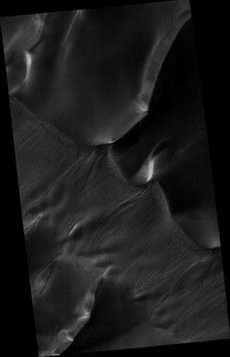
Hundreds of enigmatic small troughs are seen to carve into the slopes of these dark sand dunes lying within Russell Crater on Mars. These features were previously identified as gullies in images from the Mars Orbiter Camera on Mars Global Surveyor, but the higher resolution HiRISE image brings out many new details and mysteries. The troughs extend from near the top of the dunes to their bases, indicating that some fluid material carved into the sand. The troughs commonly begin as smaller tributaries joined together, suggesting several sources of fluid. Distinct dark spots are located near where the troughs seem to originate. Several troughs appear to begin at alcoves. Several of these troughs have sinuous middle reaches whereas others are straighter. Further down slope, some trough edges appear elevated above the surrounding terrain, particularly in the lower reaches. The troughs seem to terminate abruptly, with no deposition of material, unlike at the bases of some other gullies on Mars that are not on dunes. One hypothesis for the origin of these troughs, which has been previously been proposed by the MOC team, is that CO2 (or maybe H2O) frost is deposited on the dunes in shadows or at night. Some frost may also be incorporated into the internal parts of the dunes due to natural avalanching. When the frost is eventually heated by sunlight, rapid sublimation triggers an avalanche of fluidized displaced sand, forming a gully. HiRISE will continue to target small trough features such as these and may return to search for any changes over time. (Photo: NASA/JPL/University of Arizona)

The University of Arizona-based team that operates the high-resolution camera on NASA's Mars Reconnaissance Orbiter, in conjunction with NASA, is releasing the first of what will be a non-stop flood of incredibly detailed Mars images taken during the spacecraft's two-year primary science mission.

The High Resolution Science Imaging Experiment (HiRISE) camera took almost 100 images during the first two weeks of its main science mission, which began Nov. 7.

"There's no Earth analog for some places we see, while other places look remarkably like Earth," said Professor Alfred S. McEwen of UA's Lunar and Planetary Laboratory, HiRISE principal investigator. "The details we're seeing are just fantastic."

The HiRISE team is posting about 15 of the new large images on the HiRISE Website http://hiroc.lpl.arizona.edu today. Last week, they added more than a dozen new Mars images, as well as reprocessed images, taken from low orbit during test imaging in early October. The team plans to release the latest HiRISE images on their Website every Wednesday.

The views released today show seemingly endless fields of sand dunes, including some carved by gullies that possibly form when carbon dioxide or water frost in the dunes is heated by sunlight, triggering avalanches of flowing sand. Other HiRISE images show layered arid terrains that resemble landscapes protected as national parks on our own planet, and a fossil delta inside a crater that once held a lake. HiRISE images resolve meter-sized blocks within the delta channel that may be blocks of sand and gravel carried along as the channels eroded.

HiRISE images also capture numerous impact craters, including Endurance crater that NASA's Opportunity rover explored for ten months of its now nearly 3-year mission. Details visible in the HiRISE image of Opportunity's landing site show the parachute lying on the Martian surface, Opportunity's heat shield at a different location, and the lander itself on the floor of the small impact crater where the airbag came to a stop.

Other images show layered polar terrains that likely record Martian climate changes, and also polygon-patterned northern plains regions that are among candidate landing sites for the Phoenix Lander spacecraft in 2008.

"You see stuff at this level of detail and you want to see more," said Candy Hansen of the Jet Propulsion Laboratory, a HiRISE co-investigator who has helped lead imaging operations at the HiRISE Operations Center (HiROC) during the first weeks of the science mission this month.

"These images are at a geologist's scale," Hansen said. "A geologist could hike the terrain seen in the width of one of our images, six kilometers, in a day. These images bring the planet down to scales that match our own human level of experience, and that's a big help with interpretation."

The HiRISE camera takes images of 3.5-mile-wide (6 kilometer) swaths as the orbiter flies at about 7,800 mph between 155 and 196 miles (250 to 316 km) above the planet. The camera resolves geologic features as small as 40 inches across.

"It's been a constant race to look at all these images while we're planning our future targets," McEwen said. "But it's important to examine the data so we can learn how to use the best possible settings, and make decisions about which targets we'll need to get in stereo or color."

HiRISE began a new imaging cycle last week (Nov. 19) and begins another next week (Dec. 3). Over the next couple of weeks, the camera is targeting "all the easy-to-find hardware on Mars," McEwen said. That includes NASA's rover Spirit, the Viking 1 and Viking 2 landers, and Mars Pathfinder.

McEwen has been working a 12-hour day, seven days a week this month. The rest of the team has been clocking major overtime, too.

"We're trying not to get people too burned out, but we have to keep up. We're going to get about a hundred new images every two weeks without a break," McEwen said. "The spacecraft doesn't take Thanksgiving or Christmas off."

Source: University of Arizona


print this article email this article download pdf blog this article bookmark this article     Stumble it Digg this share on Facebook retweet share on Reddit add to delicious
Rate this story - 4.2 /5 (15 votes)


November 29, 2006 all stories

Comments: 0

4.2 /5 (15 votes)
  • Stumble this up

  • Digg this

  • share this

  • hide
  • Related Stories

  • Frost-Covered Phoenix Lander Seen in Winter Images
    created Nov 05, 2009 | popularity not rated yet | comments 0
  • New Set of High-Resolution Mars Images Online
    created Oct 08, 2009 | popularity not rated yet | comments 0
  • Scientists see water ice in fresh meteorite craters on Mars
    created Sep 24, 2009 | popularity not rated yet | comments 0
  • Patterns in Mars crater floors give picture of drying lakes
    created Sep 16, 2009 | popularity not rated yet | comments 0
  • Thousands of New Images Show Mars in High Resolution
    created Sep 03, 2009 | popularity not rated yet | comments 0


  • hide
  • Relevant PhysicsForums posts

  • dark energy can escape black holes.
    created 3 hours ago
  • Are there green, purple and pink stars?
    created 15 hours ago
  • Sideral question
    created Nov 21, 2009
  • Doppler shifted blackbody spectrum
    created Nov 21, 2009
  • More from Physics Forums - General Astronomy

Other News

Is global warming unstoppable?

Space & Earth / Environment

created 4 hours ago | popularity 3.4 / 5 (10) | comments 9

In a provocative new study, a University of Utah scientist argues that rising carbon dioxide emissions - the major cause of global warming - cannot be stabilized unless the world's economy collapses or society builds the ...


The shore of Deception Island in Antarctica, in 2008

Antarctic ice loss vaster, faster than thought: study

Space & Earth / Earth Sciences

created 20 hours ago | popularity 2.9 / 5 (17) | comments 25

The East Antarctic icesheet, once seen as largely unaffected by global warming, has lost billions of tonnes of ice since 2006 and could boost sea levels in the future, according to a new study.


Astronaut suit problem delays spacewalk No. 3 (AP)

Astronaut suit problem delays spacewalk No. 3

Space & Earth / Space Exploration

created 6 hours ago | popularity not rated yet | comments 0

(AP) -- The third and final spacewalk of space shuttle Atlantis' mission is being held up by a suit problem.


How green is your house? Recycling favorite activity among Brits says new survey

Space & Earth / Environment

created 3 hours ago | popularity not rated yet | comments 3

Seventy percent of households always separate their rubbish for recycling, but only 2 percent buy their energy on a green tariff, according to the early findings of a major new annual household survey, called "Understanding ...


Denmark: 65 world leaders for UN climate summit (AP)

Denmark: 65 world leaders for UN climate summit

Space & Earth / Environment

created 20 hours ago | popularity 2.3 / 5 (3) | comments 2

(AP) -- Sixty-five world leaders have said they will attend the Copenhagen climate summit in December, and several more have responded positively to invitations, Danish officials said Sunday.