Teams Explore Roots of Angkor Civilization
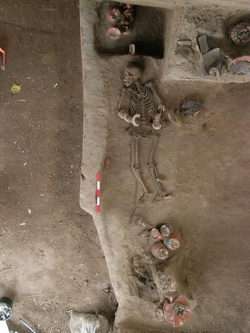
Five seasons of excavations at Ban Non Wat, in Northeast Thailand, have unearthed 470 human burials covering a time span of more than 2,000 years. Earthwatch-supported research at this great moated site, led by anthropologist Dr. Charles Higham of University of Otago (New Zealand), gives clues to the roots of the famous Angkor civilization. A Year On Earth, a new film about students making a difference through participation in scientific research, features some of these discoveries.
“The earliest graves, dating to about 2000 BC, contain the remains of the first rice farmers to settle Thailand from their ancestral homelands in the Yangtze Valley of China,” said Higham, principal investigator of Earthwatch’s Origins of Angkor project. “They were buried with ceramic vessels that were decorated with amazing designs, representing the earliest art in this part of the world.” Some of the lidded pots discovered by Earthwatch teams were large enough to contain the remains of adults, while many newly born infants were buried in smaller versions.
Historians typically attribute the rise of the magnificent Angkor civilization, which also built Ankgor Wat, to external, mostly Indian, influences. Earthwatch volunteers working in Thailand have made discoveries that support Higham’s view that the Angkor civilization sprang, at least in part, from indigenous roots. For example, in about 1200 BC, the descendents of the early farmers mentioned above entered the Bronze Age in grand style.
“Until the investigations at Ban Non Wat, Bronze Age cemeteries contained relatively poor burials, the dead being accompanied by a handful of pots and perhaps some shell beads or bangles,” said Higham. “But at Ban Non Wat, excavators found groups of princely graves in which the aristocrats were accompanied by up to 50 pottery vessels, some of which were large and beautifully decorated with red painted designs.”
The aristocrats also wore thousands of shell beads, up to 60 shell or marble bangles, and many were also buried with their bronze axes, bangles, anklets, and bells. One infant was found with a pot of stunning beauty, the painted design taking the form of a human face.
“To add to the mystery of these people, some were partially exhumed after burial, and the bones were later replaced in the grave with the skull facing the rising sun,” said Higham. “Who were these people, who exerted such an influence on Bronze Age society even when dead and buried? They were at least revered ancestors, whose bones were brought out perhaps to celebrate feasting occasions in a society that is only now revealing its secrets.”
A Year on Earth chronicles the adventures of three American teens who join Dr. Higham in Thailand, helping him to unravel early local history, and several other Earthwatch research projects around the world. The two-part film debuts on Discovery Kids Channel on December 3 and 10 at 5 p.m. EST (see local listings). For more information, go to www.earthwatch.org/film. A music video based on footage from the film can be viewed at www.youtube.com/watch?v=ZYzXjxlZOZ0
Earthwatch teams will return to Thailand to help Higham and his colleagues in January and February 2007. For more information about Earthwatch’s Origins of Angkor project, go to www.earthwatch.org/expeditions/higham.html
Source: Earthwatch Institute


