New wide-angle lens produces pictures without distortion
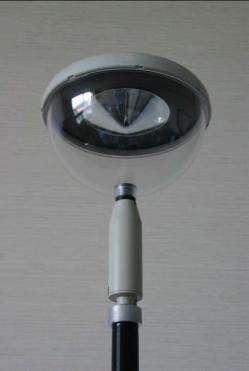
South Korean researchers have designed and built an inexpensive optical lens that collects light from a large area and produces a virtually distortion-free wide-angle image. Standing in contrast to commonly known "fisheye" lenses, which produce significant amounts of visual distortion, low-distortion wide-angle lenses can potentially improve image-based applications such as security-camera systems and robot navigation. The new wide-angle lens is lighter, smaller and more affordable than commercially available "rectilinear" lenses, which also produce low-distortion views.
The researchers present their new feat of optical technology in the Dec. 1 issue of Applied Optics, a publication of the Optical Society of America.
Made of inexpensive components and available for little more than $100, the new wide-angle lens has been designed specifically to improve indoor security.
"For spacious places with high ceilings such as factories, hotels, theaters, resorts, and auditoriums, the lens can capture the entire floor and this will help security personnel to easily monitor those places," says lead author Gyeong-il Kweon of Homan University in South Korea. In this scenario, the lens would be attached to inexpensive, commercially available bullet cameras, he says.
The principle of a wide-angle lens is simple, according to Kweon.
"Think about holding an immaculate silver spoon above your head and looking up," he says. "Then you will notice that the entire room can be seen from the reflections on the spoon."
But there's a problem, he points out.
The reflected image from the spoon is severely distorted. For example, straight lines become curved, and the distances between objects become skewed. The challenge is to design a lens that collects light from a wide area (i.e., from the entire room) and yields an image that is "perspectively correct," in that it accurately depicts the shapes and relative dimensions of imaged objects.
"The most creative part of our work was the discovery of the right shape of the spoon which gives a perspectively correct image of the room," Kweon says.
An elegant piece of optics technology, the new lens looks like a snow globe in the shape of the U.S. Capitol dome. Light from a large area enters the dome of the lens and encounters a v-shaped mirror. This reflective lens then redirects the light rays to a second lens that resembles the slender statue atop the Capitol dome. This "refractive" lens produces a sharp image of the large area at the exact location of the image sensor within the bullet camera.
The v-shaped lens is called a catoptric (reflective) lens and the second lens is known as a dioptric (refractive) lens, so the combined design is called a "catadioptric" lens.
"Ingenious catadioptric lenses having similar characteristics have been designed by other researchers," says Kweon. However, he says, "those lenses were optically inefficient and were mostly of academic interest."
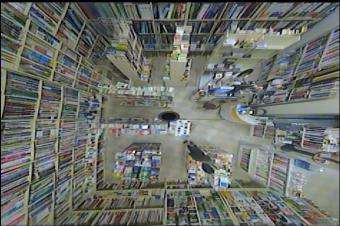
In contrast, this new design delivers straightforward, practical wide-angle images, producing a "field of view" (FOV) of 151 degrees. The FOV from this technology can be increased to 160 degrees by adding a little more complexity, Kweon says. A FOV of 180 degrees would mean capturing everything that you see in front of you, as well as on your left and right sides. Mathematically, this is the upper limit of what is possible with rectilinear imaging, the kind of imaging that renders straight lines as straight rather than being curved and distorted. By comparison, the human eye has a field of view of approximately 46 degrees.
Some fish-eye lenses have a FOV that exceeds 180 degrees. However, they suffer from "barrel distortion," in which lines are stretched outward. In a fish-eye picture of a jail cell, for example, the metal bars would appear stretched outward, as if a cartoon character had pulled them apart.
Rectilinear lenses, those that produce images without such distortions, are commercially available. However, for technical reasons, these models have a limited field of view, of typically less than 120 degrees. Also, they are bulky, large, and very expensive, costing more than $1,000.
While the new design does not have the FOV of some fisheye lenses, there is no shortage of useful applications for wide-angle cameras with an FOV of less than 180 degrees. One possible application, Kweon says, is to use the lens as an ingredient of intelligent security systems. In this scenario, the new catadioptric lens would capture a large swath of space, and a camera with "pan-tilt" ability would zoom in on the region of interest (ROI), such as the location of an intruder. This can be more effective, Kweon says, than a multitude of cameras watching their respective ROIs.
The new lens is relatively small and commercially available through a South Korean company called Nanophotonics (www.nanophotonics.co.kr) that Kweon has started up.
In addition to improving security cameras, many other indoor applications are possible, Kweon says. One possibility, he says, is as a robot navigational aid. "When this lens is installed on a ceiling, the room is captured in a perspectively correct manner. In other words, the captured image is a scaled version of the room. Therefore it is easier to estimate distances and object sizes, and it can help home robots to effectively navigate the room," he says.
With much promise for strengthening image quality, there is one area the researchers are focusing on for improvement: the camera itself unavoidably shows up as a small circle in the center of images, a phenomenon called "central obscuration." By removing the catoptric (reflective) lens, Kweon and his research partner Milton Laikin, a renowned lens-design expert from Los Angeles, have designed another lens that eliminates this problem, but has a narrower field of view, at approximately 120 degrees so far.
Due to its tiny size and delicacy, the current lens can only be used indoors but according to Kweon, it is easy to improve upon this first step and create a larger lens for outdoor commercial needs. "This lens is designed for a bullet camera," he says. "Since a bullet camera is really tiny, I think this imaging system cannot endure the harsh outdoor environment."
"An outdoor version can be made for a larger camera and this lens could be installed on intersections to monitor traffic violations and pedestrians."
"Because it uses a mirror, it is easy to translate the lens design for other wavelengths, such as the infrared," he says. Wide-angle lenses in these other wavelengths have other potential applications, such as wild-fire monitoring and human search-and-rescue.
Source: Optical Society of America


