How to Shrink a Carbon Nanotube

November 30th, 2006 How to Shrink a Carbon Nanotube

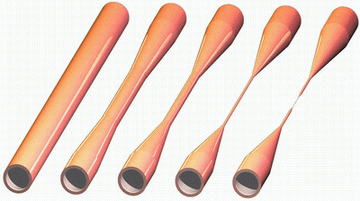
A depiction of the gradual reduction of the diameter of a carbon nanotube via the process created by Yuzvinsky et al. (Image courtesy Tom Yuzvinsky)

A research group has devised a way to control the diameter of a carbon nanotube – down to essentially zero nanometers. This useful new ability, designed by scientists from the University of California at Berkeley and Lawrence Berkeley National Laboratory, may help carbon nanotubes become more easily incorporated into new technologies.

“One of the biggest hurdles in working with carbon nanotubes has been lack of control over their size,” said UC Berkeley physicist Tom Yuzvinsky, the study's lead author, to PhysOrg.com. “Now that we can precisely set the diameter of carbon nanotubes, we can tailor individual nanoscale devices to meet our needs.”

The exceptional electrical and physical properties of carbon nanotubes – for example, they conduct very well and are extremely strong – have led them to become the basis of many nanoscale devices, such as sensors and transistors. But since these properties depend on the size of the nanotubes and methods to precisely control their size have been unreliable, nanotubes have not been as thoroughly incorporated into new technologies as many scientists would like.

Yuzvinsky and his colleagues have taken a significant step toward changing this.

They began with a multi-walled carbon nanotube (which resembles a few single nanotubes nested together); theirs had four walls. They applied a carefully selected voltage to the nanotube, which caused the outer two walls to break down electrically and fall away. The already-slimmer nanotube was next bombarded with a high-energy electron beam that knocked carbon atoms out of the nanotube, creating vacancies and other defects in its atomic structure. Simultaneously, the group ran a current through the nanotube. This heated it to the point where it could heal its vacancies and defects by spontaneously reforming into a narrower, nearly defect-free nanotube.

Repeating this process shrank the nanotube gradually and controllably in a matter of minutes. As the diameter dwindled, Yuzvinsky and his collaborators were careful to adjust the current through nanotube to account for its increasing electrical resistance. This yielded a surprising and important secondary result of their work: that the conductance of a multi-walled carbon nanotube is directly proportional to its diameter. This clears up many conflicting studies of electrical conduction in nanotubes.

The researchers followed the changes as they occurred using a transmission electron microscope, which produced detailed images of the nanotube. Eventually, they could see that the nanotube became so narrow (less than one nanometer) that the inner wall broke, leaving two nanotube fragments connected by an unstable bridge of carbon atoms that soon failed as well.

Citation: T.D. Yuzvinsky, W. Mickelson, S. Aloni, G.E. Begtrup, A. Kis, and A. Zettl, “Shrinking a Carbon Nanotube.” Nano Lett. (2006) DOI: 10.1021/nl061671j

By Laura Mgrdichian, Copyright 2006 PhysOrg.com


print this article email this article download pdf blog this article bookmark this article     Digg this Stumble it share on Facebook share on Reddit add to delicious save to Yahoo! bookmarks
4.3/5 after 125 votes


November 30th, 2006 all stories
Nanotechnology / Nanophysics

Comments: 0
Rank: 4.3/5 after 125 votes

  • Stumble this up

  • Digg this

  • Share it:
  • share on Facebook
  • share on MySpace
  • share on Slashdot
  • rss-newsfeed
  • share on Google
  • share on Reddit
  • add to delicious
  • save to Yahoo! bookmarks
  • share on Windows Live
  • Add to Mixx!
Rating: 4.3/5 after 125 votes

  • Related Stories

  • Carbon Nanotubes Continue To Show Promise in Battle Against Cancer
    created Jun 30, 2009 | popularity not rated yet | comments 0
  • Nanotubes weigh the atom
    created Jun 29, 2009 | popularity not rated yet | comments 0
  • Scientists fight cancer with nanotechnology
    created May 21, 2009 | popularity not rated yet | comments 0
  • 'Writing' Patterns on Carbon Nanotubes With Polymer Chains
    created May 19, 2009 | popularity not rated yet | comments 0
  • Highly conductive nanocomposites: Inexpensive plastic used in CDs could improve electronics
    created May 15, 2009 | popularity not rated yet | comments 0

Tags


  • Physicists Demonstrate Quantum Memory with Matter Qubits
    Physicists Demonstrate Quantum Memory with Matter Qubits
    Physics / General Physics
    created Jul 03, 2009 | popularity 4.4 / 5 (17) | comments 1
  • 'Holey' Nanosheets for Wastewater Dye Removal
    Nanotechnology / Nanomaterials
    created Jul 01, 2009 | popularity 5 / 5 (5) | comments 1
  • Jellyfish Robot Swims Like its Biological Counterpart
    Jellyfish Robot Swims Like its Biological Counterpart
    Electronics / Robotics
    created Jun 26, 2009 | popularity 4.4 / 5 (8) | comments 1
  • Could Maxwell's Demon Exist in Nanoscale Systems?
    Could Maxwell's Demon Exist in Nanoscale Systems?
    Physics / General Physics
    created Jun 24, 2009 | popularity 4.4 / 5 (18) | comments 29
  • Living Safely with Robots, Beyond Asimov's Laws
    Living Safely with Robots, Beyond Asimov's Laws
    Electronics / Robotics
    created Jun 22, 2009 | popularity 4.6 / 5 (52) | comments 40
  • Other News

    A 'quantum of sol' -- how nanotechnology could hold the key to a solar-powered future

    A 'quantum of sol' -- how nanotechnology could hold the key to a solar-powered future

    Nanotechnology / Nanomaterials

    created Jun 30, 2009 | popularity 3.8 / 5 (13) | comments 16

    (PhysOrg.com) -- A new generation of 'nano-structured' millimetre-sized solar cells that could convert the sun's energy to electricity more than twice as efficiently as current technology, is the subject of ...


    Australian researchers are set to begin human trials of a tiny nano-cell that acts as a "Trojan horse" against cancer

    Hi-tech 'Trojan horse' can kill cancer cells: researchers

    Nanotechnology / Bio & Medicine

    created Jun 29, 2009 | popularity 4.6 / 5 (11) | comments 7

    Australian researchers are set to begin human trials of a tiny nano-cell that acts as a "Trojan horse" against cancer cells, a breakthrough they say may curb the need for debilitating chemotherapy.


    Harnessing Nanoparticles To Track Cancer Cell Changes

    Nanotechnology / Bio & Medicine

    created Jul 03, 2009 | popularity not rated yet | comments 1

    The more dots there are, the more accurate a picture you get when you connect them. Cancer researchers adopting that philosophy have developed a new imaging technology that could give scientists the ability to simultaneously ...


    'Holey' Nanosheets for Wastewater Dye Removal

    Nanotechnology / Nanomaterials

    created Jul 01, 2009 | popularity 5 / 5 (5) | comments 1

    (PhysOrg.com) -- Researchers have discovered that extremely thin sheets of nickel oxide with hexagonally shaped holes can absorb hazardous dyes from wastewater nearly as well as the best traditional methods, but are recyclable. ...


    Computer-Guided Nanoparticle Therapy Destroys Tumors

    Nanotechnology / Bio & Medicine

    created Jun 29, 2009 | popularity 5 / 5 (11) | comments 0

    Gold nanoshells are among the most promising new nanoscale therapeutics being developed to kill tumors, acting as antennas that turn light energy into heat that cooks cancer to death. Now, a multi-institutional research team ...