With fruit fly sex, researchers find mind-body connection
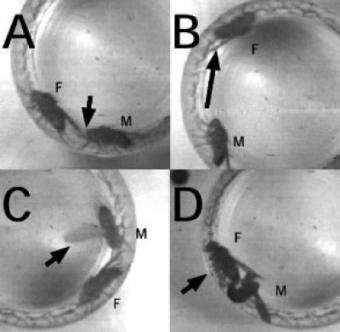
Male fruit flies are smaller and darker than female flies. The hair-like bristles on their forelegs are shorter, thicker. Their sexual equipment, of course, is different, too.
"Doublesex" is the gene largely responsible for these body differences. Doublesex, new research shows, is responsible for behavior differences as well. The finding, made by Brown University biologists, debunks the notion that sexual mind and sexual body are built by separate sets of genes. Rather, researchers found, doublesex acts in concert with the gene "fruitless" to establish the wing-shaking come-ons and flirtatious flights that mark male and female fly courtship.
Results are published in Nature Genetics.
"What we found here, and what is becoming increasingly clear in the field, is that genetic interactions that influence behavior are more complex than we thought," said Michael McKeown, a Brown biologist who led the research. "In the case of sex-differences in flies, there isn't a simple two-track genetic system – one that shapes body and one that shapes behavior. Doublesex and fruitless act together to help regulate behavior in the context of other developmental genes."
How genes contribute to behavior, from aggression to alcoholism, is a growing and contentious area of biology. For more than a decade, McKeown has been steeped in the science, using the fruit fly as a model to understand how genes build a nervous system that, in turn, controls complex behaviors. Since humans and flies have thousands of genes in common, the work can shine a light on the biological roots of human behavior. For example, McKeown recently helped discover a genetic mutation that causes flies to develop symptoms similar to Alzheimer's disease – a gene very similar to one found in humans.
Some of McKeown's recent work focuses on understanding gene networks that control sexual behavior. Research on the topic is often contradictory. Some scientists suggest that the fruitless gene, active only in males, controls courtship and sexual receptivity by repressing female behavior and activating male behavior. Other scientists have found that a web of interacting genes control courtship and receptivity. McKeown wanted to settle the debate.
McKeown suspected that multiple genes shape behavior and that doublesex played a role. But experimenting with doublesex is difficult. When both copies of the gene are removed – a powerful way to test gene function – flies have the physical features of both sexes. As a result, these mutant females are not recognized by normal males and these mutant males are not recognized by normal females – and none of the mutants can mate. So this makes it difficult for scientists to categorize their behavior as gender appropriate.
So McKeown raised flies missing one of two copies of doublesex, a process that didn't completely remove the gene's influence but drastically reduced it. The result: Flies' sexual equipment was intact, but, theoretically, their sexual behavior might be different. McKeown and graduate student Troy Shirangi also reduced the activity of the fruitless gene as well as one called "retained."
Shirangi and McKeown did, indeed, see a doublesex influence. Doublesex helped the males act macho during courting – chasing females, shaking their wings to "sing" love songs, tapping or licking their intended mates. In females, doublesex worked together with the gene retained to make them more receptive to this wooing; Females with two good copies of the gene were more likely to listen to love songs and to copulate. Interestingly, reducing the activity of doublesex or retained also allowed females to court like males, even though they lack the male-behavior-inducing activity of fruitless.
By manipulating fruitless and retained in other experiments, McKeown and his team found critical interactions, or overlaps, in the "mind" and "body" pathways. Retained acts in both sexes, repressing male courting behavior and boosting female receptivity. Fruitless and doublesex act together, as a switch system, to affect this sexual behavior.
"The big story is the crossover between the 'mind' and 'body' pathways," McKeown said. "If sexual behaviors are genetically controlled in humans, I expect that this system would be just as much, if not more, complicated."
Source: Brown University


